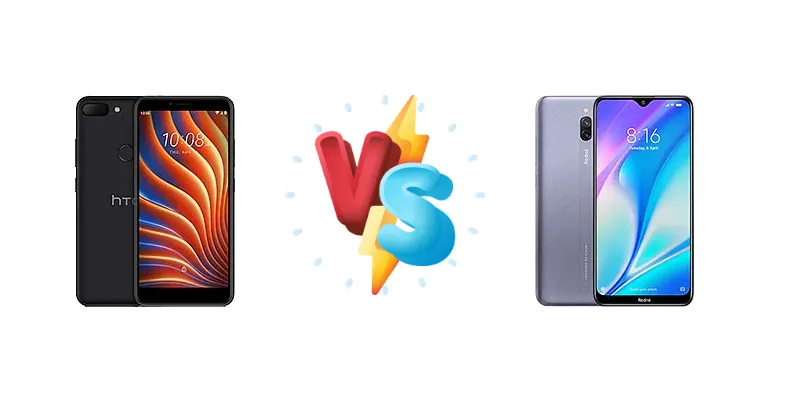
The sub-$150 smartphone market is fiercely competitive. Both the Xiaomi Redmi 8A Pro and the HTC Wildfire E1 lite aim to deliver essential smartphone functionality at an accessible price point. However, they take different approaches to achieving this, with Xiaomi prioritizing processing power and fast charging, while HTC focuses on a streamlined experience. This comparison dissects their key differences to help you choose the right device.
🏆 Quick Verdict
For most users, the Xiaomi Redmi 8A Pro is the superior choice. Its octa-core Snapdragon 439 chipset provides a significantly more responsive experience than the Wildfire E1 lite’s quad-core Helio A20, especially noticeable in multitasking and app loading. The 18W charging is a substantial advantage, offsetting the slightly smaller battery capacity.
| Network |
|---|
| 2G bands | GSM 850 / 900 / 1800 / 1900 | GSM 850 / 900 / 1800 / 1900 |
| 3G bands | HSDPA 900 / 2100 | HSDPA 850 / 900 / 1900 / 2100 |
| 4G bands | 1, 3, 5, 7, 8, 20, 38, 40 | 1, 3, 5, 8, 40, 41 |
| Speed | HSPA 42.2/11.5 Mbps, LTE Cat4 150/75 Mbps | HSPA, LTE |
| Technology | GSM / HSPA / LTE | GSM / HSPA / LTE |
| Launch |
|---|
| Announced | 2020, September 24. Released 2020, September 24 | 2020, April 02. Released 2020, April 02 |
| Status | Discontinued | Discontinued |
| Body |
|---|
| Build | Glass front, plastic back, plastic frame | Glass front (Gorilla Glass 5), plastic back, plastic frame |
| Dimensions | 147.9 x 71.4 x 8.9 mm (5.82 x 2.81 x 0.35 in) | 156.5 x 75.4 x 9.4 mm (6.16 x 2.97 x 0.37 in) |
| SIM | Nano-SIM + Nano-SIM | Nano-SIM + Nano-SIM |
| Weight | 160 g (5.64 oz) | 188 g (6.63 oz) |
| | - | Water-repellent coating |
| Display |
|---|
| Protection | - | Corning Gorilla Glass 5 |
| Resolution | 720 x 1440 pixels, 18:9 ratio (~295 ppi density) | 720 x 1520 pixels, 19:9 ratio (~270 ppi density) |
| Size | 5.45 inches, 76.7 cm2 (~72.6% screen-to-body ratio) | 6.22 inches, 96.6 cm2 (~81.8% screen-to-body ratio) |
| Type | TFT LCD | IPS LCD, 400 nits (typ) |
| Platform |
|---|
| CPU | Quad-core 1.8 GHz Cortex-A53 | Octa-core (4x1.95 GHz Cortex-A53 & 4x1.45 GHz Cortex A53) |
| Chipset | Mediatek MT6761D Helio A20 (12 nm) | Qualcomm SDM439 Snapdragon 439 (12 nm) |
| GPU | PowerVR GE8320 | Adreno 505 |
| OS | Android 10 (Go edition) | Android 9.0 (Pie), planned upgrade to Android 10, MIUI 12 |
| Memory |
|---|
| Card slot | microSDHC | microSDXC (dedicated slot) |
| Internal | 16GB 2GB RAM | 32GB 2GB RAM, 32GB 3GB RAM |
| | eMMC 5.1 | eMMC 5.1 |
| Main Camera |
|---|
| Dual | 8 MP, f/2.0, (wide), AF
Auxiliary lens | 13 MP, f/2.2, (wide), 1/3.1", 1.12µm, PDAF
Auxiliary lens |
| Features | LED flash, HDR, panorama | LED flash, HDR, panorama |
| Video | 1080p@30fps | 1080p@30fps |
| Selfie camera |
|---|
| Features | HDR | HDR |
| Single | 5 MP, f/2.2, (wide) | 8 MP, f/2.0, 1/4.0", 1.12µm |
| Video | 720p@30fps | 1080p@30fps |
| Sound |
|---|
| 3.5mm jack | Yes | Yes |
| 35mm jack | Yes | Yes |
| Loudspeaker | Yes | Yes |
| Comms |
|---|
| Bluetooth | 5.0, A2DP | 4.2, A2DP, LE |
| NFC | No | No |
| Positioning | GPS, GLONASS, GALILEO | GPS, GLONASS, BDS |
| Radio | Unspecified | FM Radio, built-in antenna |
| USB | microUSB 2.0 | USB Type-C 2.0, OTG |
| WLAN | Wi-Fi 802.11 a/b/g/n/ac, dual-band | Wi-Fi 802.11 b/g/n, Wi-Fi Direct |
| Features |
|---|
| Sensors | Fingerprint (rear-mounted), accelerometer, proximity | Accelerometer, proximity, compass |
| Battery |
|---|
| Charging | - | 18W wired
2.5W reverse wired |
| Type | Li-Ion 3000 mAh | Li-Po 5000 mAh |
| Misc |
|---|
| Colors | Black | Sky White, Sea Blue, Midnight Grey |
| Price | About 80 EUR | About 90 EUR |
HTC Wildfire E1 lite
- Simpler, more streamlined software experience.
- Potentially more durable build quality (HTC's reputation).
- Lower price point (potentially).
- Significantly weaker processor performance.
- Slower charging speeds.
- Likely limited multitasking capabilities.
Xiaomi Redmi 8A Pro
- Faster and more responsive processor.
- 18W fast charging for quicker top-ups.
- More capable ISP for potentially better image processing.
- Xiaomi’s MIUI software can be resource-intensive.
- Potential for more bloatware.
- Build quality may not be as robust as HTC.
Display Comparison
Neither device boasts a standout display. Both likely utilize LCD panels, typical for this price bracket. Specifics like resolution and brightness are not provided, but we can infer similar performance. The focus here isn't on visual fidelity, but rather basic readability. Bezels are expected to be noticeable on both, as maximizing screen real estate isn't a priority at this price point. Color accuracy will likely be standard for budget displays, leaning towards cooler tones.
Camera Comparison
Camera performance is likely to be similar in real-world usage, given the focus on affordability. Both devices likely feature a primary camera and a depth sensor. Without specific sensor size or aperture information, it’s difficult to make a definitive judgment. However, the Snapdragon 439’s image signal processor (ISP) is generally more capable than the Helio A20’s, potentially resulting in slightly better image processing and dynamic range on the Redmi 8A Pro. The prevalence of 2MP macro lenses on both devices suggests limited utility; these are often included for marketing purposes rather than significant image quality improvements.
Performance
The core difference lies in the chipset. The Xiaomi Redmi 8A Pro’s Qualcomm Snapdragon 439, with its octa-core configuration (4x1.95 GHz Cortex-A53 & 4x1.45 GHz Cortex A53), offers a clear advantage over the HTC Wildfire E1 lite’s MediaTek Helio A20 (Quad-core 1.8 GHz Cortex-A53). The Snapdragon 439’s eight cores allow for more efficient multitasking and a smoother experience with demanding applications. While both are built on a 12nm process, the architectural differences and core count give the Snapdragon a significant edge. The Helio A20 will struggle with heavier apps and multitasking, leading to noticeable lag. RAM configurations are not specified, but the chipset difference will be the primary performance bottleneck for the Wildfire E1 lite.
Battery Life
Battery capacity isn't specified for the Wildfire E1 lite, but the Redmi 8A Pro’s battery life is significantly enhanced by its 18W wired charging capability, and 2.5W reverse wired charging. While the Redmi 8A Pro’s battery capacity is not specified, the faster charging speed allows for quicker top-ups, mitigating any capacity difference. The Wildfire E1 lite will likely rely on slower charging speeds, requiring longer to reach a full charge. This makes the Redmi 8A Pro a more convenient option for users who frequently need to recharge their devices.
Buying Guide
Buy the HTC Wildfire E1 lite if you prioritize simplicity and a minimal software experience, and your usage is limited to basic tasks like calls, texts, and light social media. Buy the Xiaomi Redmi 8A Pro if you need a phone capable of handling more demanding apps, enjoy faster charging, and appreciate the benefits of a more powerful processor for smoother multitasking and occasional gaming.
Frequently Asked Questions
❓ Will the Redmi 8A Pro struggle with popular games like PUBG Mobile?
While the Snapdragon 439 isn't a gaming powerhouse, it can handle PUBG Mobile at lower settings. Expect frame rate drops during intense action, but it's playable. The Wildfire E1 lite’s Helio A20 will likely struggle significantly, even at the lowest settings.
❓ Does the Xiaomi Redmi 8A Pro support USB-C charging?
No, the Redmi 8A Pro utilizes a Micro-USB port for charging and data transfer. This is a common feature in this price range, but it's slower and less convenient than USB-C.
❓ Is the reverse wired charging on the Redmi 8A Pro useful for topping up accessories?
The 2.5W reverse wired charging is very slow and best suited for emergency charging of small accessories like wireless earbuds. Don't expect to significantly charge a smartphone with it.
❓ How does the software experience differ between the two phones?
The Wildfire E1 lite likely runs a near-stock version of Android, offering a cleaner and more streamlined experience. The Redmi 8A Pro runs Xiaomi’s MIUI, which is heavily customized and includes numerous features, but can also be more resource-intensive and include pre-installed apps (bloatware).