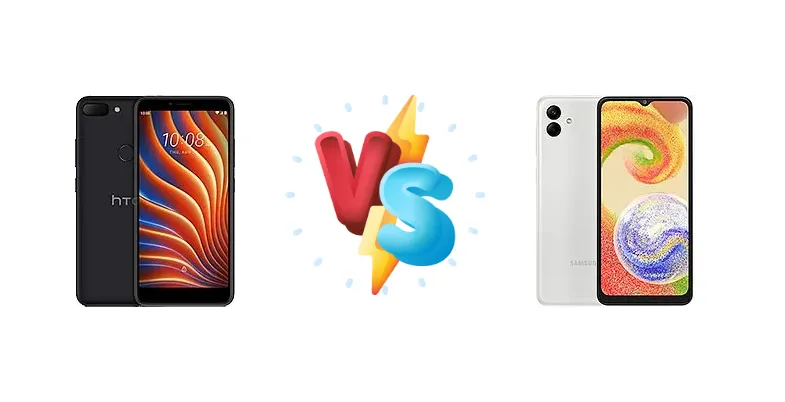
The sub-$150 smartphone market is fiercely competitive. Both the HTC Wildfire E1 lite and the Samsung Galaxy A04 aim to deliver essential smartphone functionality at an accessible price. However, their core performance differs significantly due to their respective chipsets, making the choice crucial for users prioritizing speed and responsiveness.
🏆 Quick Verdict
For the average user, the Samsung Galaxy A04 is the better choice. Its Helio P35 chipset, featuring an octa-core CPU, provides a noticeably smoother experience for multitasking and app loading compared to the quad-core Helio A20 in the Wildfire E1 lite. While both phones are entry-level, the A04 offers a more future-proofed platform.
| Network |
|---|
| 2G bands | GSM 850 / 900 / 1800 / 1900 | GSM 850 / 900 / 1800 / 1900 |
| 3G bands | HSDPA 900 / 2100 | HSDPA 850 / 900 / 2100 |
| 4G bands | 1, 3, 5, 7, 8, 20, 38, 40 | 1, 3, 5, 7, 8, 20, 28, 38, 40, 41 |
| Speed | HSPA 42.2/11.5 Mbps, LTE Cat4 150/75 Mbps | HSPA 42.2/5.76 Mbps, LTE Cat4 150/50 Mbps |
| Technology | GSM / HSPA / LTE | GSM / HSPA / LTE |
| Launch |
|---|
| Announced | 2020, September 24. Released 2020, September 24 | 2022, August 24 |
| Status | Discontinued | Available. Released 2022, October 10 |
| Body |
|---|
| Build | Glass front, plastic back, plastic frame | Glass front, plastic back, plastic frame |
| Dimensions | 147.9 x 71.4 x 8.9 mm (5.82 x 2.81 x 0.35 in) | 164.4 x 76.3 x 9.1 mm (6.47 x 3.00 x 0.36 in) |
| SIM | Nano-SIM + Nano-SIM | · Nano-SIM· Nano-SIM + Nano-SIM |
| Weight | 160 g (5.64 oz) | 192 g (6.77 oz) |
| Display |
|---|
| Resolution | 720 x 1440 pixels, 18:9 ratio (~295 ppi density) | 720 x 1600 pixels, 20:9 ratio (~270 ppi density) |
| Size | 5.45 inches, 76.7 cm2 (~72.6% screen-to-body ratio) | 6.5 inches, 102.0 cm2 (~81.3% screen-to-body ratio) |
| Type | TFT LCD | PLS LCD |
| Platform |
|---|
| CPU | Quad-core 1.8 GHz Cortex-A53 | Octa-core (4x2.3 GHz Cortex-A53 & 4x1.8 GHz Cortex-A53) |
| Chipset | Mediatek MT6761D Helio A20 (12 nm) | Mediatek MT6765 Helio P35 (12 nm) |
| GPU | PowerVR GE8320 | PowerVR GE8320 |
| OS | Android 10 (Go edition) | Android 12, upgradable to Android 13, One UI Core 5.0 |
| Memory |
|---|
| Card slot | microSDHC | microSDXC (dedicated slot) |
| Internal | 16GB 2GB RAM | 32GB 3GB RAM, 32GB 4GB RAM, 64GB 3GB RAM, 64GB 4GB RAM, 64GB 6GB RAM, 128GB 4GB RAM, 128GB 8GB RAM |
| | eMMC 5.1 | eMMC 5.1 |
| Main Camera |
|---|
| Dual | 8 MP, f/2.0, (wide), AF
Auxiliary lens | 50 MP, f/1.8, 25mm (wide), 1/2.51", 0.7µm, AF
Auxiliary lens |
| Features | LED flash, HDR, panorama | LED flash |
| Single | - | 5 MP, f/2.2 |
| Video | 1080p@30fps | 1080p@30fps |
| Selfie camera |
|---|
| Features | HDR | - |
| Single | 5 MP, f/2.2, (wide) | 5 MP, f/2.2, 28mm (wide), 1/5", 1.12µm |
| Video | 720p@30fps | Yes |
| Sound |
|---|
| 3.5mm jack | Yes | Yes |
| 35mm jack | Yes | Yes |
| Loudspeaker | Yes | Yes |
| Comms |
|---|
| Bluetooth | 5.0, A2DP | 5.0, A2DP, LE |
| NFC | No | No |
| Positioning | GPS, GLONASS, GALILEO | GPS, GLONASS, GALILEO, BDS |
| Radio | Unspecified | Unspecified |
| USB | microUSB 2.0 | USB Type-C 2.0 |
| WLAN | Wi-Fi 802.11 a/b/g/n/ac, dual-band | Wi-Fi 802.11 a/b/g/n/ac, dual-band, Wi-Fi Direct |
| Features |
|---|
| Sensors | Fingerprint (rear-mounted), accelerometer, proximity | Accelerometer, proximity |
| Battery |
|---|
| Type | Li-Ion 3000 mAh | Li-Po 5000 mAh |
| Misc |
|---|
| Colors | Black | Black, Green, White, Copper |
| Models | - | SM-A045F, SM-A045F/DS, SM-A045M |
| Price | About 80 EUR | About 70 EUR |
| SAR EU | - | 0.32 W/kg (head) 1.10 W/kg (body) |
HTC Wildfire E1 lite
- More powerful octa-core processor for smoother performance
- Likely better software optimization from Samsung
- Potentially better camera image processing
- May be slightly more expensive than the Wildfire E1 lite
- Battery life may be slightly shorter under heavy load
Samsung Galaxy A04
- Lower price point
- Potentially longer battery life with light usage
- Simple and straightforward user experience
- Significantly slower processor
- Struggles with multitasking and demanding apps
- Less responsive user interface
Display Comparison
Neither device boasts a standout display. Both utilize panels likely based on IPS LCD technology, given their price points. However, detailed specifications regarding brightness and color accuracy are unavailable. The A04 likely benefits from Samsung’s display tuning, potentially offering slightly better color reproduction. Bezels are expected to be substantial on both, reflecting their budget nature. The display is not a differentiating factor.
Camera Comparison
Camera performance is likely similar, relying heavily on software processing. Both phones likely feature a primary camera and potentially a depth sensor. Detailed sensor sizes and apertures are unavailable, but given the price bracket, expectations should be tempered. The A04 may benefit from Samsung’s image processing algorithms, potentially delivering slightly more pleasing results. The presence of a 2MP macro camera on either device is largely a marketing gimmick and offers limited practical benefit.
Performance
The core difference lies in the chipsets. The Samsung Galaxy A04’s Mediatek Helio P35 is an octa-core processor (4x2.3 GHz Cortex-A53 & 4x1.8 GHz Cortex-A53), offering significantly more processing power than the HTC Wildfire E1 lite’s Mediatek MT6761D Helio A20, which is a quad-core 1.8 GHz Cortex-A53. This translates to faster app launch times, smoother multitasking, and a more responsive user interface on the A04. While both are built on a 12nm process, the P35’s additional cores provide a clear advantage. The A04 will handle more demanding apps and light gaming with greater ease. The A20 in the Wildfire E1 lite will struggle with anything beyond basic tasks.
Battery Life
Battery capacity details are missing for both devices. However, given the less demanding chipset in the Wildfire E1 lite, it may achieve comparable battery life to the A04 despite potentially having a smaller capacity. Charging wattage is also unknown, but both are likely to ship with basic 5W or 10W chargers, resulting in relatively slow 0-100% charge times. Battery life will heavily depend on usage patterns, but the A04’s more powerful processor will consume more power during intensive tasks.
Buying Guide
Buy the HTC Wildfire E1 lite if you absolutely need the lowest possible price and your smartphone usage is limited to basic tasks like calls, texts, and light social media. Buy the Samsung Galaxy A04 if you value a more responsive user experience, plan to use multiple apps simultaneously, or occasionally engage in casual gaming. The A04’s extra processing power justifies the slight price premium.
Frequently Asked Questions
❓ Will the Samsung Galaxy A04 struggle with popular apps like Facebook and WhatsApp?
No, the Helio P35 chipset in the Galaxy A04 is capable of running apps like Facebook and WhatsApp smoothly. However, running multiple apps simultaneously or using more demanding features within these apps may cause some slowdown. The Wildfire E1 lite with its Helio A20 would struggle more noticeably.
❓ Is the Samsung Galaxy A04 suitable for playing mobile games like PUBG Mobile or Call of Duty Mobile?
The Galaxy A04 can run PUBG Mobile and Call of Duty Mobile, but not at high settings. Expect to play at the lowest graphics settings and potentially with a lower frame rate to maintain a playable experience. The Helio P35 is not a gaming chipset, and the Wildfire E1 lite would be significantly less capable.
❓ Does the HTC Wildfire E1 lite have enough storage for photos and videos?
Storage capacity is not specified, but entry-level phones often come with limited internal storage (e.g., 16GB or 32GB). The Wildfire E1 lite likely supports microSD card expansion, which is essential for storing a significant number of photos and videos. Check the specific model's specifications for confirmation.
❓ What kind of charging does the Samsung Galaxy A04 support?
The charging standard is not officially specified, but it's highly probable that the Galaxy A04 uses Micro-USB with 5W or 10W charging. Expect a relatively slow charging time from 0% to 100% – likely over 3 hours.