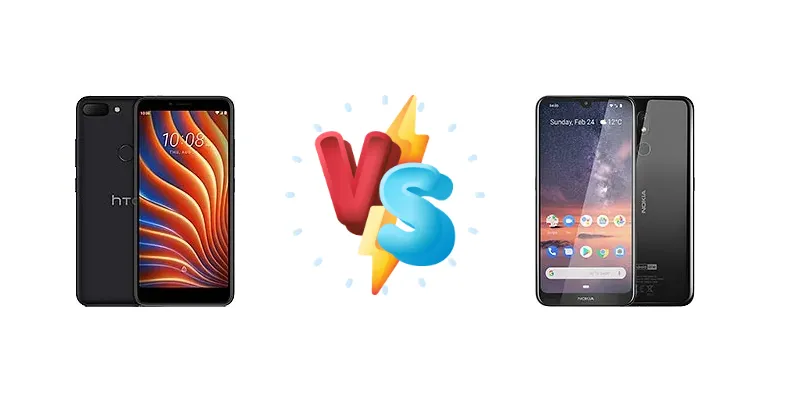
The HTC Wildfire E1 Lite and Nokia 3.2 represent the very bottom end of the smartphone market, targeting first-time buyers or those needing a reliable secondary device. Both phones aim for affordability, but employ different chipsets – Mediatek’s Helio A20 in the HTC and Qualcomm’s Snapdragon 429 in the Nokia – leading to subtle but important performance differences. This comparison dives deep into those differences to help you choose the best option for your needs.
🏆 Quick Verdict
For the average user prioritizing a slightly smoother experience and the convenience of 10W charging, the Nokia 3.2 emerges as the better choice. While both phones share a similar CPU core count and clock speed, the Snapdragon 429 generally offers better sustained performance and a more mature software ecosystem, justifying its slight price premium.
| Network |
|---|
| 2G bands | GSM 850 / 900 / 1800 / 1900 | GSM 850 / 900 / 1800 / 1900 |
| 3G bands | HSDPA 900 / 2100 | HSDPA 850 / 900 / 2100 |
| 4G bands | 1, 3, 5, 7, 8, 20, 38, 40 | 1, 3, 5, 7, 8, 20, 28, 38, 40 - EMEA, APAC, MENA |
| Speed | HSPA 42.2/11.5 Mbps, LTE Cat4 150/75 Mbps | HSPA 42.2/5.76 Mbps, LTE Cat4 150/50 Mbps |
| Technology | GSM / HSPA / LTE | GSM / HSPA / LTE |
| | - | 1, 3, 5, 8, 40, 41 - India |
| Launch |
|---|
| Announced | 2020, September 24. Released 2020, September 24 | 2019, February 24. Released 2019, May 22 |
| Status | Discontinued | Discontinued |
| Body |
|---|
| Build | Glass front, plastic back, plastic frame | Glass front, plastic back, plastic frame |
| Dimensions | 147.9 x 71.4 x 8.9 mm (5.82 x 2.81 x 0.35 in) | 159.4 x 76.2 x 8.6 mm (6.28 x 3.00 x 0.34 in) |
| SIM | Nano-SIM + Nano-SIM | Nano-SIM + Nano-SIM |
| Weight | 160 g (5.64 oz) | 181 g (6.38 oz) |
| Display |
|---|
| Resolution | 720 x 1440 pixels, 18:9 ratio (~295 ppi density) | 720 x 1520 pixels, 19:9 ratio (~269 ppi density) |
| Size | 5.45 inches, 76.7 cm2 (~72.6% screen-to-body ratio) | 6.26 inches, 97.8 cm2 (~80.5% screen-to-body ratio) |
| Type | TFT LCD | IPS LCD |
| Platform |
|---|
| CPU | Quad-core 1.8 GHz Cortex-A53 | Quad-core 1.8 GHz Cortex-A53 |
| Chipset | Mediatek MT6761D Helio A20 (12 nm) | Qualcomm SDM429 Snapdragon 429 (12 nm) |
| GPU | PowerVR GE8320 | Adreno 504 |
| OS | Android 10 (Go edition) | Android 9.0 (Pie), upgradable to Android 11, Android One |
| Memory |
|---|
| Card slot | microSDHC | microSDXC (dedicated slot) |
| Internal | 16GB 2GB RAM | 16GB 2GB RAM, 32GB 3GB RAM, 64GB 3GB RAM |
| | eMMC 5.1 | eMMC 5.1 |
| Main Camera |
|---|
| Dual | 8 MP, f/2.0, (wide), AF
Auxiliary lens | - |
| Features | LED flash, HDR, panorama | LED flash |
| Single | - | 13 MP, f/2.2, 1/3.1", 1.12µm, AF |
| Video | 1080p@30fps | 1080p@30fps |
| Selfie camera |
|---|
| Features | HDR | - |
| Single | 5 MP, f/2.2, (wide) | 5 MP, f/2.2, 27mm (wide), 1/5.0", 1.12µm |
| Video | 720p@30fps | - |
| Sound |
|---|
| 3.5mm jack | Yes | Yes |
| 35mm jack | Yes | Yes |
| Loudspeaker | Yes | Yes |
| Comms |
|---|
| Bluetooth | 5.0, A2DP | 4.2, A2DP, LE, aptX |
| NFC | No | No |
| Positioning | GPS, GLONASS, GALILEO | GPS, GLONASS, BDS |
| Radio | Unspecified | FM radio |
| USB | microUSB 2.0 | microUSB 2.0, OTG |
| WLAN | Wi-Fi 802.11 a/b/g/n/ac, dual-band | Wi-Fi 802.11 b/g/n |
| Features |
|---|
| Sensors | Fingerprint (rear-mounted), accelerometer, proximity | Fingerprint (rear-mounted, 32/3GB only), accelerometer, proximity |
| Battery |
|---|
| Charging | - | 10W wired |
| Type | Li-Ion 3000 mAh | Li-Ion 4000 mAh, non-removable |
| Misc |
|---|
| Colors | Black | Black, Steel |
| Models | - | TA-1156, TA-1159, TA-1164 |
| Price | About 80 EUR | About 140 EUR |
| SAR EU | - | 0.24 W/kg (head) 1.63 W/kg (body) |
HTC Wildfire E1 lite
- Potentially lower price point
- Functional for basic smartphone tasks
- Compact and lightweight design
- Less refined software experience
- Likely slower sustained performance
- No information on charging capabilities
Nokia 3.2
- More efficient Snapdragon 429 chipset
- 10W wired charging for convenience
- Generally better software support from Nokia
- Slightly higher price compared to the HTC
- Basic camera system
- Limited gaming capabilities
Display Comparison
Neither the HTC Wildfire E1 Lite nor the Nokia 3.2 boast impressive displays. Specific display specs (resolution, panel type, brightness) are not provided, but given their price points, both likely utilize LCD panels with 720p+ resolutions. The focus here isn't on visual fidelity, but on basic usability. Bezels are expected to be substantial on both devices, maximizing screen real estate within a compact form factor. Color accuracy is likely to be standard for this segment, prioritizing power efficiency over color calibration.
Camera Comparison
Camera performance on both devices will be limited. Without specific sensor details, it’s safe to assume both feature basic camera setups geared towards casual snapshots. The Nokia 3.2’s camera system, while likely not groundbreaking, benefits from Qualcomm’s image signal processing (ISP), which generally delivers more consistent results than Mediatek’s equivalent. The absence of Optical Image Stabilization (OIS) on either device means low-light photography will be challenging. Any secondary cameras (often 2MP macro or depth sensors) are unlikely to significantly enhance the overall photography experience.
Performance
Both devices are equipped with quad-core 1.8 GHz Cortex-A53 CPUs, suggesting similar raw processing power. However, the chipset difference – Mediatek MT6761D Helio A20 versus Qualcomm Snapdragon 429 – is crucial. Qualcomm’s Snapdragon 429, built on a 12nm process, generally exhibits better sustained performance and more efficient thermal management than the Helio A20. While both are capable of handling basic tasks like calling, texting, and light social media browsing, the Snapdragon 429 will likely provide a smoother experience when multitasking or running slightly more demanding applications. The GPU within the Snapdragon 429 also offers a modest advantage for casual gaming.
Battery Life
Battery capacity is not specified for the HTC Wildfire E1 Lite, but given its market positioning, it’s likely comparable to the Nokia 3.2’s. The Nokia 3.2 supports 10W wired charging, a significant advantage over the HTC Wildfire E1 Lite, which lacks any charging information. This means the Nokia 3.2 will offer a more convenient charging experience, allowing for faster top-ups and reducing downtime. While neither phone will deliver exceptional battery life, the 10W charging on the Nokia 3.2 provides a practical benefit for daily use.
Buying Guide
Buy the HTC Wildfire E1 Lite if you absolutely need the lowest possible price and are comfortable with a potentially less refined software experience. It’s a functional device for basic tasks. Buy the Nokia 3.2 if you value a more polished user experience, the convenience of standard 10W charging, and a brand known for reliable software updates, even on its entry-level devices.
Frequently Asked Questions
❓ Will the Nokia 3.2 struggle with popular apps like Facebook or WhatsApp?
While the Snapdragon 429 isn't a powerhouse, it's generally sufficient for running apps like Facebook and WhatsApp smoothly. However, expect some loading times and occasional lag when multitasking or using resource-intensive features within these apps. The Nokia 3.2's software optimization will help mitigate these issues.
❓ Is the HTC Wildfire E1 Lite a good option for someone upgrading from a feature phone?
The HTC Wildfire E1 Lite is a viable option for a first-time smartphone user transitioning from a feature phone. It provides the core functionality of a smartphone – calling, texting, internet access – at a very affordable price. However, be prepared for a basic user experience and limited performance.
❓ Can either of these phones handle basic mobile games like Candy Crush or Subway Surfers?
Yes, both phones can handle casual games like Candy Crush or Subway Surfers. However, don't expect high frame rates or detailed graphics. The Snapdragon 429 in the Nokia 3.2 will likely provide a slightly smoother gaming experience due to its more capable GPU.
❓ How long will software updates be supported on the Nokia 3.2?
Nokia is known for providing relatively good software support for its entry-level devices. While the Nokia 3.2 won't receive the same level of updates as flagship models, it's likely to receive at least one major Android version update and regular security patches for a reasonable period, offering better long-term security and functionality.