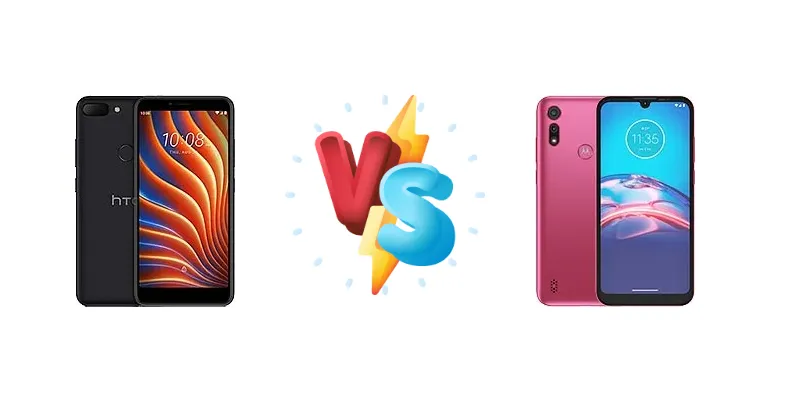
The HTC Wildfire E1 Lite and Motorola Moto E6i represent the extreme end of the smartphone price spectrum. Both aim to deliver basic smartphone functionality at an incredibly affordable price point, but they take very different approaches to achieving this. The Wildfire E1 Lite prioritizes power efficiency with a newer, albeit less powerful, chipset, while the Moto E6i opts for more cores, potentially offering a boost in multitasking, despite its older manufacturing process.
🏆 Quick Verdict
For the average user prioritizing smooth, consistent performance for basic tasks like calling, messaging, and light social media, the Motorola Moto E6i is the better choice. Its octa-core processor, while built on a larger node, provides a noticeable advantage over the Wildfire E1 Lite’s quad-core setup, making it more responsive in everyday use.
| Network |
|---|
| 2G bands | GSM 850 / 900 / 1800 / 1900 | GSM 850 / 900 / 1800 / 1900 |
| 3G bands | HSDPA 900 / 2100 | HSDPA 850 / 900 / 1700(AWS) / 1900 / 2100 |
| 4G bands | 1, 3, 5, 7, 8, 20, 38, 40 | 1, 2, 3, 4, 5, 7, 8, 19, 28, 66 |
| Speed | HSPA 42.2/11.5 Mbps, LTE Cat4 150/75 Mbps | HSPA, LTE |
| Technology | GSM / HSPA / LTE | GSM / HSPA / LTE |
| Launch |
|---|
| Announced | 2020, September 24. Released 2020, September 24 | 2021, February 11 |
| Status | Discontinued | Available. Released 2021, February 11 |
| Body |
|---|
| Build | Glass front, plastic back, plastic frame | Glass front, plastic back, plastic frame |
| Dimensions | 147.9 x 71.4 x 8.9 mm (5.82 x 2.81 x 0.35 in) | 155.6 x 73 x 8.5 mm (6.13 x 2.87 x 0.33 in) |
| SIM | Nano-SIM + Nano-SIM | Nano-SIM + Nano-SIM |
| Weight | 160 g (5.64 oz) | 160 g (5.64 oz) |
| Display |
|---|
| Resolution | 720 x 1440 pixels, 18:9 ratio (~295 ppi density) | 720 x 1560 pixels, 19.5:9 ratio (~282 ppi density) |
| Size | 5.45 inches, 76.7 cm2 (~72.6% screen-to-body ratio) | 6.1 inches, 91.3 cm2 (~80.4% screen-to-body ratio) |
| Type | TFT LCD | IPS LCD |
| Platform |
|---|
| CPU | Quad-core 1.8 GHz Cortex-A53 | Octa-core (4x1.6 GHz Cortex-A55 & 4x1.2 GHz Cortex-A55) |
| Chipset | Mediatek MT6761D Helio A20 (12 nm) | Unisoc SC9863A (28 nm) |
| GPU | PowerVR GE8320 | IMG8322 |
| OS | Android 10 (Go edition) | Android 10 (Go edition) |
| Memory |
|---|
| Card slot | microSDHC | microSDXC (uses shared SIM slot) |
| Internal | 16GB 2GB RAM | 32GB 2GB RAM |
| | eMMC 5.1 | eMMC 5.1 |
| Main Camera |
|---|
| Dual | 8 MP, f/2.0, (wide), AF
Auxiliary lens | 13 MP, f/2.2, 26mm (wide), 1/3.1", 1.12µm, PDAF
Auxiliary lens |
| Features | LED flash, HDR, panorama | LED flash, HDR, panorama |
| Video | 1080p@30fps | 1080p@30fps |
| Selfie camera |
|---|
| Features | HDR | - |
| Single | 5 MP, f/2.2, (wide) | 5 MP, f/2.2, 27mm (wide), 1.12µm |
| Video | 720p@30fps | 1080p@30fps |
| Sound |
|---|
| 3.5mm jack | Yes | Yes |
| 35mm jack | Yes | Yes |
| Loudspeaker | Yes | Yes |
| Comms |
|---|
| Bluetooth | 5.0, A2DP | 4.2, A2DP, LE |
| NFC | No | No |
| Positioning | GPS, GLONASS, GALILEO | GPS, GLONASS |
| Radio | Unspecified | Unspecified |
| USB | microUSB 2.0 | microUSB 2.0, OTG |
| WLAN | Wi-Fi 802.11 a/b/g/n/ac, dual-band | Wi-Fi 802.11 b/g/n |
| Features |
|---|
| Sensors | Fingerprint (rear-mounted), accelerometer, proximity | Fingerprint (rear-mounted), accelerometer, proximity |
| Battery |
|---|
| Charging | - | 10W wired |
| Type | Li-Ion 3000 mAh | Li-Ion 3000 mAh |
| Misc |
|---|
| Colors | Black | Titanium Gray, Pink |
| Models | - | XT2053-5 |
| Price | About 80 EUR | About 170 EUR |
HTC Wildfire E1 lite
- Potentially longer battery life due to efficient chipset.
- Newer chipset architecture (Helio A20).
- Likely more affordable.
- Quad-core processor may struggle with multitasking.
- Performance may feel sluggish compared to the Moto E6i.
- Limited camera capabilities.
Motorola Moto E6i
- Octa-core processor offers smoother multitasking.
- More responsive user interface.
- 10W wired charging.
- Older, less efficient chipset (Unisoc SC9863A).
- Shorter battery life compared to the Wildfire E1 Lite.
- Larger manufacturing node (28nm).
Display Comparison
Neither device boasts a standout display. Details regarding panel type, resolution, and brightness are scarce for both, typical of this price bracket. However, the focus should be on usability, not visual fidelity. Expect basic LCD panels with adequate, but not impressive, viewing angles. Bezels are likely to be substantial on both devices, maximizing screen real estate within their compact form factors.
Camera Comparison
Camera performance on both devices will be limited. Details on sensor size and image processing are unavailable, but given the price point, expectations should be tempered. Both are likely to feature basic cameras suitable for casual snapshots in good lighting conditions. The Moto E6i may have a slight edge due to potentially better image processing capabilities inherent in the Unisoc chipset, but this is speculative. Avoid relying on these phones for serious photography.
Performance
The core difference lies in the chipsets. The HTC Wildfire E1 Lite utilizes the Mediatek MT6761D Helio A20, a 12nm process chip with a quad-core Cortex-A53 CPU clocked at 1.8 GHz. This architecture prioritizes power efficiency. Conversely, the Motorola Moto E6i features the Unisoc SC9863A, a significantly older 28nm chip, but with an octa-core configuration (4x1.6 GHz Cortex-A55 & 4x1.2 GHz Cortex-A55). While the A55 cores are more efficient than the A53, the larger node and increased core count will likely result in higher power consumption. The Moto E6i’s octa-core setup should translate to smoother multitasking and a more responsive user interface, especially when switching between apps. The Helio A20, while efficient, may struggle with more demanding tasks.
Battery Life
Battery capacity details are missing for both devices. However, the HTC Wildfire E1 Lite’s more efficient Mediatek Helio A20 chipset should deliver longer battery life on a single charge, assuming similar battery capacities. The Motorola Moto E6i, with its 28nm Unisoc chip, will likely drain the battery faster under similar usage. The Moto E6i does offer 10W wired charging, which is a slight advantage over potentially slower charging on the Wildfire E1 Lite, though neither will offer rapid charging speeds.
Buying Guide
Buy the HTC Wildfire E1 Lite if you absolutely need the longest possible battery life and are willing to sacrifice some performance. It’s ideal for users who primarily need a device for calls, texts, and occasional light browsing. Buy the Motorola Moto E6i if you prefer a more responsive experience, even if it means slightly shorter battery life. This phone is better suited for users who multitask between a few apps or occasionally play simple mobile games.
Frequently Asked Questions
❓ Will the Motorola Moto E6i struggle with popular apps like WhatsApp and Facebook?
While the Unisoc SC9863A isn't a powerhouse, it should handle apps like WhatsApp and Facebook without significant issues. The octa-core configuration provides enough processing power for these common social media applications. However, expect some lag when switching between multiple apps or using more demanding features within these apps.
❓ Is the HTC Wildfire E1 Lite a good choice for someone who primarily uses their phone for calls and texts?
Yes, the HTC Wildfire E1 Lite is an excellent choice for basic communication. Its power-efficient Mediatek Helio A20 chipset will maximize battery life, ensuring it can last through a full day of calls and texts. The quad-core processor is sufficient for these core functions, and the phone's simplicity is a benefit for users who don't need advanced features.
❓ Can either of these phones handle basic mobile games?
Both phones can handle *very* basic mobile games, but don't expect a smooth experience with anything graphically demanding. Simple 2D games or older titles will be playable, but newer, more complex games will likely suffer from significant lag and low frame rates. The Moto E6i has a slight advantage due to its octa-core processor.