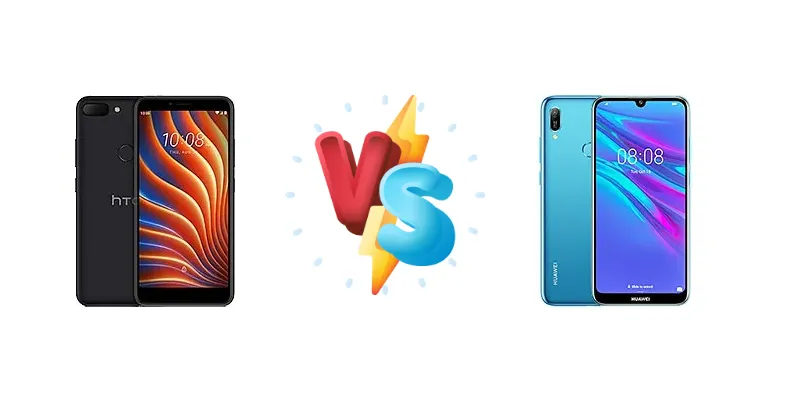
The HTC Wildfire E1 Lite and Huawei Y6 (2019) represent the extreme end of the smartphone price spectrum. Both devices target first-time smartphone buyers or those needing a reliable secondary device. This comparison dissects their core components to determine which offers the most value for users prioritizing basic functionality and affordability.
🏆 Quick Verdict
For the average user seeking a slightly more responsive experience, the Huawei Y6 (2019) emerges as the better choice. Its Mediatek Helio A22 chipset, clocked at 2.0 GHz, provides a modest but noticeable performance advantage over the HTC Wildfire E1 Lite’s 1.8 GHz Helio A20, making everyday tasks feel smoother.
| Network |
|---|
| 2G bands | GSM 850 / 900 / 1800 / 1900 | GSM 850 / 900 / 1800 / 1900 |
| 3G bands | HSDPA 900 / 2100 | HSDPA 850 / 900 / 1900 / 2100 |
| 4G bands | 1, 3, 5, 7, 8, 20, 38, 40 | 1, 3, 7, 8, 20 |
| Speed | HSPA 42.2/11.5 Mbps, LTE Cat4 150/75 Mbps | HSPA 42.2/5.76 Mbps, LTE (2CA) Cat6 300/50 Mbps |
| Technology | GSM / HSPA / LTE | GSM / HSPA / LTE |
| Launch |
|---|
| Announced | 2020, September 24. Released 2020, September 24 | 2019, March 02. Released 2019, March 02 |
| Status | Discontinued | Discontinued |
| Body |
|---|
| Build | Glass front, plastic back, plastic frame | Glass front, plastic back, plastic frame |
| Dimensions | 147.9 x 71.4 x 8.9 mm (5.82 x 2.81 x 0.35 in) | 156.3 x 73.5 x 8 mm (6.15 x 2.89 x 0.31 in) |
| SIM | Nano-SIM + Nano-SIM | Nano-SIM + Nano-SIM |
| Weight | 160 g (5.64 oz) | 150 g (5.29 oz) |
| Display |
|---|
| Resolution | 720 x 1440 pixels, 18:9 ratio (~295 ppi density) | 720 x 1560 pixels, 19.5:9 ratio (~282 ppi density) |
| Size | 5.45 inches, 76.7 cm2 (~72.6% screen-to-body ratio) | 6.09 inches, 91.0 cm2 (~79.2% screen-to-body ratio) |
| Type | TFT LCD | IPS LCD |
| Platform |
|---|
| CPU | Quad-core 1.8 GHz Cortex-A53 | Quad-core 2.0 GHz Cortex-A53 |
| Chipset | Mediatek MT6761D Helio A20 (12 nm) | Mediatek MT6761 Helio A22 (12 nm) |
| GPU | PowerVR GE8320 | PowerVR GE8320 |
| OS | Android 10 (Go edition) | Android 9.0 (Pie), EMUI 9.1 |
| Memory |
|---|
| Card slot | microSDHC | microSDXC (dedicated slot) |
| Internal | 16GB 2GB RAM | 32GB 2GB RAM |
| | eMMC 5.1 | eMMC 5.1 |
| Main Camera |
|---|
| Dual | 8 MP, f/2.0, (wide), AF
Auxiliary lens | - |
| Features | LED flash, HDR, panorama | LED flash, HDR, panorama |
| Single | - | 13 MP, f/1.8, PDAF |
| Video | 1080p@30fps | 1080p@30fps |
| Selfie camera |
|---|
| Features | HDR | LED flash |
| Single | 5 MP, f/2.2, (wide) | 8 MP, f/2.0 |
| Video | 720p@30fps | 1080p@30fps |
| Sound |
|---|
| 3.5mm jack | Yes | Yes |
| 35mm jack | Yes | Yes |
| Loudspeaker | Yes | Yes |
| Comms |
|---|
| Bluetooth | 5.0, A2DP | 4.2, A2DP, LE |
| NFC | No | No |
| Positioning | GPS, GLONASS, GALILEO | GPS, GLONASS, BDS |
| Radio | Unspecified | FM Radio, built-in antenna |
| USB | microUSB 2.0 | microUSB 2.0 |
| WLAN | Wi-Fi 802.11 a/b/g/n/ac, dual-band | Wi-Fi 802.11 b/g/n, Wi-Fi Direct |
| Features |
|---|
| Sensors | Fingerprint (rear-mounted), accelerometer, proximity | Fingerprint (rear-mounted), accelerometer, proximity |
| Battery |
|---|
| Type | Li-Ion 3000 mAh | Li-Ion 3020 mAh, non-removable |
| Misc |
|---|
| Colors | Black | Midnight Black, Sapphire Blue, Amber Brown |
| Models | - | MRD-LX1F, MRD-LX1, MRD-LX3, MRD-LX1N |
| Price | About 80 EUR | About 130 EUR |
HTC Wildfire E1 lite
- Potentially lower price point
- Reliable Mediatek chipset
- Suitable for basic smartphone tasks
- Slower processor than the Y6 (2019)
- Likely limited multitasking capabilities
- Camera performance likely average
Huawei Y6 (2019)
- Faster processor for smoother performance
- Slightly more responsive user experience
- Potentially better battery efficiency
- May be slightly more expensive
- Still limited by 2GB of RAM
- Camera performance likely average
Display Comparison
Neither device boasts a standout display. Given the shared 12nm process node and target market, it's reasonable to assume both utilize similar LCD panels with 720p+ resolutions. However, display quality differences are likely minimal and not specified in the provided data. The focus here is on functionality, not visual fidelity.
Camera Comparison
Camera performance is likely to be similar on both devices, given their shared market segment. Both will likely feature a primary camera and potentially a depth sensor, but detailed sensor specifications are unavailable. It’s safe to assume image quality will be adequate for casual snapshots in good lighting conditions, but struggles in low light. The absence of Optical Image Stabilization (OIS) on either device further limits low-light performance. Focusing on megapixel counts alone would be misleading without knowing sensor size and lens aperture.
Performance
The core difference lies in the chipsets. The Huawei Y6 (2019) features the Mediatek Helio A22, with a quad-core Cortex-A53 CPU clocked at 2.0 GHz. The HTC Wildfire E1 Lite uses the Helio A20, clocked at 1.8 GHz. While both are based on the same Cortex-A53 architecture, the 200 MHz clock speed difference translates to a tangible, albeit small, performance gain for the Y6 (2019) in CPU-bound tasks. This means faster app loading times and smoother multitasking. Both devices are likely paired with 2GB of RAM, further limiting their multitasking capabilities, but the faster CPU will mitigate this to some extent.
Battery Life
Battery capacity isn’t specified for either device, but given their target market, both likely feature batteries in the 3000-4000 mAh range. Charging wattage is also unknown. Real-world battery life will depend heavily on usage patterns, but the slightly more efficient Helio A22 in the Y6 (2019) *could* translate to marginally longer battery life, though the difference is unlikely to be significant.
Buying Guide
Buy the HTC Wildfire E1 Lite if you absolutely need the most basic smartphone experience and are prioritizing a potentially lower price point. It’s suitable for users who primarily need calling, texting, and light app usage. Buy the Huawei Y6 (2019) if you prefer a slightly more fluid user experience, even for simple tasks, and appreciate the small performance boost offered by the faster processor. It’s a better fit for those who occasionally browse the web or use social media apps.
Frequently Asked Questions
❓ Will either of these phones struggle with popular apps like WhatsApp or Facebook?
Both phones will run WhatsApp and Facebook, but expect a somewhat sluggish experience, especially with multiple chats or tabs open. The Helio A22 in the Y6 (2019) will handle these apps slightly better than the Helio A20 in the E1 Lite, but neither is designed for heavy app usage.
❓ Are these phones suitable for playing mobile games?
These phones are not ideal for gaming. While simple 2D games might be playable at low settings, demanding 3D games will likely experience significant lag and frame rate drops. The integrated graphics on both chipsets are not powerful enough for modern mobile gaming.
❓ Do either of these phones support fast charging?
Fast charging support is unlikely on either device, given their price point. Expect charging times to be several hours from 0% to 100% using the included charger.
❓ Which phone is better for an elderly user who primarily needs to make calls and send texts?
Both phones are suitable for this purpose. However, the slightly more responsive interface of the Huawei Y6 (2019) might be easier to navigate for some users. The key factor is ease of use and reliability, and both phones deliver on those fronts.