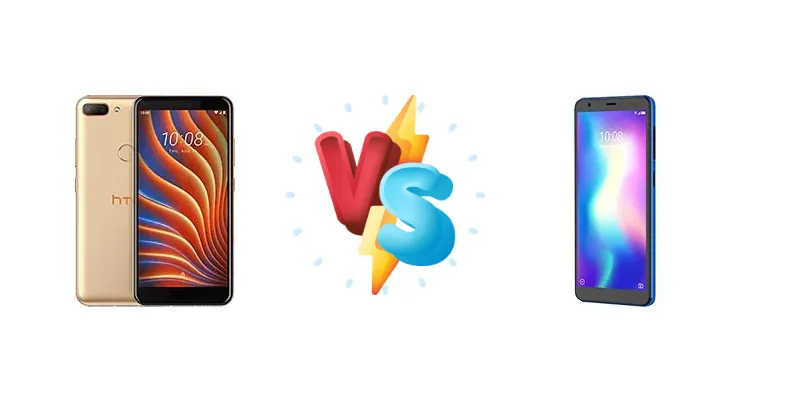
The HTC Wildfire E and ZTE Blade A5 (2019) occupy the ultra-budget smartphone segment, and a quick glance at the specifications reveals a startling similarity: both are powered by the Unisoc SC9863A chipset. This comparison dives deep to uncover if any meaningful differences exist beyond branding and potential software tweaks, helping you determine which device offers the best value for your money.
🏆 Quick Verdict
For the average user prioritizing absolute affordability, the ZTE Blade A5 (2019) likely presents a slightly better value proposition, assuming comparable pricing. Both phones offer identical core performance due to the shared Unisoc SC9863A chipset, but ZTE’s established presence in the budget market often translates to more competitive pricing.
| Network |
|---|
| 2G bands | GSM 850 / 900 / 1800 / 1900 | GSM 850 / 900 / 1800 / 1900 |
| 3G bands | HSDPA 900 / 2100 | HSDPA 850 / 900 / 2100 |
| 4G bands | 1, 3, 7, 20, 38, 40 | 1, 3, 5, 7, 8, 38 |
| Speed | HSPA 42.2/11.5 Mbps, LTE Cat4 150/50 Mbps | HSPA 42.2/5.76 Mbps, LTE Cat4 150/50 Mbps |
| Technology | GSM / HSPA / LTE | GSM / HSPA / LTE |
| Launch |
|---|
| Announced | 2019, August 15. Released 2019, August 15 | 2019, May. Released 2019, May |
| Status | Discontinued | Discontinued |
| Body |
|---|
| Build | Glass front, plastic back, plastic frame | Glass front, plastic back, plastic frame |
| Dimensions | 147.9 x 71.4 x 8.9 mm (5.82 x 2.81 x 0.35 in) | 145.8 x 70 x 9.6 mm (5.74 x 2.76 x 0.38 in) |
| SIM | Nano-SIM + Nano-SIM | Nano-SIM + Nano-SIM |
| Weight | 160 g (5.64 oz) | 157 g (5.54 oz) |
| Display |
|---|
| Resolution | 720 x 1440 pixels, 18:9 ratio (~295 ppi density) | 720 x 1440 pixels, 18:9 ratio (~295 ppi density) |
| Size | 5.45 inches, 76.7 cm2 (~72.6% screen-to-body ratio) | 5.45 inches, 76.7 cm2 (~75.1% screen-to-body ratio) |
| Type | TFT LCD | IPS LCD |
| Platform |
|---|
| CPU | Octa-core (4x1.6 GHz Cortex-A55 & 4x1.2 GHz Cortex-A55) | Octa-core (4x1.6 GHz Cortex-A55 & 4x1.2 GHz Cortex-A55) |
| Chipset | Unisoc SC9863A (28 nm) | Unisoc SC9863A (28 nm) |
| GPU | IMG8322 | IMG8322 |
| OS | Android 9.0 (Pie) | Android 9.0 (Pie) |
| Memory |
|---|
| Card slot | microSDXC | microSDXC (dedicated slot) |
| Internal | 32GB 2GB RAM | 16GB 2GB RAM |
| | eMMC 5.1 | - |
| Main Camera |
|---|
| Dual | 13 MP, f/2.0, (wide), AF
Auxiliary lens | - |
| Features | LED flash, HDR, panorama | LED flash, HDR |
| Single | - | 13 MP, f/2.0, AF |
| Video | 1080p@30fps | 1080p@30fps |
| Selfie camera |
|---|
| Features | HDR | - |
| Single | 5 MP, f/2.8, (wide) | 8 MP, f/2.4 |
| Video | 720p@30fps | - |
| Sound |
|---|
| 3.5mm jack | Yes | Yes |
| 35mm jack | Yes | Yes |
| Loudspeaker | Yes | Yes |
| Comms |
|---|
| Bluetooth | 4.2, A2DP | 4.2, A2DP, LE |
| NFC | No | No |
| Positioning | GPS, GLONASS, GALILEO | GPS, GLONASS |
| Radio | Unspecified | FM radio |
| USB | microUSB 2.0 | microUSB 2.0 |
| WLAN | Wi-Fi 802.11 b/g/n | Wi-Fi 802.11 b/g/n, Wi-Fi Direct |
| Features |
|---|
| Sensors | Fingerprint (rear-mounted), accelerometer, proximity, compass | Accelerometer, proximity |
| Battery |
|---|
| Type | Li-Ion 3000 mAh | Li-Ion 2600 mAh, non-removable |
| Misc |
|---|
| Colors | Black, Gold | Black, Blue |
| Price | About 120 EUR | About 80 EUR |
HTC Wildfire E
- Potential for cleaner Android software experience (HTC)
- Brand recognition (HTC)
- Identical core performance to ZTE Blade A5
- Likely higher price compared to ZTE Blade A5
- Limited performance due to Unisoc SC9863A chipset
ZTE Blade A5 (2019)
- Likely lower price point
- Established presence in the budget smartphone market (ZTE)
- Identical core performance to HTC Wildfire E
- Potentially more bloatware or customized Android skin
- Limited performance due to Unisoc SC9863A chipset
Display Comparison
Both the HTC Wildfire E and ZTE Blade A5 (2019) utilize displays that are likely in the 6.0-6.2 inch range, based on typical devices in this segment. However, specific details like panel type (IPS vs. TFT) and resolution are not provided. Given the price point, expect 720p+ resolution. The shared chipset suggests similar graphics capabilities, meaning neither device will excel in graphically demanding applications. The absence of information on peak brightness or color gamut makes a direct comparison impossible, but both will likely offer adequate, but not exceptional, viewing experiences.
Camera Comparison
Camera specifications are not detailed, but given the target market, both devices likely feature a primary camera in the 8-13MP range, potentially accompanied by a depth sensor or a low-resolution macro lens. Image quality will be adequate in well-lit conditions, but expect significant noise and a lack of detail in low-light scenarios. The Unisoc SC9863A’s image signal processor (ISP) is basic, limiting the potential for advanced image processing features. The absence of Optical Image Stabilization (OIS) on either device will further hinder low-light performance.
Performance
The core of both devices is the Unisoc SC9863A, featuring an octa-core CPU configuration with 4 cores clocked at 1.6 GHz (Cortex-A55) and another 4 cores at 1.2 GHz (Cortex-A55). This means CPU performance will be virtually identical between the two. The 28nm manufacturing process is relatively dated, indicating moderate power efficiency. While sufficient for basic tasks like calling, texting, and light web browsing, demanding applications or multitasking will likely result in noticeable slowdowns. RAM capacity, a crucial factor for multitasking, is not specified, but is likely 2GB or 3GB in both cases, further limiting performance.
Battery Life
Battery capacity is not specified for either device. However, typical smartphones in this price range feature batteries between 3000mAh and 4000mAh. Given the power efficiency limitations of the 28nm Unisoc SC9863A, battery life will likely be sufficient for a full day of light use, but heavy users may need to recharge before the end of the day. Charging wattage is also unknown, but is likely limited to 5W or 10W, resulting in relatively slow charging times.
Buying Guide
Buy the HTC Wildfire E if you value brand recognition and potentially a cleaner, more streamlined Android experience, even if it comes at a slight premium. Buy the ZTE Blade A5 (2019) if you prioritize maximizing value and are comfortable with a potentially more customized Android skin, and are seeking the lowest possible price point for a functional smartphone.
Frequently Asked Questions
❓ Will either of these phones run PUBG Mobile smoothly?
Given the Unisoc SC9863A chipset and likely limited RAM, running PUBG Mobile on either the HTC Wildfire E or ZTE Blade A5 (2019) will likely be a compromised experience. Expect low frame rates, significant lag, and the need to use the lowest graphics settings. It's not designed for demanding gaming.
❓ Are these phones likely to receive Android updates?
Android updates are unlikely to be frequent or guaranteed on either device. Both the HTC Wildfire E and ZTE Blade A5 (2019) fall into the ultra-budget category, and manufacturers typically prioritize newer models for software support. Expect to be stuck on the version of Android they ship with, or potentially receive one minor update.
❓ What kind of storage options are available on these phones?
Storage is likely limited to 16GB or 32GB on both devices, with a microSD card slot for expansion. Given the limited internal storage, a microSD card is highly recommended for storing photos, videos, and apps.