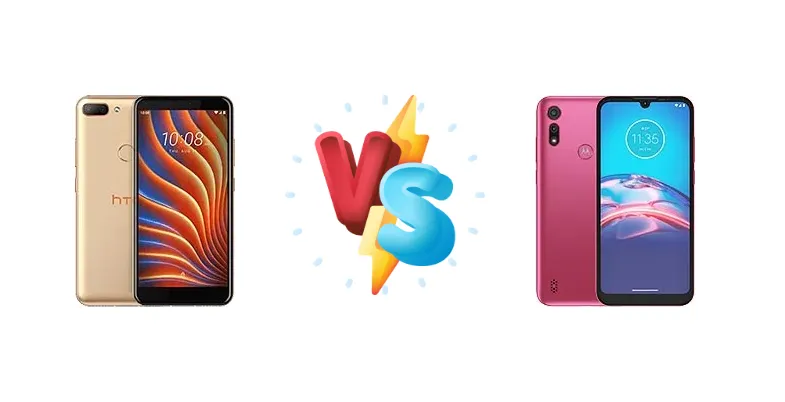
The HTC Wildfire E and Motorola Moto E6i represent the absolute bottom end of the smartphone market. Both devices target first-time smartphone buyers or those needing a very basic, reliable device. The key question isn't about flagship features, but which phone delivers the most usable experience for the price. Both rely on the same Unisoc SC9863A chipset, making the differences subtle but potentially impactful.
🏆 Quick Verdict
For the average user, the Motorola Moto E6i is the slightly better choice. While both phones share identical processing power thanks to the Unisoc SC9863A, the inclusion of 10W wired charging provides a tangible benefit over the Wildfire E's unspecified charging capabilities, making it more convenient for daily use.
| Network |
|---|
| 2G bands | GSM 850 / 900 / 1800 / 1900 | GSM 850 / 900 / 1800 / 1900 |
| 3G bands | HSDPA 900 / 2100 | HSDPA 850 / 900 / 1700(AWS) / 1900 / 2100 |
| 4G bands | 1, 3, 7, 20, 38, 40 | 1, 2, 3, 4, 5, 7, 8, 19, 28, 66 |
| Speed | HSPA 42.2/11.5 Mbps, LTE Cat4 150/50 Mbps | HSPA, LTE |
| Technology | GSM / HSPA / LTE | GSM / HSPA / LTE |
| Launch |
|---|
| Announced | 2019, August 15. Released 2019, August 15 | 2021, February 11 |
| Status | Discontinued | Available. Released 2021, February 11 |
| Body |
|---|
| Build | Glass front, plastic back, plastic frame | Glass front, plastic back, plastic frame |
| Dimensions | 147.9 x 71.4 x 8.9 mm (5.82 x 2.81 x 0.35 in) | 155.6 x 73 x 8.5 mm (6.13 x 2.87 x 0.33 in) |
| SIM | Nano-SIM + Nano-SIM | Nano-SIM + Nano-SIM |
| Weight | 160 g (5.64 oz) | 160 g (5.64 oz) |
| Display |
|---|
| Resolution | 720 x 1440 pixels, 18:9 ratio (~295 ppi density) | 720 x 1560 pixels, 19.5:9 ratio (~282 ppi density) |
| Size | 5.45 inches, 76.7 cm2 (~72.6% screen-to-body ratio) | 6.1 inches, 91.3 cm2 (~80.4% screen-to-body ratio) |
| Type | TFT LCD | IPS LCD |
| Platform |
|---|
| CPU | Octa-core (4x1.6 GHz Cortex-A55 & 4x1.2 GHz Cortex-A55) | Octa-core (4x1.6 GHz Cortex-A55 & 4x1.2 GHz Cortex-A55) |
| Chipset | Unisoc SC9863A (28 nm) | Unisoc SC9863A (28 nm) |
| GPU | IMG8322 | IMG8322 |
| OS | Android 9.0 (Pie) | Android 10 (Go edition) |
| Memory |
|---|
| Card slot | microSDXC | microSDXC (uses shared SIM slot) |
| Internal | 32GB 2GB RAM | 32GB 2GB RAM |
| | eMMC 5.1 | eMMC 5.1 |
| Main Camera |
|---|
| Dual | 13 MP, f/2.0, (wide), AF
Auxiliary lens | 13 MP, f/2.2, 26mm (wide), 1/3.1", 1.12µm, PDAF
Auxiliary lens |
| Features | LED flash, HDR, panorama | LED flash, HDR, panorama |
| Video | 1080p@30fps | 1080p@30fps |
| Selfie camera |
|---|
| Features | HDR | - |
| Single | 5 MP, f/2.8, (wide) | 5 MP, f/2.2, 27mm (wide), 1.12µm |
| Video | 720p@30fps | 1080p@30fps |
| Sound |
|---|
| 3.5mm jack | Yes | Yes |
| 35mm jack | Yes | Yes |
| Loudspeaker | Yes | Yes |
| Comms |
|---|
| Bluetooth | 4.2, A2DP | 4.2, A2DP, LE |
| NFC | No | No |
| Positioning | GPS, GLONASS, GALILEO | GPS, GLONASS |
| Radio | Unspecified | Unspecified |
| USB | microUSB 2.0 | microUSB 2.0, OTG |
| WLAN | Wi-Fi 802.11 b/g/n | Wi-Fi 802.11 b/g/n |
| Features |
|---|
| Sensors | Fingerprint (rear-mounted), accelerometer, proximity, compass | Fingerprint (rear-mounted), accelerometer, proximity |
| Battery |
|---|
| Charging | - | 10W wired |
| Type | Li-Ion 3000 mAh | Li-Ion 3000 mAh |
| Misc |
|---|
| Colors | Black, Gold | Titanium Gray, Pink |
| Models | - | XT2053-5 |
| Price | About 120 EUR | About 170 EUR |
HTC Wildfire E
- Potential for lower price point
- HTC brand recognition
- Compact and lightweight design (likely)
- Unspecified charging speed
- Limited software update support (historically)
- Potentially lower availability
Motorola Moto E6i
- 10W wired charging for convenience
- Generally better software update support from Motorola
- Wider availability in many markets
- Identical chipset to the Wildfire E
- Basic camera performance
- Limited RAM capacity (likely)
Display Comparison
Neither HTC nor Motorola provide detailed display specifications for these models. Given their price point, it's safe to assume both utilize LCD panels with resolutions around 720p+. Expect relatively low brightness levels, making outdoor visibility a challenge. Color accuracy will likely be standard for this segment, prioritizing power efficiency over vibrant colors. Bezels are expected to be substantial on both devices, maximizing screen real estate within a compact form factor.
Camera Comparison
Camera performance is expected to be basic on both devices. Details are scarce, but it's likely both feature a single rear camera, potentially an 8MP or 13MP sensor. Image quality will be acceptable in good lighting conditions, but struggle in low light. The absence of Optical Image Stabilization (OIS) will exacerbate this issue. Any additional cameras (often 2MP macro lenses) are likely to offer minimal practical benefit. Image processing will be focused on basic noise reduction and sharpening.
Performance
Both the HTC Wildfire E and Motorola Moto E6i are powered by the Unisoc SC9863A chipset, featuring an octa-core CPU configuration with 4 cores clocked at 1.6 GHz (Cortex-A55) and 4 cores at 1.2 GHz (Cortex-A55). This means performance will be virtually identical in day-to-day tasks like browsing, social media, and light app usage. The 28nm manufacturing process is relatively dated, indicating limited thermal headroom and potential for throttling under sustained load. RAM capacity is a critical factor not specified, but likely around 2GB-3GB, which will impact multitasking capabilities.
Battery Life
Battery capacity is not specified for either device. However, given the low-power chipset and basic displays, both should offer at least a full day of light usage. The Motorola Moto E6i gains a clear advantage with its 10W wired charging support. While not fast by modern standards, it's significantly more convenient than the unspecified charging capabilities of the HTC Wildfire E, potentially reducing charging times from several hours to a more manageable timeframe. The lack of fast charging protocols on both devices means a full 0-100% charge will still take a considerable amount of time.
Buying Guide
Buy the HTC Wildfire E if you prioritize brand recognition within the HTC ecosystem and find it at a significantly lower price point. However, be prepared for potentially slower charging speeds. Buy the Motorola Moto E6i if you value the convenience of 10W charging and a generally more readily available software experience, as Motorola has a stronger track record of updates, even on budget devices.
Frequently Asked Questions
❓ Will the Unisoc SC9863A chipset struggle with popular apps like WhatsApp and Facebook?
The Unisoc SC9863A is a very basic chipset, but it should be sufficient for running lightweight apps like WhatsApp and Facebook. However, expect some lag when switching between apps or loading complex content. Avoid running multiple apps simultaneously to maintain a smooth experience.
❓ How long will it take to fully charge the Motorola Moto E6i with the 10W charger?
With a 10W charger, expect the Motorola Moto E6i to take approximately 3-4 hours to fully charge from 0% to 100%, assuming a battery capacity around 3000-4000 mAh. This is a relatively slow charging speed compared to modern smartphones, but it's a significant improvement over potentially much slower charging on the HTC Wildfire E.
❓ Can either of these phones play PUBG Mobile?
While technically possible to *launch* PUBG Mobile on these phones, the experience will be severely limited. The Unisoc SC9863A lacks the graphical power to run the game smoothly, even at the lowest settings. Expect significant frame rate drops and lag, making it largely unplayable.