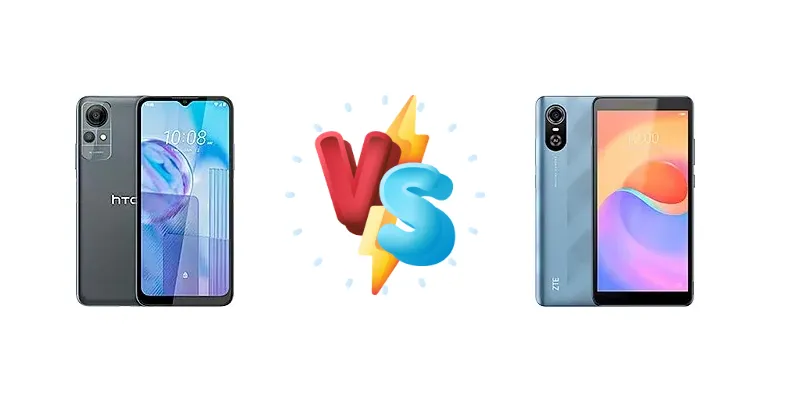
The HTC Wildfire E star and ZTE Blade A31 Plus represent the extreme end of the smartphone price spectrum. Both devices rely on Unisoc chipsets to deliver a functional Android experience, but significant architectural differences exist between the SC9832E in the HTC and the SC9863A in the ZTE. This comparison dissects those differences to determine which phone offers the best value for users prioritizing basic smartphone functionality.
🏆 Quick Verdict
For the average user needing a basic smartphone for calls, messaging, and light app usage, the ZTE Blade A31 Plus is the better choice. Its octa-core processor, built on the same 28nm process as the HTC, provides a noticeable performance advantage over the Wildfire E star’s quad-core setup, translating to smoother multitasking and app loading.
| Network |
|---|
| 2G bands | GSM 850 / 900 / 1800 / 1900 | GSM 850 / 900 / 1800 / 1900 |
| 3G bands | HSDPA 850 / 900 / 2100 | HSDPA 850 / 900 / 2100 |
| 4G bands | 1, 3, 5, 7, 8, 20, 38, 40, 41 | 1, 2, 3, 5, 7, 8, 20, 28, 38, 40, 41 |
| Speed | HSPA, LTE | HSPA, LTE |
| Technology | GSM / HSPA / LTE | GSM / HSPA / LTE |
| Launch |
|---|
| Announced | 2023, August 08 | 2021, October 31 |
| Status | Available. Released 2023, August | Available. Released 2021, October 31 |
| Body |
|---|
| Build | Glass front, plastic back, plastic frame | - |
| Dimensions | 164.8 x 76.5 x 9.2 mm (6.49 x 3.01 x 0.36 in) | 159.2 x 77.5 x 9.6 mm (6.27 x 3.05 x 0.38 in) |
| SIM | Nano-SIM + Nano-SIM | Nano-SIM + Nano-SIM |
| Weight | 200 g (7.05 oz) | - |
| Display |
|---|
| Resolution | 720 x 1600 pixels, 20:9 ratio (~269 ppi density) | 480 x 960 pixels, 18:9 ratio (~179 ppi density) |
| Size | 6.52 inches, 102.6 cm2 (~81.4% screen-to-body ratio) | 6.0 inches, 92.9 cm2 (~75.3% screen-to-body ratio) |
| Type | IPS LCD | IPS LCD |
| Platform |
|---|
| CPU | Quad-core 1.4 GHz | Octa-core (4x1.6 GHz Cortex-A55 & 4x1.2 GHz Cortex-A55) |
| Chipset | Unisoc SC9832E (28 nm) | Unisoc SC9863A (28 nm) |
| GPU | Mali-T820 MP1 | IMG8322 |
| OS | Android 12 (Go edition) | Android 11 (Go edition) |
| Memory |
|---|
| Card slot | microSDXC (uses shared SIM slot) | microSDXC |
| Internal | 16GB 2GB RAM | 32GB 1GB RAM |
| | - | eMMC 5.1 |
| Main Camera |
|---|
| Features | LED flash | LED flash, HDR |
| Single | 8 MP, f/2.2, (wide), AF
Auxiliary lens | 5 MP (up-scaled to 8 MP) |
| Video | 1080p@30fps | 720p@30fps |
| Selfie camera |
|---|
| Single | 5 MP, f/2.2, (wide) | 2 MP (up-scaled to 5 MP) |
| Video | 720p@30fps | - |
| Sound |
|---|
| 3.5mm jack | - | Yes |
| 35mm jack | Yes | Yes |
| Loudspeaker | Yes | Yes |
| Comms |
|---|
| Bluetooth | 4.2, A2DP | 4.2, A2DP, LE |
| NFC | No | Yes |
| Positioning | GPS, GLONASS, GALILEO | GPS, GLONASS |
| Radio | Unspecified | FM radio |
| USB | USB Type-C 2.0 | microUSB 2.0 |
| WLAN | Wi-Fi 802.11 a/b/g/n | Wi-Fi 802.11 b/g/n |
| Features |
|---|
| Sensors | Fingerprint (side-mounted), accelerometer, proximity | Accelerometer |
| Battery |
|---|
| Type | Li-Ion 3000 mAh | Li-Ion 3000 mAh |
| Misc |
|---|
| Colors | Gray | Blue, Gray |
| Price | About 100 EUR | - |
HTC Wildfire E star
- Potentially lower price point
- Simple and straightforward user experience
- May be ideal for first-time smartphone users
- Significantly slower performance
- Limited multitasking capabilities
- Less responsive user interface
ZTE Blade A31 Plus
- Faster octa-core processor
- Smoother multitasking and app loading
- More responsive user interface
- Better suited for slightly more demanding tasks
- May be slightly more expensive
- Potentially slightly lower battery life (speculative)
Display Comparison
Neither HTC nor ZTE provide detailed display specifications beyond size. Given the price point, both likely utilize LCD panels. The focus here isn't display quality, but rather the processing power needed to drive the UI. A more powerful processor, like the one in the ZTE, can contribute to smoother animations even on a basic display.
Camera Comparison
Both devices likely feature basic camera setups, and detailed sensor information is scarce. It's safe to assume both rely on relatively low-resolution sensors. Without specific megapixel counts or aperture details, it's difficult to make a meaningful comparison. Image processing capabilities will be heavily reliant on the chipset, giving the ZTE Blade A31 Plus a slight edge due to its more powerful processor. However, expectations should remain low; these cameras are primarily for casual snapshots.
Performance
The core difference lies in the chipsets. The HTC Wildfire E star utilizes the Unisoc SC9832E, featuring a quad-core CPU clocked at 1.4 GHz. The ZTE Blade A31 Plus, however, boasts the Unisoc SC9863A, an octa-core processor with a heterogeneous configuration: four Cortex-A55 cores at 1.6 GHz and four at 1.2 GHz. This octa-core design provides a substantial advantage in multitasking and handling more complex applications. While both are built on a 28nm process, the additional cores and higher clock speeds of the SC9863A translate to a demonstrably faster user experience. The A55 architecture, while entry-level, is more efficient than older Cortex-A53 designs often found in this price bracket.
Battery Life
Battery capacity details are unavailable for either device. Given the low-power chipsets, both should offer at least a full day of light usage. Charging wattage is also unknown, but likely falls in the 5W-10W range. The more efficient octa-core processor in the ZTE Blade A31 Plus *could* translate to slightly better battery life under moderate use, but this is speculative without concrete battery capacity figures.
Buying Guide
Buy the HTC Wildfire E star if you absolutely need the most minimal smartphone possible, perhaps as a secondary device or for someone completely new to smartphones. Its simpler processor and potentially lower price point (depending on regional availability) make it a bare-bones option. Buy the ZTE Blade A31 Plus if you prefer a more responsive experience, even for basic tasks. The octa-core processor offers a significant uplift in performance, making it better suited for handling multiple apps and slightly more demanding workloads.
Frequently Asked Questions
❓ Will the ZTE Blade A31 Plus handle popular social media apps like Facebook and WhatsApp smoothly?
Yes, the octa-core Unisoc SC9863A processor in the ZTE Blade A31 Plus is sufficiently powerful to run social media apps like Facebook and WhatsApp without significant lag. While it won't offer a flagship-level experience, it will provide a usable and responsive experience for these common tasks.
❓ Is the HTC Wildfire E star a good choice for someone who primarily uses their phone for calls and texts?
The HTC Wildfire E star is adequate for basic calling and texting. However, even for these simple tasks, the slower quad-core processor may result in slight delays when opening the dialer or messaging app. The ZTE Blade A31 Plus offers a more fluid experience even for these core functions.
❓ Can either of these phones run multiple apps simultaneously without slowing down?
The ZTE Blade A31 Plus is significantly better at multitasking than the HTC Wildfire E star. The octa-core processor allows it to handle two or three apps simultaneously without major performance drops. The Wildfire E star will struggle with even two apps open at once.