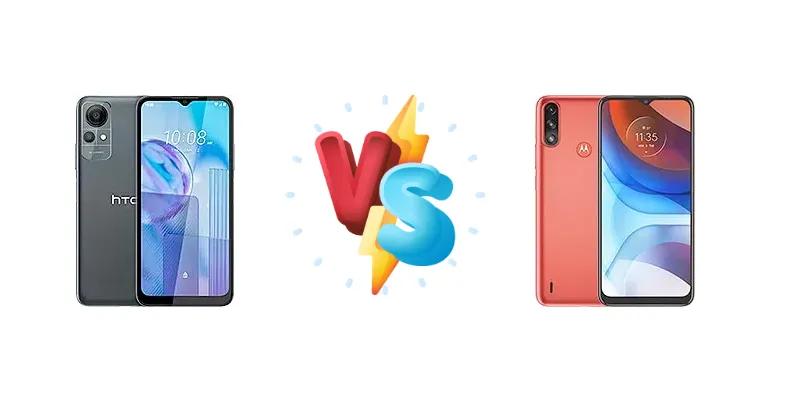
The HTC Wildfire E star and Motorola Moto E7i Power represent the extreme end of the smartphone price spectrum. Both aim to deliver essential smartphone functionality at a minimal cost, but they achieve this with different approaches to processing power and battery optimization. This comparison dissects their key specifications to determine which device offers the best value for users prioritizing affordability.
🏆 Quick Verdict
For the average user seeking a functional, no-frills smartphone, the Motorola Moto E7i Power emerges as the better choice. Its octa-core processor provides a significantly smoother experience for multitasking and app usage compared to the Wildfire E star’s quad-core chipset, despite both utilizing the same 28nm process.
| Network |
|---|
| 2G bands | GSM 850 / 900 / 1800 / 1900 | GSM 850 / 900 / 1800 / 1900 |
| 3G bands | HSDPA 850 / 900 / 2100 | HSDPA 850 / 900 / 1700(AWS) / 1900 / 2100 |
| 4G bands | 1, 3, 5, 7, 8, 20, 38, 40, 41 | LTE |
| Speed | HSPA, LTE | HSPA, LTE |
| Technology | GSM / HSPA / LTE | GSM / HSPA / LTE |
| Launch |
|---|
| Announced | 2023, August 08 | 2021, February 23 |
| Status | Available. Released 2023, August | Available. Released 2021, March 15 |
| Body |
|---|
| Build | Glass front, plastic back, plastic frame | Glass front, plastic back, plastic frame |
| Dimensions | 164.8 x 76.5 x 9.2 mm (6.49 x 3.01 x 0.36 in) | 165.1 x 75.9 x 9.2 mm (6.5 x 2.99 x 0.36 in) |
| SIM | Nano-SIM + Nano-SIM | Nano-SIM + Nano-SIM |
| Weight | 200 g (7.05 oz) | 200 g (7.05 oz) |
| | - | Water-repellent design |
| Display |
|---|
| Resolution | 720 x 1600 pixels, 20:9 ratio (~269 ppi density) | 720 x 1600 pixels, 20:9 ratio (~270 ppi density) |
| Size | 6.52 inches, 102.6 cm2 (~81.4% screen-to-body ratio) | 6.51 inches, 102.3 cm2 (~81.7% screen-to-body ratio) |
| Type | IPS LCD | IPS LCD, 380 nits (typ) |
| Platform |
|---|
| CPU | Quad-core 1.4 GHz | Octa-core (4x1.6 GHz Cortex-A55 & 4x1.2 GHz Cortex-A55) |
| Chipset | Unisoc SC9832E (28 nm) | Unisoc SC9863A (28 nm) |
| GPU | Mali-T820 MP1 | IMG8322 |
| OS | Android 12 (Go edition) | Android 10 (Go edition) |
| Memory |
|---|
| Card slot | microSDXC (uses shared SIM slot) | microSDXC (uses shared SIM slot) |
| Internal | 16GB 2GB RAM | 32GB 2GB RAM |
| | - | eMMC 5.1 |
| Main Camera |
|---|
| Dual | - | 13 MP, f/2.0, 26mm (wide), 1/3.1", 1.12µm, PDAF
2 MP (macro) |
| Features | LED flash | LED flash, HDR, panorama |
| Single | 8 MP, f/2.2, (wide), AF
Auxiliary lens | - |
| Video | 1080p@30fps | 1080p@30fps |
| Selfie camera |
|---|
| Features | - | HDR |
| Single | 5 MP, f/2.2, (wide) | 5 MP, f/2.2, 27mm (wide), 1.12µm |
| Video | 720p@30fps | 1080p@30fps |
| Sound |
|---|
| 3.5mm jack | - | Yes |
| 35mm jack | Yes | Yes |
| Loudspeaker | Yes | Yes |
| Comms |
|---|
| Bluetooth | 4.2, A2DP | 4.2, A2DP |
| NFC | No | No |
| Positioning | GPS, GLONASS, GALILEO | GPS, GLONASS, GALILEO |
| Radio | Unspecified | Unspecified |
| USB | USB Type-C 2.0 | USB Type-C 2.0 |
| WLAN | Wi-Fi 802.11 a/b/g/n | Wi-Fi 802.11 b/g/n |
| Features |
|---|
| Sensors | Fingerprint (side-mounted), accelerometer, proximity | Fingerprint (rear-mounted), accelerometer, proximity |
| Battery |
|---|
| Charging | - | 10W wired |
| Type | Li-Ion 3000 mAh | Li-Ion 5000 mAh |
| Misc |
|---|
| Colors | Gray | Tahiti Blue, Coral Red |
| Models | - | XT2097-13 |
| Price | About 100 EUR | About 120 EUR |
HTC Wildfire E star
- Potentially lower price point
- Simple and straightforward user experience
- Compact form factor (likely)
- Significantly slower processor
- Limited multitasking capabilities
- Likely slower charging speeds
Motorola Moto E7i Power
- Faster octa-core processor for smoother performance
- 10W wired charging for quicker top-ups
- More responsive user interface
- May be slightly more expensive
- Potentially larger size
- Still limited by budget components
Display Comparison
Neither device boasts a standout display. Given the shared target market, both likely utilize LCD panels with modest resolutions (720p is expected). The absence of detailed display specifications necessitates focusing on the impact of processing power on UI smoothness. A faster processor, like the one in the Moto E7i Power, will contribute more to a fluid visual experience than minor display improvements.
Camera Comparison
Both devices likely feature basic camera setups geared towards casual photography. Without specific sensor details, it’s safe to assume both rely on relatively low-resolution sensors. The presence of a 2MP macro camera on either device is largely a marketing tactic, offering limited practical benefit due to the small sensor size and lack of optical image stabilization. Image processing will be a key differentiator, but without sample images, it’s difficult to assess which device performs better.
Performance
The core difference lies in the chipset. The Motorola Moto E7i Power’s Unisoc SC9863A features an octa-core CPU configuration – four cores clocked at 1.6 GHz (Cortex-A55) and four at 1.2 GHz (Cortex-A55). This contrasts sharply with the HTC Wildfire E star’s Unisoc SC9832E, which employs a quad-core CPU clocked at 1.4 GHz. The Cortex-A55 architecture is power-efficient, but the doubling of core count in the Moto E7i Power translates to a substantial performance advantage in multi-threaded tasks and app switching. While both are built on a 28nm process, the architectural advantage of the octa-core setup is significant.
Battery Life
Battery capacity is not specified for either device, but given the budget nature, expect capacities around 3000-4000 mAh. The Motorola Moto E7i Power includes 10W wired charging, a slight advantage over the likely 5W or non-standard charging solution on the HTC Wildfire E star. While 10W isn’t fast by modern standards, it will reduce charging times compared to slower alternatives, benefiting users who need to quickly replenish their battery.
Buying Guide
Buy the HTC Wildfire E star if you absolutely need the lowest possible price and your usage is limited to very basic tasks like calls, texts, and light web browsing. Buy the Motorola Moto E7i Power if you prioritize a more responsive user experience, even with basic apps, and appreciate the benefit of slightly faster charging, making it ideal for users who need to top up quickly between uses.
Frequently Asked Questions
❓ Will the Motorola Moto E7i Power struggle with popular social media apps like Facebook and WhatsApp?
While not a powerhouse, the Moto E7i Power’s octa-core processor should handle Facebook and WhatsApp reasonably well. Expect some loading times and occasional slowdowns with multiple apps open, but it’s significantly better equipped than the quad-core Wildfire E star for these common tasks.
❓ Is the Unisoc SC9863A chipset in the Moto E7i Power known for overheating during prolonged use?
The Unisoc SC9863A is a low-power chipset designed for efficiency, not high performance. Overheating is unlikely during typical usage scenarios like calls, texts, and light browsing. However, extended gaming or demanding tasks could lead to some thermal throttling, reducing performance slightly.
❓ Can either of these phones run multiple apps simultaneously without significant lag?
The Motorola Moto E7i Power is better suited for multitasking due to its octa-core processor. The HTC Wildfire E star will likely struggle with more than two or three apps open simultaneously, resulting in noticeable lag and slowdowns.
❓ What kind of storage options are available on these devices, and can it be expanded?
Storage details are not provided. However, given the price point, expect 32GB of internal storage as a base. Both devices likely support microSD card expansion, allowing users to increase storage capacity for photos, videos, and apps.