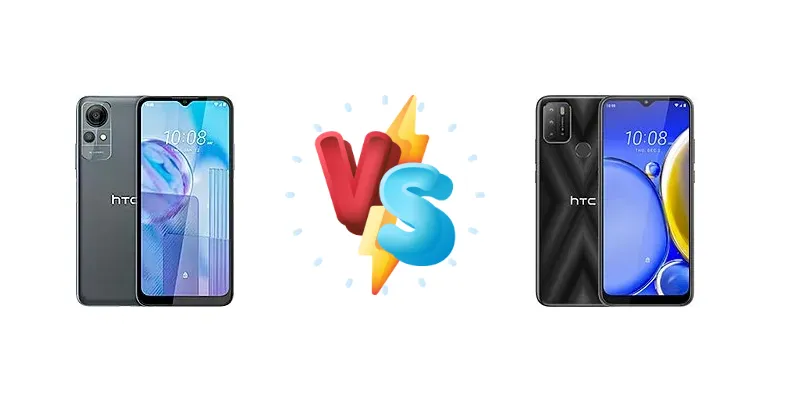
The HTC Wildfire E Star and E2 Plus represent HTC's continued commitment to the entry-level smartphone market. While both devices aim to deliver affordable connectivity, they differ significantly in their internal hardware. This comparison dissects those differences, focusing on how the newer E2 Plus’s chipset impacts real-world performance and user experience compared to the older E Star.
🏆 Quick Verdict
For most users, the HTC Wildfire E2 Plus is the superior choice. Its Unisoc T610 chipset, featuring an octa-core configuration, provides a substantial performance boost over the E Star’s quad-core SC9832E. While both phones target the budget segment, the E2 Plus offers a smoother, more responsive experience for everyday tasks and light multitasking.
| Network |
|---|
| 2G bands | GSM 850 / 900 / 1800 / 1900 | GSM 850 / 900 / 1800 / 1900 |
| 3G bands | HSDPA 850 / 900 / 2100 | HSDPA 850 / 900 / 2100 |
| 4G bands | 1, 3, 5, 7, 8, 20, 38, 40, 41 | 1, 3, 5, 7, 8, 20, 38, 40, 41 |
| Speed | HSPA, LTE | HSPA, LTE |
| Technology | GSM / HSPA / LTE | GSM / HSPA / LTE |
| Launch |
|---|
| Announced | 2023, August 08 | 2021, December 14 |
| Status | Available. Released 2023, August | Available. Released 2021, December 14 |
| Body |
|---|
| Build | Glass front, plastic back, plastic frame | Glass front, plastic back, plastic frame |
| Dimensions | 164.8 x 76.5 x 9.2 mm (6.49 x 3.01 x 0.36 in) | 174.2 x 78.6 x 9.3 mm (6.86 x 3.09 x 0.37 in) |
| SIM | Nano-SIM + Nano-SIM | Nano-SIM + Nano-SIM |
| Weight | 200 g (7.05 oz) | 210 g (7.41 oz) |
| Display |
|---|
| Resolution | 720 x 1600 pixels, 20:9 ratio (~269 ppi density) | 720 x 1640 pixels (~263 ppi density) |
| Size | 6.52 inches, 102.6 cm2 (~81.4% screen-to-body ratio) | 6.82 inches, 110.5 cm2 (~80.7% screen-to-body ratio) |
| Type | IPS LCD | IPS LCD, 450 nits (typ) |
| Platform |
|---|
| CPU | Quad-core 1.4 GHz | Octa-core (2x1.8 GHz Cortex-A75 & 6x1.8 GHz Cortex-A55) |
| Chipset | Unisoc SC9832E (28 nm) | Unisoc T610 (12 nm) |
| GPU | Mali-T820 MP1 | Mali-G52 MP2 |
| OS | Android 12 (Go edition) | Android 11 |
| Memory |
|---|
| Card slot | microSDXC (uses shared SIM slot) | microSDXC (uses shared SIM slot) |
| Internal | 16GB 2GB RAM | 64GB 4GB RAM |
| | - | eMMC 5.1 |
| Main Camera |
|---|
| Features | LED flash | LED flash |
| Quad | - | 13 MP, f/2.2, (wide), PDAF
5 MP, (ultrawide)
2 MP (macro)
Auxiliary lens |
| Single | 8 MP, f/2.2, (wide), AF
Auxiliary lens | - |
| Video | 1080p@30fps | 1080p@30fps |
| Selfie camera |
|---|
| Single | 5 MP, f/2.2, (wide) | 8 MP, f/2.2, (wide) |
| Video | 720p@30fps | 720p |
| Sound |
|---|
| 3.5mm jack | - | Yes |
| 35mm jack | Yes | Yes |
| Loudspeaker | Yes | Yes |
| Comms |
|---|
| Bluetooth | 4.2, A2DP | 5.0, A2DP, LE |
| NFC | No | No |
| Positioning | GPS, GLONASS, GALILEO | GPS, GLONASS, GALILEO, BDS |
| Radio | Unspecified | Unspecified |
| USB | USB Type-C 2.0 | USB Type-C 2.0, OTG |
| WLAN | Wi-Fi 802.11 a/b/g/n | Wi-Fi 802.11 a/b/g/n/ac, dual-band, Wi-Fi Direct |
| Features |
|---|
| Sensors | Fingerprint (side-mounted), accelerometer, proximity | Fingerprint (rear-mounted), accelerometer, proximity, compass |
| Battery |
|---|
| Charging | - | 10W wired |
| Type | Li-Ion 3000 mAh | Li-Po 4600 mAh |
| Misc |
|---|
| Colors | Gray | Black |
| Price | About 100 EUR | About 160 EUR |
HTC Wildfire E star
- Potentially lower price point
- Sufficient for basic phone functions
- Simple and straightforward user experience
- Significantly slower performance
- Less efficient chipset
- Limited multitasking capabilities
HTC Wildfire E2 Plus
- Faster and more responsive performance
- More power-efficient chipset
- 10W wired charging support
- Improved ISP for better image processing
- Likely a higher price than the E Star
- Still a budget device with limitations
Display Comparison
Neither HTC provides detailed display specifications. Given the price point, both likely utilize LCD panels. However, the focus here isn't display quality, but the chipset's ability to drive the display smoothly. The E2 Plus’s more powerful GPU within the T610 will likely result in smoother scrolling and animations, even if the resolution and panel technology are similar.
Camera Comparison
Without detailed camera specs beyond the presence of cameras, it’s difficult to make a definitive statement. However, the T610 in the E2 Plus includes an improved Image Signal Processor (ISP) compared to the SC9832E. This ISP will likely result in better image processing, potentially leading to sharper images, improved dynamic range, and more accurate colors, even if both phones use similar sensor resolutions. The E2 Plus will likely offer a more refined camera experience.
Performance
The core difference lies in the chipsets. The HTC Wildfire E Star’s Unisoc SC9832E is a quad-core processor built on a 28nm process. This older architecture is significantly less efficient and powerful than the Unisoc T610 in the E2 Plus. The T610’s octa-core configuration – utilizing two Cortex-A75 cores for performance and six Cortex-A55 cores for efficiency – built on a more modern 12nm process, offers a substantial leap in processing power. This translates to faster app loading times, smoother multitasking, and a more responsive user interface on the E2 Plus. The E2 Plus will handle more demanding apps and light gaming with greater ease.
Battery Life
Battery capacity isn’t specified for either device. However, the Unisoc T610’s 12nm process is more power-efficient than the SC9832E’s 28nm process. This means the E2 Plus will likely achieve comparable or better battery life despite potentially having a similar battery capacity. Furthermore, the E2 Plus supports 10W wired charging, a feature absent or slower on the E Star, allowing for quicker top-ups when needed.
Buying Guide
Buy the HTC Wildfire E Star if you prioritize extreme affordability and only need a phone for basic communication – calls, texts, and very light web browsing. Its older chipset is sufficient for these minimal tasks. Buy the HTC Wildfire E2 Plus if you want a more capable device for social media, streaming video, and occasional gaming. The T610 chipset delivers a noticeably improved user experience, justifying the likely price difference.
Frequently Asked Questions
❓ Will the HTC Wildfire E2 Plus handle popular social media apps like Facebook and Instagram smoothly?
Yes, the Unisoc T610 chipset in the E2 Plus is significantly more capable of handling the demands of social media apps compared to the SC9832E in the E Star. You should experience smoother scrolling, faster loading times, and fewer instances of lag when using these apps.
❓ Is the performance difference between the E Star and E2 Plus noticeable for everyday tasks like making calls and sending texts?
For basic tasks like calls and texts, the difference might not be immediately apparent. However, the E2 Plus will feel more responsive when switching between apps or opening new ones. The E Star may exhibit slight delays, especially with multiple apps open.
❓ Can the HTC Wildfire E2 Plus run mobile games?
The E2 Plus can run some mobile games, but don't expect high-end performance. Less demanding titles will be playable at lower settings. More graphically intensive games may experience lag or require significant compromises in graphics quality. The E Star will struggle with even moderately demanding games.
❓ Does the HTC Wildfire E2 Plus support fast charging beyond the 10W specification?
No, the HTC Wildfire E2 Plus is officially rated for 10W wired charging. While it might be possible to use a charger with a higher wattage, the phone will likely only draw 10W due to its internal charging circuitry.