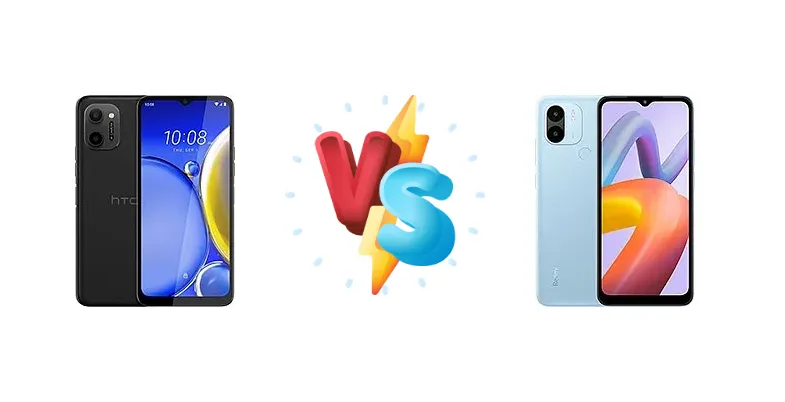
Looking for an affordable smartphone that won't break the bank? The HTC Wildfire E Plus and Xiaomi Redmi A2+ are both contenders in the budget phone arena. But which one offers the best bang for your buck? Let's dive into a detailed comparison to help you decide.
🏆 Quick Verdict
The Xiaomi Redmi A2+ emerges as the clear winner. Its more modern chipset, improved performance, and slightly better battery life outweigh the HTC Wildfire E Plus's strengths. Both are budget options, but the Redmi A2+ provides a more compelling overall experience.
| Network |
|---|
| 2G bands | GSM 850 / 900 / 1800 / 1900 | GSM 850 / 900 / 1800 / 1900 |
| 3G bands | HSDPA 850 / 900 / 2100 | HSDPA 850 / 900 / 2100 |
| 4G bands | LTE | 1, 3, 5, 7, 8, 20, 28, 38, 40, 41 - International |
| Speed | HSPA, LTE | HSPA, LTE |
| Technology | GSM / HSPA / LTE | GSM / HSPA / LTE |
| | - | 1, 3, 5, 8, 40, 41 - India |
| Launch |
|---|
| Announced | 2022, October 24 | 2023, March 24 |
| Status | Available. Released 2022, October 24 | Available. Released 2023, March 24 |
| Body |
|---|
| Build | Glass front, plastic back, plastic frame | - |
| Dimensions | 164.1 x 75.9 x 8.8 mm (6.46 x 2.99 x 0.35 in) | 164.9 x 76.8 x 9.1 mm (6.49 x 3.02 x 0.36 in) |
| SIM | Nano-SIM + Nano-SIM | Nano-SIM + Nano-SIM |
| Weight | 190 g (6.70 oz) | 192 g (6.77 oz) |
| Display |
|---|
| Resolution | 720 x 1600 pixels, 20:9 ratio (~269 ppi density) | 720 x 1600 pixels, 20:9 ratio (~269 ppi density) |
| Size | 6.52 inches, 102.6 cm2 (~82.4% screen-to-body ratio) | 6.52 inches, 102.6 cm2 (~81.0% screen-to-body ratio) |
| Type | IPS LCD | IPS LCD, 400 nits (typ) |
| Platform |
|---|
| CPU | Quad-core 1.5 GHz Cortex-A53 | Octa-core (4x2.2 GHz Cortex-A53 & 4x1.7 GHz Cortex-A53) |
| Chipset | Mediatek MT6739 (28 nm) | Mediatek Helio G36 (12 nm) |
| GPU | PowerVR GE8100 | PowerVR GE8320 |
| OS | Android 12 (Go edition) | Android 12 or 13 (Go edition), MIUI |
| Memory |
|---|
| Card slot | microSDXC (dedicated slot) | microSDXC (dedicated slot) |
| Internal | 32GB 2GB RAM | 32GB 2GB RAM, 32GB 3GB RAM, 64GB 3GB RAM, 64GB 4GB RAM, 128GB 4GB RAM |
| | eMMC 5.1 | eMMC 5.1 |
| Main Camera |
|---|
| Dual | 13 MP, (wide), AF
5 MP | 8 MP, f/2.0, (wide)
0.08 MP (depth) |
| Features | LED flash | Dual-LED flash, HDR |
| Single | - | 8 MP, f/2.0, (wide)
Auxiliary lens |
| Video | 1080p@30fps | 1080p@30fps |
| Selfie camera |
|---|
| Single | 5 MP | 5 MP, f/2.2 |
| Video | Yes | 1080p@30fps |
| Sound |
|---|
| 3.5mm jack | Yes | Yes |
| 35mm jack | Yes | Yes |
| Loudspeaker | Yes | Yes |
| Comms |
|---|
| Bluetooth | 4.2, A2DP | 5.0, A2DP, LE |
| NFC | No | No |
| Positioning | GPS, GLONASS, BDS | GPS, GLONASS, GALILEO, BDS |
| Radio | Unspecified | FM radio |
| USB | USB Type-C 2.0 | microUSB 2.0 |
| WLAN | Wi-Fi 802.11 b/g/n | Wi-Fi 802.11 a/b/g/n |
| Features |
|---|
| Sensors | Accelerometer, compass | Fingerprint (rear-mounted), accelerometer |
| Battery |
|---|
| Charging | - | 10W wired |
| Type | Li-Po 5150 mAh | Li-Po 5000 mAh |
| Misc |
|---|
| Colors | Black | Aqua Blue, Classic Black, Sea Green |
| Models | - | 23028RNCAG, 23028RN4DI, 23028RNCAI, 23028RN4DH |
| Price | About 130 EUR | About 100 EUR |
| SAR | - | 1.10 W/kg (head) 1.01 W/kg (body) |
| SAR EU | - | 0.71 W/kg (head) 1.00 W/kg (body) |
HTC Wildfire E plus
- Potentially smaller form factor
- Brand recognition (though diminishing)
- Outdated chipset
- Lower performance
- Less efficient battery
- Likely limited software updates
Xiaomi Redmi A2+
- More modern chipset (Helio G36)
- Better performance
- Improved battery efficiency
- More frequent software updates (potentially)
- 10W Charging
- Basic display
- Limited camera capabilities
- Plastic build quality
Display Comparison
Both phones feature similar basic LCD displays, likely around 6.5 inches with HD+ resolution. Expect adequate viewing angles and color reproduction for everyday use, but don't expect vibrant or high-resolution visuals. The Redmi A2+ might have slightly better brightness due to its newer panel, but the difference will be minimal.
Camera Comparison
Camera specs are likely similar – both will feature a basic main camera (likely 13MP) and a front-facing camera for selfies. Image quality will be adequate in good lighting conditions, but expect noise and limited detail in low light. The Redmi A2+’s newer processor might offer slightly better image processing capabilities.
Performance
This is where the Redmi A2+ shines. The Mediatek Helio G36, built on a 12nm process, is significantly more efficient and powerful than the HTC Wildfire E Plus's 28nm MT6739. Expect smoother multitasking, faster app loading times, and a generally more responsive user experience on the Redmi A2+. The octa-core CPU in the Redmi A2+ also provides a noticeable performance boost.
Battery Life
The Redmi A2+ likely has a slightly larger battery capacity (potentially 5000mAh) and a more efficient chipset, resulting in better battery life. Expect a full day of moderate use from the Redmi A2+, while the Wildfire E Plus might require more frequent charging.
Buying Guide
The HTC Wildfire E Plus is a decent choice for users prioritizing a very basic smartphone experience and potentially a slightly smaller form factor. The Xiaomi Redmi A2+ is ideal for those seeking a more responsive device with better performance, a more efficient chipset, and a slightly longer battery life, all while remaining budget-friendly.
Frequently Asked Questions
❓ Which phone is better for gaming?
The Xiaomi Redmi A2+ is significantly better for gaming due to its more powerful chipset and improved performance. The HTC Wildfire E Plus will struggle with even basic games.
❓ How much storage do these phones have?
Both phones typically offer 32GB of internal storage, expandable via microSD card. Storage options may vary depending on the region.