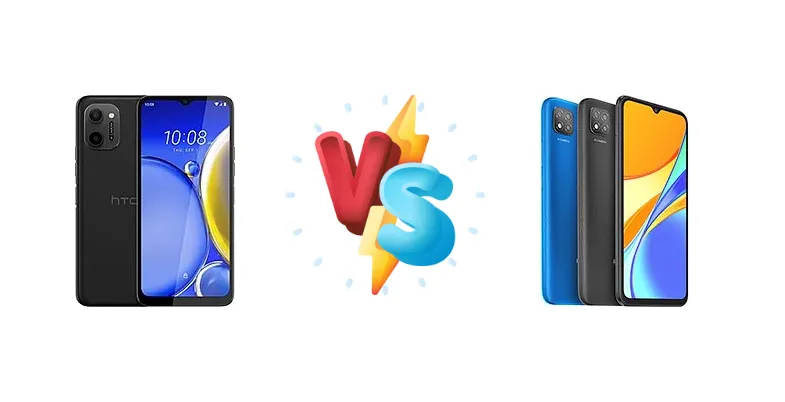
The HTC Wildfire E plus and Xiaomi Redmi 9C NFC represent the lower end of the smartphone market, targeting users prioritizing affordability and essential features. Both devices offer NFC for contactless payments, but diverge significantly in their internal hardware, creating a clear performance gap despite similar price points. This comparison dissects those differences to help you choose the best option for your needs.
🏆 Quick Verdict
For the average user, the Xiaomi Redmi 9C NFC is the superior choice. Its Helio G35 chipset, built on a more efficient 12nm process and featuring an octa-core CPU, delivers noticeably better performance than the HTC Wildfire E plus’s aging Mediatek MT6739. While both phones are entry-level, the Redmi 9C NFC offers a smoother user experience and better multitasking capabilities.
| Network |
|---|
| 2G bands | GSM 850 / 900 / 1800 / 1900 | GSM 850 / 900 / 1800 / 1900 |
| 3G bands | HSDPA 850 / 900 / 2100 | HSDPA 850 / 900 / 1700(AWS) / 1900 / 2100 |
| 4G bands | LTE | 1, 2, 3, 4, 5, 7, 8, 20, 38, 40 |
| Speed | HSPA, LTE | HSPA, LTE |
| Technology | GSM / HSPA / LTE | GSM / HSPA / LTE |
| Launch |
|---|
| Announced | 2022, October 24 | 2020, August 27. Released 2020, August 27 |
| Status | Available. Released 2022, October 24 | Discontinued |
| Body |
|---|
| Build | Glass front, plastic back, plastic frame | - |
| Dimensions | 164.1 x 75.9 x 8.8 mm (6.46 x 2.99 x 0.35 in) | 164.9 x 77.1 x 9 mm (6.49 x 3.04 x 0.35 in) |
| SIM | Nano-SIM + Nano-SIM | Nano-SIM + Nano-SIM |
| Weight | 190 g (6.70 oz) | 196 g (6.91 oz) |
| Display |
|---|
| Resolution | 720 x 1600 pixels, 20:9 ratio (~269 ppi density) | 720 x 1600 pixels, 20:9 ratio (~269 ppi density) |
| Size | 6.52 inches, 102.6 cm2 (~82.4% screen-to-body ratio) | 6.53 inches, 102.9 cm2 (~81.0% screen-to-body ratio) |
| Type | IPS LCD | IPS LCD, 400 nits (typ) |
| Platform |
|---|
| CPU | Quad-core 1.5 GHz Cortex-A53 | Octa-core (4x2.3 GHz Cortex-A53 & 4x1.8 GHz Cortex-A53) |
| Chipset | Mediatek MT6739 (28 nm) | Mediatek MT6765G Helio G35 (12 nm) |
| GPU | PowerVR GE8100 | PowerVR GE8320 |
| OS | Android 12 (Go edition) | Android 10, MIUI 12 |
| Memory |
|---|
| Card slot | microSDXC (dedicated slot) | microSDXC (dedicated slot) |
| Internal | 32GB 2GB RAM | 32GB 2GB RAM, 32GB 3GB RAM, 64GB 2GB RAM, 64GB 3GB RAM, 128GB 3GB RAM, 128GB 4GB RAM |
| | eMMC 5.1 | eMMC 5.1 |
| Main Camera |
|---|
| Dual | 13 MP, (wide), AF
5 MP | 13 MP, f/2.2, 28mm (wide), 1.0µm, PDAF
2 MP (macro) |
| Features | LED flash | LED flash, HDR |
| Video | 1080p@30fps | 1080p@30fps |
| Selfie camera |
|---|
| Features | - | HDR |
| Single | 5 MP | 5 MP, f/2.2, (wide), 1.12µm |
| Video | Yes | 1080p@30fps |
| Sound |
|---|
| 3.5mm jack | Yes | Yes |
| 35mm jack | Yes | Yes |
| Loudspeaker | Yes | Yes |
| Comms |
|---|
| Bluetooth | 4.2, A2DP | 5.0, A2DP, LE |
| NFC | No | Yes |
| Positioning | GPS, GLONASS, BDS | GPS, GLONASS, BDS |
| Radio | Unspecified | FM radio |
| USB | USB Type-C 2.0 | microUSB 2.0, OTG |
| WLAN | Wi-Fi 802.11 b/g/n | Wi-Fi 802.11 b/g/n, Wi-Fi Direct |
| Features |
|---|
| Sensors | Accelerometer, compass | Fingerprint (rear-mounted), accelerometer, proximity |
| Battery |
|---|
| Charging | - | 10W wired |
| Type | Li-Po 5150 mAh | Li-Po 5000 mAh |
| Misc |
|---|
| Colors | Black | Midnight Gray, Sunshine Yellow, Twilight Blue |
| Models | - | M2006C3MNG |
| Price | About 130 EUR | About 100 EUR |
| SAR | - | 0.57 W/kg (head) 0.90 W/kg (body) |
| SAR EU | - | 0.37 W/kg (head) 1.14 W/kg (body) |
HTC Wildfire E plus
- Potentially lower price point (depending on region)
- Compact form factor (likely)
- Basic functionality for essential tasks
- Significantly weaker performance
- Outdated chipset and manufacturing process
- Likely lacks fast charging
Xiaomi Redmi 9C NFC
- Superior performance with Helio G35 chipset
- More efficient 12nm process
- NFC for contactless payments
- 10W wired charging
- Still an entry-level device with limitations
- Display quality likely similar to Wildfire E plus
- Slow charging speed
Display Comparison
Neither device boasts a standout display. Both likely utilize LCD panels, a common trait in this price bracket. However, details regarding resolution and brightness are missing. The Redmi 9C NFC’s advantage lies in its potential for slightly better color reproduction due to the more modern chipset’s image signal processor (ISP), which can influence display calibration. Bezels are expected to be substantial on both devices, reflecting their budget nature.
Camera Comparison
Camera performance is likely similar in real-world usage, given both phones target the budget segment. Details on sensor sizes and apertures are unavailable, but it’s safe to assume both feature basic camera setups. The Redmi 9C NFC’s ISP, tied to the more powerful chipset, may offer slightly better image processing, potentially resulting in more vibrant and detailed photos in good lighting conditions. The presence of NFC on both devices doesn't impact camera performance.
Performance
The performance disparity is the most significant difference. The Xiaomi Redmi 9C NFC’s Mediatek Helio G35, fabricated on a 12nm process, is a substantial upgrade over the HTC Wildfire E plus’s 28nm Mediatek MT6739. The Helio G35’s octa-core configuration (4x2.3 GHz Cortex-A53 & 4x1.8 GHz Cortex-A53) provides a significant boost in multitasking and app loading speeds compared to the Wildfire E plus’s quad-core 1.5 GHz Cortex-A53. The 12nm process also contributes to better thermal efficiency, reducing the likelihood of performance throttling during sustained use. This translates to a smoother experience for everyday tasks and even light gaming on the Redmi 9C NFC.
Battery Life
Battery capacity details are missing for both devices. However, the Redmi 9C NFC includes 10W wired charging, a feature likely absent on the Wildfire E plus. While 10W is slow by modern standards, it provides a charging capability the Wildfire E plus may lack. The more efficient Helio G35 chipset in the Redmi 9C NFC will also contribute to better battery life, even with a similar capacity battery, due to reduced power consumption.
Buying Guide
Buy the HTC Wildfire E plus if you absolutely need a phone with a minimal footprint and are willing to sacrifice performance for a potentially lower price (depending on regional availability). It's suitable for very basic tasks like calls and messaging. Buy the Xiaomi Redmi 9C NFC if you prioritize a more responsive user experience, occasional gaming, and the convenience of NFC for mobile payments. It’s the better all-rounder for most users.
Frequently Asked Questions
❓ Will the Redmi 9C NFC struggle with popular apps like WhatsApp and Facebook?
While the Redmi 9C NFC is an entry-level device, the Helio G35 chipset is capable of running apps like WhatsApp and Facebook smoothly for most users. Expect some loading times for heavier features, but the overall experience should be acceptable for everyday social media use. The Wildfire E plus will likely exhibit more noticeable lag.
❓ Is the NFC on the Redmi 9C NFC compatible with Google Pay?
Yes, the NFC on the Xiaomi Redmi 9C NFC is compatible with Google Pay and other NFC-based mobile payment services, provided those services are available in your region. You can set up your cards within the Google Pay app and use the phone to make contactless payments at compatible terminals.
❓ Can I play games like PUBG Mobile on the Redmi 9C NFC?
You can *attempt* to play PUBG Mobile on the Redmi 9C NFC, but the experience will be limited. You'll likely need to run the game at the lowest graphics settings and frame rate to achieve playable performance. Expect stuttering and lag, especially during intense firefights. The Wildfire E plus is even less suited for gaming.