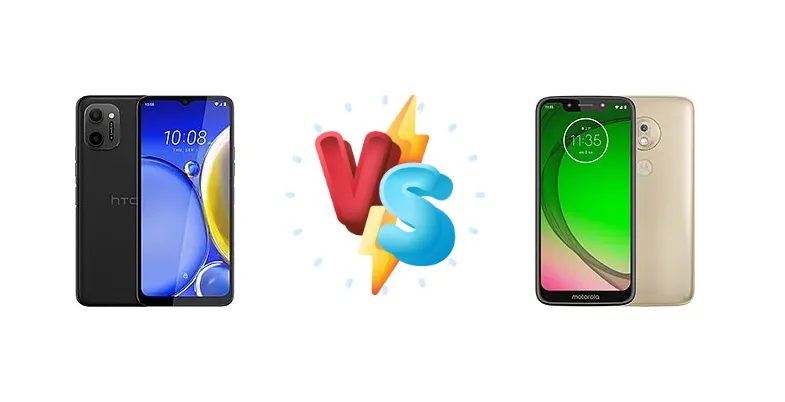
The sub-$150 smartphone market is fiercely competitive. Both the HTC Wildfire E plus and Motorola Moto G7 Play aim to deliver essential smartphone functionality at an accessible price. However, they take different approaches: the Wildfire E plus focuses on a basic, streamlined experience, while the Moto G7 Play attempts to offer a more robust feature set powered by a more modern chipset. This comparison dissects their key differences to determine which device offers the best value.
🏆 Quick Verdict
For the average user prioritizing responsiveness and a smoother overall experience, the Motorola Moto G7 Play is the clear winner. Its Snapdragon 632 chipset, built on a 14nm process, provides significantly better performance than the HTC Wildfire E plus’s Mediatek MT6739. While both boast similar battery endurance, the G7 Play’s superior processing power makes it the more versatile choice.
| Network |
|---|
| 2G bands | GSM 850 / 900 / 1800 / 1900 | GSM 850 / 900 / 1800 / 1900 |
| 3G bands | HSDPA 850 / 900 / 2100 | HSDPA 850 / 900 / 1700(AWS) / 1900 / 2100 |
| 4G bands | LTE | 1, 2, 3, 4, 5, 7, 8, 20, 28, 38, 40, 41 - Europe |
| Speed | HSPA, LTE | HSPA 42.2/5.76 Mbps, LTE (2CA) Cat7 300/50 Mbps |
| Technology | GSM / HSPA / LTE | GSM / HSPA / LTE |
| | - | 1, 2, 3, 4, 5, 7, 8, 12, 13, 14, 17, 20, 25, 26, 29, 30, 38, 39, 40, 41, 41, 66, 71 - USA |
| Launch |
|---|
| Announced | 2022, October 24 | 2019, February. Released 2019, March |
| Status | Available. Released 2022, October 24 | Discontinued |
| Body |
|---|
| Build | Glass front, plastic back, plastic frame | Glass front (Gorilla Glass 3), plastic back, plastic frame |
| Dimensions | 164.1 x 75.9 x 8.8 mm (6.46 x 2.99 x 0.35 in) | 147.3 x 71.5 x 8 mm (5.80 x 2.81 x 0.31 in) |
| SIM | Nano-SIM + Nano-SIM | · Nano-SIM· Nano-SIM + Nano-SIM |
| Weight | 190 g (6.70 oz) | 149 g (5.26 oz) |
| | - | Splash resistant (market dependent) |
| Display |
|---|
| Protection | - | Corning Gorilla Glass 3 (market dependent) |
| Resolution | 720 x 1600 pixels, 20:9 ratio (~269 ppi density) | 720 x 1512 pixels, 19:9 ratio (~294 ppi density) |
| Size | 6.52 inches, 102.6 cm2 (~82.4% screen-to-body ratio) | 5.7 inches, 81.4 cm2 (~77.3% screen-to-body ratio) |
| Type | IPS LCD | IPS LCD |
| Platform |
|---|
| CPU | Quad-core 1.5 GHz Cortex-A53 | Octa-core (4x1.8 GHz Kryo 250 Gold & 4x1.8 GHz Kryo 250 Silver) |
| Chipset | Mediatek MT6739 (28 nm) | Qualcomm SDM632 Snapdragon 632 (14 nm) |
| GPU | PowerVR GE8100 | Adreno 506 |
| OS | Android 12 (Go edition) | Android 9.0 (Pie), upgradable to Android 10 |
| Memory |
|---|
| Card slot | microSDXC (dedicated slot) | microSDXC (dedicated slot) |
| Internal | 32GB 2GB RAM | 32GB 2GB RAM, 32GB 3GB RAM |
| | eMMC 5.1 | eMMC 5.1 |
| Main Camera |
|---|
| Dual | 13 MP, (wide), AF
5 MP | - |
| Features | LED flash | LED flash, panorama, HDR |
| Single | - | 13 MP, f/2.0, 1/3.1", 1.12µm, PDAF |
| Video | 1080p@30fps | 4K@30fps, 1080p@30fps |
| Selfie camera |
|---|
| Features | - | LED flash |
| Single | 5 MP | 8 MP, f/2.2, 1/4.0", 1.12µm |
| Video | Yes | 1080p@30fps |
| Sound |
|---|
| 3.5mm jack | Yes | Yes |
| 35mm jack | Yes | Yes |
| Loudspeaker | Yes | Yes |
| Comms |
|---|
| Bluetooth | 4.2, A2DP | 4.2, A2DP, LE |
| NFC | No | No |
| Positioning | GPS, GLONASS, BDS | GPS, GLONASS |
| Radio | Unspecified | FM radio |
| USB | USB Type-C 2.0 | USB Type-C 2.0, OTG |
| WLAN | Wi-Fi 802.11 b/g/n | Wi-Fi 802.11 b/g/n |
| Features |
|---|
| Sensors | Accelerometer, compass | Fingerprint (rear-mounted), accelerometer, gyro, proximity, compass |
| Battery |
|---|
| Charging | - | 10W wired |
| Type | Li-Po 5150 mAh | Li-Ion 3000 mAh, non-removable |
| Misc |
|---|
| Colors | Black | Deep indigo, Fine Gold, Starry Black |
| Models | - | XT1952-4, XT1952-5 |
| Price | About 130 EUR | About 160 EUR |
| SAR | - | 0.74 W/kg (head) 1.40 W/kg (body) |
| SAR EU | - | 0.84 W/kg (head) 0.85 W/kg (body) |
| Tests |
|---|
| Audio quality | - |
Noise -90.0dB / Crosstalk -92.9dB |
| Battery life | - | Endurance rating 103h |
| Camera | - |
Photo / Video |
| Display | - |
Contrast ratio: 1468:1 (nominal), 3.180 (sunlight) |
| Loudspeaker | - |
Voice 66dB / Noise 74dB / Ring 81dB |
| Performance | - |
AnTuTu: 97230 (v7)
GeekBench: 4154 (v4.4)
GFXBench: 7.7fps (ES 3.1 onscreen) |
HTC Wildfire E plus
- Potentially lower price point
- Simple and streamlined user experience
- Decent battery endurance
- Significantly weaker processor
- Less efficient chipset (28nm)
- Limited multitasking capabilities
Motorola Moto G7 Play
- More powerful Snapdragon 632 processor
- More efficient 14nm chipset
- Smoother multitasking and app performance
- May be slightly more expensive
- Similar battery endurance despite better efficiency (usage dependent)
- Basic camera system
Display Comparison
Both the HTC Wildfire E plus and Motorola Moto G7 Play share a similar contrast ratio of 1468:1 (nominal) and 3180:1 (sunlight), suggesting comparable outdoor visibility. However, detailed display specifications like resolution and panel type are missing for the Wildfire E plus. The G7 Play’s display, while not exceptional, benefits from Motorola’s image tuning, offering acceptable color accuracy for everyday use. Without knowing the Wildfire E plus’s panel technology, it’s difficult to assess its color gamut or viewing angles, but it’s likely to be a more basic LCD panel.
Camera Comparison
Both devices list 'Photo / Video' capabilities, but lack specific details regarding sensor size, aperture, or image processing features. Given the budget nature of both phones, image quality is unlikely to be a standout feature. It’s reasonable to assume the Moto G7 Play, benefiting from the more powerful Snapdragon 632’s image signal processor (ISP), will offer slightly better image processing and potentially faster capture times. However, without detailed specifications, a definitive comparison is impossible. The presence of a 2MP macro lens on either device is likely to yield minimal improvements in image quality.
Performance
The performance gap is the most significant differentiator. The Motorola Moto G7 Play’s Qualcomm Snapdragon 632 (14nm) is an octa-core processor featuring a mix of Kryo 250 Gold and Silver cores, designed for efficient performance. This contrasts sharply with the HTC Wildfire E plus’s Mediatek MT6739 (28nm), a quad-core Cortex-A53 processor. The 14nm fabrication process of the Snapdragon 632 is far more efficient, resulting in better thermal management and sustained performance. The G7 Play will handle multitasking and app switching with considerably less lag, making it a more pleasant daily driver. The MT6739 in the Wildfire E plus is likely to struggle with demanding applications.
Battery Life
Both the HTC Wildfire E plus and Motorola Moto G7 Play achieve an endurance rating of 103 hours, indicating similar battery life under typical usage. However, this doesn’t tell the whole story. The Snapdragon 632’s superior power efficiency means the Moto G7 Play can maintain that endurance even with more demanding tasks. The Wildfire E plus, with its less efficient processor, may require more conservative usage to achieve the same battery life. Both devices support 10W wired charging, suggesting similar charging speeds.
Buying Guide
Buy the HTC Wildfire E plus if you need a supremely basic smartphone for essential tasks like calls, texts, and light app usage, and are comfortable with a potentially slower experience. It’s a good option for first-time smartphone users or those seeking extreme simplicity. Buy the Motorola Moto G7 Play if you prefer a more responsive device capable of handling multitasking, moderate gaming, and a wider range of apps without significant lag. It’s ideal for users who want a reliable and capable budget smartphone.
Frequently Asked Questions
❓ Will the Mediatek MT6739 in the Wildfire E plus struggle with popular apps like Facebook or WhatsApp?
While these apps will likely function, the Mediatek MT6739’s limited processing power may result in noticeable lag, slow loading times, and occasional crashes, especially when multitasking. The Snapdragon 632 in the Moto G7 Play offers a significantly smoother experience with these applications.
❓ Does the Motorola Moto G7 Play support any form of fast charging, or is it limited to 10W?
The Motorola Moto G7 Play is limited to 10W wired charging. While not fast charging by modern standards, it’s sufficient for topping up the battery overnight. The battery efficiency of the Snapdragon 632 means you won’t need to charge it as frequently.
❓ Is the HTC Wildfire E plus a good choice for someone upgrading from a feature phone?
Yes, the Wildfire E plus could be a suitable entry point for someone new to smartphones, provided they have modest expectations. Its simplicity and basic functionality might be appealing, but be aware of the performance limitations.