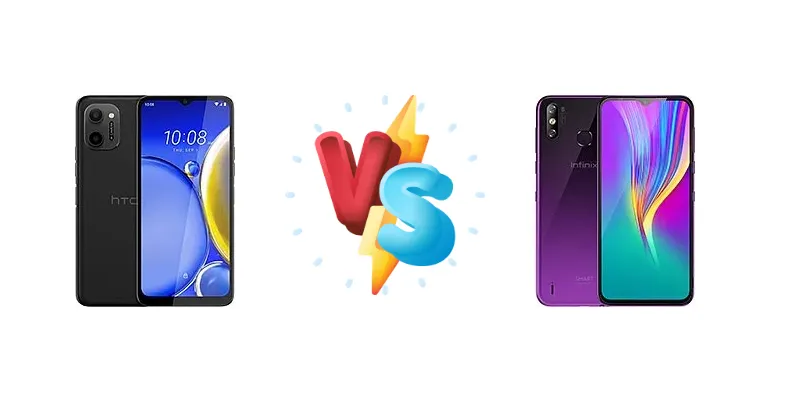
The HTC Wildfire E plus and the Infinix Smart 4c represent the extreme end of the smartphone price spectrum. Both aim to deliver essential smartphone functionality at an incredibly low cost, but they achieve this through different approaches to hardware. This comparison dissects their core components to determine which device offers the best value for users prioritizing either efficiency or raw processing power.
🏆 Quick Verdict
For the average user seeking a responsive, albeit basic, smartphone experience, the Infinix Smart 4c emerges as the better choice. Its newer 12nm Helio A22 chipset provides a noticeable performance uplift over the older 28nm MT6739 in the Wildfire E plus, translating to smoother multitasking and app loading times, despite both utilizing the same Cortex-A53 architecture.
| Network |
|---|
| 2G bands | GSM 850 / 900 / 1800 / 1900 | GSM 850 / 900 / 1800 / 1900 |
| 3G bands | HSDPA 850 / 900 / 2100 | HSDPA 850 / 900 / 2100 |
| 4G bands | LTE | 1, 3, 5, 8, 38, 40, 41 |
| Speed | HSPA, LTE | HSPA 21.1/5.76 Mbps, LTE Cat4 150/50 Mbps |
| Technology | GSM / HSPA / LTE | GSM / HSPA / LTE |
| Launch |
|---|
| Announced | 2022, October 24 | 2019, November. Released 2019, December |
| Status | Available. Released 2022, October 24 | Discontinued |
| Body |
|---|
| Build | Glass front, plastic back, plastic frame | - |
| Dimensions | 164.1 x 75.9 x 8.8 mm (6.46 x 2.99 x 0.35 in) | 167 x 76 x 8.3 mm (6.57 x 2.99 x 0.33 in) |
| SIM | Nano-SIM + Nano-SIM | Nano-SIM + Nano-SIM |
| Weight | 190 g (6.70 oz) | 183 g (6.46 oz) |
| Display |
|---|
| Resolution | 720 x 1600 pixels, 20:9 ratio (~269 ppi density) | 720 x 1600 pixels, 20:9 ratio (~266 ppi density) |
| Size | 6.52 inches, 102.6 cm2 (~82.4% screen-to-body ratio) | 6.6 inches, 105.2 cm2 (~82.9% screen-to-body ratio) |
| Type | IPS LCD | IPS LCD |
| Platform |
|---|
| CPU | Quad-core 1.5 GHz Cortex-A53 | Quad-core 2.0 GHz Cortex-A53 |
| Chipset | Mediatek MT6739 (28 nm) | Mediatek MT6761 Helio A22 (12 nm) |
| GPU | PowerVR GE8100 | PowerVR GE8320 |
| OS | Android 12 (Go edition) | Android 9.0 (Pie) |
| Memory |
|---|
| Card slot | microSDXC (dedicated slot) | microSDXC (dedicated slot) |
| Internal | 32GB 2GB RAM | 32GB 2GB RAM |
| | eMMC 5.1 | eMMC 5.1 |
| Main Camera |
|---|
| Dual | 13 MP, (wide), AF
5 MP | 8 MP
Auxiliary lens |
| Features | LED flash | Dual-LED flash |
| Video | 1080p@30fps | 1080p@30fps |
| Selfie camera |
|---|
| Single | 5 MP | 5 MP |
| Video | Yes | - |
| Sound |
|---|
| 3.5mm jack | Yes | Yes |
| 35mm jack | Yes | Yes |
| Loudspeaker | Yes | Yes |
| Comms |
|---|
| Bluetooth | 4.2, A2DP | 5.0, A2DP, LE |
| NFC | No | No |
| Positioning | GPS, GLONASS, BDS | GPS |
| Radio | Unspecified | FM radio |
| USB | USB Type-C 2.0 | microUSB 2.0 |
| WLAN | Wi-Fi 802.11 b/g/n | Wi-Fi 802.11 a/b/g/n |
| Features |
|---|
| Sensors | Accelerometer, compass | Fingerprint (rear-mounted), accelerometer, proximity, compass |
| Battery |
|---|
| Type | Li-Po 5150 mAh | 4000 mAh, non-removable |
| Misc |
|---|
| Colors | Black | Midnight Black, Quetzal Cyan, Cosmic Purple |
| Models | - | X653C |
| Price | About 130 EUR | - |
HTC Wildfire E plus
- Established Brand Reputation (HTC)
- Potentially slightly longer battery life under *very* light use
- May be more readily available in certain regions
- Older, less efficient chipset (MT6739)
- Slower performance compared to the Smart 4c
- Likely limited software updates
Infinix Smart 4c
- More powerful and efficient chipset (Helio A22)
- Smoother multitasking and app loading
- Better value for money
- Less established brand (Infinix)
- Potentially shorter battery life under heavy use
- Software support may be limited
Display Comparison
Neither device boasts a standout display. Both likely feature basic LCD panels with resolutions around 720p+, typical for this price point. However, the lack of detailed display specifications prevents a definitive comparison of brightness or color accuracy. The focus here is on functionality, not visual fidelity. Bezels are expected to be substantial on both models, maximizing screen real estate within their budget constraints.
Camera Comparison
Camera performance on both devices will be limited. Expect basic 8MP or 5MP main sensors, likely paired with low-resolution depth or macro sensors. Image quality will be acceptable in good lighting conditions, but will suffer significantly in low light. The aperture sizes are likely small, limiting light intake. The Infinix Smart 4c may benefit from slightly more advanced image processing algorithms, but the sensor itself remains the limiting factor. Focusing on the main sensor, the Smart 4c's newer chipset may allow for faster image processing, resulting in quicker shot-to-shot times.
Performance
The core difference lies in the chipsets. The Infinix Smart 4c’s Mediatek Helio A22, fabricated on a 12nm process, is a significant upgrade over the HTC Wildfire E plus’s 28nm Mediatek MT6739. While both CPUs utilize the same quad-core Cortex-A53 architecture, the smaller fabrication node of the Helio A22 translates to improved power efficiency and the ability to clock higher – in this case, 2.0 GHz versus 1.5 GHz. This means the Smart 4c will handle app launches and multitasking with noticeably less lag. The MT6739, while adequate for basic tasks, will struggle with more demanding applications. RAM configurations are likely similar, further emphasizing the chipset as the primary performance differentiator.
Battery Life
Battery capacity is a crucial factor in this segment. While specific mAh ratings are unavailable, the MT6739 in the Wildfire E plus, due to its larger 28nm node, is inherently less power-efficient than the 12nm Helio A22 in the Smart 4c. This means the Wildfire E plus might require more frequent charging despite potentially having a slightly larger battery. The Smart 4c’s more efficient chipset will translate to longer screen-on time and overall battery life, even with similar usage patterns. Charging speeds are likely slow on both devices, relying on micro-USB connectivity.
Buying Guide
Buy the HTC Wildfire E plus if you prioritize a brand with a longer track record and are comfortable with a slightly slower, more power-efficient device. This phone is best suited for users who primarily need a phone for calls, texts, and very light app usage. Buy the Infinix Smart 4c if you prefer a more modern chipset offering better performance for the price, even if it means sacrificing some potential battery longevity. This is the better option for users who occasionally browse social media, stream videos, or play casual games.
Frequently Asked Questions
❓ Will the Infinix Smart 4c struggle with popular apps like WhatsApp and Facebook?
While the Helio A22 isn't a powerhouse, it's sufficient for running essential apps like WhatsApp and Facebook smoothly. You might experience some slowdown with multiple apps open simultaneously, but for typical social media usage, it should be adequate. The MT6739 in the Wildfire E plus will likely exhibit more noticeable lag.
❓ Is the difference in chipset performance noticeable in everyday use?
Yes, the difference between the 28nm MT6739 and the 12nm Helio A22 is quite noticeable. The Smart 4c will feel snappier when opening apps, scrolling through menus, and switching between tasks. The Wildfire E plus will feel comparatively sluggish, especially after prolonged use.
❓ Which phone is better for playing casual games like Candy Crush or Subway Surfers?
The Infinix Smart 4c is the better choice for casual gaming. The Helio A22's higher clock speed and improved efficiency will provide a smoother gaming experience, even if these games aren't graphically demanding. The Wildfire E plus may struggle to maintain a consistent frame rate.
❓ Do either of these phones support fast charging?
Neither the HTC Wildfire E plus nor the Infinix Smart 4c are expected to support fast charging. Both likely rely on standard 5W or 10W charging via micro-USB, meaning a full charge will take several hours.