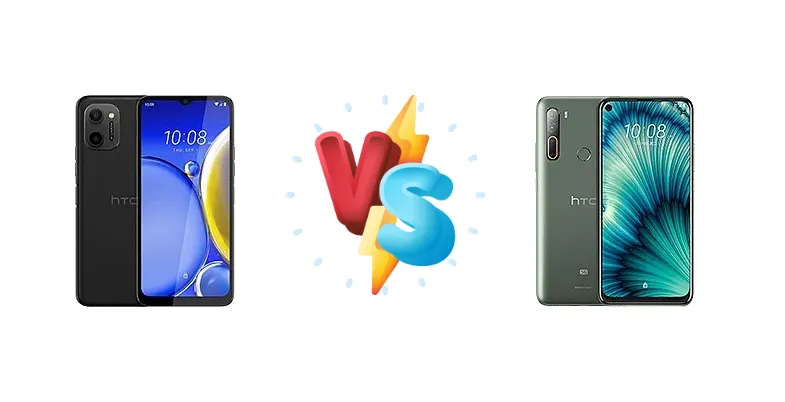
HTC offers a range of phones catering to different budgets and needs. The Wildfire E Plus targets the entry-level market, while the U20 5G brings 5G connectivity and a more premium experience. Let's dive into a head-to-head comparison to see which phone comes out on top.
🏆 Quick Verdict
The HTC U20 5G is the clear winner. Its Snapdragon 765G chipset, 5G connectivity, and superior camera system vastly outperform the Wildfire E Plus. While the Wildfire E Plus is a budget option, the U20 5G offers significantly better performance and features for a reasonable price.
| Network |
|---|
| 2G bands | GSM 850 / 900 / 1800 / 1900 | GSM 850 / 900 / 1800 / 1900 |
| 3G bands | HSDPA 850 / 900 / 2100 | HSDPA 850 / 900 / 1900 / 2100 |
| 4G bands | LTE | 1, 2, 3, 5, 7, 8, 20, 28, 38, 39, 40, 41 |
| 5G bands | - | 1, 3, 28, 41, 78 SA/NSA |
| Speed | HSPA, LTE | HSPA, LTE, 5G 2.56/0.9 Gbps |
| Technology | GSM / HSPA / LTE | GSM / HSPA / LTE / 5G |
| Launch |
|---|
| Announced | 2022, October 24 | 2020, June 16. Released 2020, October 01 |
| Status | Available. Released 2022, October 24 | Discontinued |
| Body |
|---|
| Build | Glass front, plastic back, plastic frame | - |
| Dimensions | 164.1 x 75.9 x 8.8 mm (6.46 x 2.99 x 0.35 in) | 171.2 x 78.1 x 9.4 mm (6.74 x 3.07 x 0.37 in) |
| SIM | Nano-SIM + Nano-SIM | Nano-SIM + Nano-SIM |
| Weight | 190 g (6.70 oz) | 215.5 g (7.62 oz) |
| Display |
|---|
| Protection | - | Asahi Dragontrail Glass |
| Resolution | 720 x 1600 pixels, 20:9 ratio (~269 ppi density) | 1080 x 2400 pixels, 20:9 ratio (~387 ppi density) |
| Size | 6.52 inches, 102.6 cm2 (~82.4% screen-to-body ratio) | 6.8 inches, 111.6 cm2 (~83.5% screen-to-body ratio) |
| Type | IPS LCD | IPS LCD |
| Platform |
|---|
| CPU | Quad-core 1.5 GHz Cortex-A53 | Octa-core (1x2.4 GHz Kryo 475 Prime & 1x2.2 GHz Kryo 475 Gold & 6x1.8 GHz Kryo 475 Silver) |
| Chipset | Mediatek MT6739 (28 nm) | Qualcomm SM7250 Snapdragon 765G 5G (7 nm) |
| GPU | PowerVR GE8100 | Adreno 620 |
| OS | Android 12 (Go edition) | Android 10 |
| Memory |
|---|
| Card slot | microSDXC (dedicated slot) | microSDXC |
| Internal | 32GB 2GB RAM | 256GB 6GB RAM, 256GB 8GB RAM |
| | eMMC 5.1 | - |
| Main Camera |
|---|
| Dual | 13 MP, (wide), AF
5 MP | - |
| Features | LED flash | Dual-LED flash, HDR, panorama |
| Quad | - | 48 MP, f/1.8, 26mm (wide), 1/2.0", 0.8µm, PDAF
8 MP, f/2.2, 118˚ (ultrawide), 1/4.0", 1.12µm
2 MP (macro)
Auxiliary lens |
| Single | - | 8 MP, AF |
| Video | 1080p@30fps | 4K@30fps, 1080p@30fps, gyro-EIS |
| Selfie camera |
|---|
| Features | - | HDR |
| Single | 5 MP | 32 MP, f/2.0, (wide), 1/2.8", 0.8µm |
| Video | Yes | 1080p@30fps |
| Sound |
|---|
| 3.5mm jack | Yes | No |
| 35mm jack | Yes | No |
| Loudspeaker | Yes | Yes |
| Comms |
|---|
| Bluetooth | 4.2, A2DP | 5.0, A2DP, LE |
| NFC | No | Yes |
| Positioning | GPS, GLONASS, BDS | GPS, GLONASS, GALILEO, BDS |
| Radio | Unspecified | No |
| USB | USB Type-C 2.0 | USB Type-C 2.0 |
| WLAN | Wi-Fi 802.11 b/g/n | Wi-Fi 802.11 a/b/g/n/ac, dual-band, Wi-Fi Direct |
| Features |
|---|
| Sensors | Accelerometer, compass | Fingerprint (rear-mounted), accelerometer, gyro, proximity, compass, SAR |
| Battery |
|---|
| Charging | - | 18W wired, QC4 |
| Stand-by | - | Up to 200 h |
| Talk time | - | Up to 8 h 20 min |
| Type | Li-Po 5150 mAh | Li-Po 5000 mAh |
| Misc |
|---|
| Colors | Black | Green, White |
| Price | About 130 EUR | - |
| SAR EU | - | 0.44 W/kg (head) |
HTC Wildfire E plus
- Very affordable
- Decent battery life (likely)
- Lightweight
- Weak performance
- Low-resolution display
- Basic camera
- Outdated chipset
HTC U20 5G
- 5G connectivity
- Powerful Snapdragon 765G chipset
- Excellent camera system
- Large, high-resolution display
- Fast charging (QC4)
- More expensive than Wildfire E Plus
- Potentially larger and heavier
Display Comparison
The HTC Wildfire E Plus likely features a smaller, lower-resolution display (likely around 6.5 inches, HD+). The HTC U20 5G boasts a larger 6.43-inch Full HD+ display, offering better image quality and a more immersive viewing experience. The U20 5G's display likely has better color accuracy and brightness.
Camera Comparison
The U20 5G's camera system is a major upgrade. While the Wildfire E Plus likely has a basic single or dual-camera setup, the U20 5G features a more versatile triple-camera system with a main sensor, ultrawide lens, and depth sensor. Expect better image quality, more features, and improved low-light performance on the U20 5G.
Performance
This is where the U20 5G shines. The Snapdragon 765G is a significantly more powerful chipset than the Mediatek MT6739. Expect smoother multitasking, faster app loading times, and better gaming performance on the U20 5G. The Wildfire E Plus will struggle with demanding apps and games.
Battery Life
Both phones likely have batteries in the 4000-4500 mAh range. However, the U20 5G's more efficient chipset and 18W fast charging (QC4) give it an edge in battery life and charging speed compared to the Wildfire E Plus, which likely has slower charging.
Buying Guide
The HTC Wildfire E Plus is ideal for users on a very tight budget who primarily need a basic smartphone for calls, texts, and light social media use. The HTC U20 5G is a better choice for those who want 5G connectivity, a faster processor, a better camera, and a more modern smartphone experience.
Frequently Asked Questions
❓ Is the HTC Wildfire E Plus worth buying in 2024?
Only if you're on an extremely tight budget and only need basic smartphone functionality. Otherwise, there are better options available.
❓ Does the HTC U20 5G support 5G on all carriers?
5G support depends on your carrier and region. Check with your carrier to ensure compatibility.