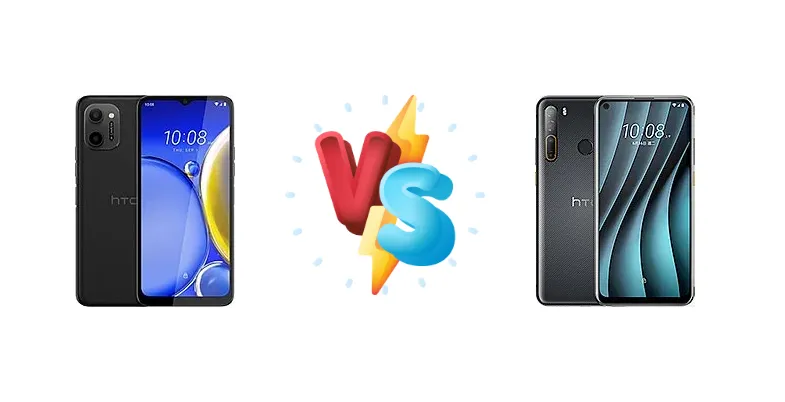
Looking for an affordable HTC smartphone? The Wildfire E Plus and Desire 20 Pro offer compelling options, but cater to different needs. This comparison dives deep into their specs and features to help you decide which one is right for you.
🏆 Quick Verdict
The HTC Desire 20 Pro is the clear winner. Its Snapdragon 665 chipset, faster processor, and improved camera capabilities offer a significantly better user experience than the Wildfire E Plus, despite a slightly higher price point. It's a worthwhile upgrade.
| Network |
|---|
| 2G bands | GSM 850 / 900 / 1800 / 1900 | GSM 850 / 900 / 1800 / 1900 |
| 3G bands | HSDPA 850 / 900 / 2100 | HSDPA 850 / 900 / 1900 / 2100 |
| 4G bands | LTE | 1, 2, 3, 5, 7, 8, 20, 28, 38, 39, 40, 41 |
| EDGE | - | No |
| GPRS | - | No |
| Speed | HSPA, LTE | HSPA 42.2/5.76 Mbps, LTE (2CA) Cat13 400/150 Mbps |
| Technology | GSM / HSPA / LTE | GSM / HSPA / LTE |
| Launch |
|---|
| Announced | 2022, October 24 | 2020, June 16. Released 2020, July 18 |
| Status | Available. Released 2022, October 24 | Discontinued |
| Body |
|---|
| Build | Glass front, plastic back, plastic frame | - |
| Dimensions | 164.1 x 75.9 x 8.8 mm (6.46 x 2.99 x 0.35 in) | 162 x 77 x 9.4 mm (6.38 x 3.03 x 0.37 in) |
| SIM | Nano-SIM + Nano-SIM | Nano-SIM + Nano-SIM |
| Weight | 190 g (6.70 oz) | 201 g (7.09 oz) |
| Display |
|---|
| Resolution | 720 x 1600 pixels, 20:9 ratio (~269 ppi density) | 1080 x 2340 pixels, 19.5:9 ratio (~396 ppi density) |
| Size | 6.52 inches, 102.6 cm2 (~82.4% screen-to-body ratio) | 6.5 inches, 103.7 cm2 (~83.1% screen-to-body ratio) |
| Type | IPS LCD | IPS LCD |
| Platform |
|---|
| CPU | Quad-core 1.5 GHz Cortex-A53 | Octa-core (4x2.0 GHz Kryo 260 Gold & 4x1.8 GHz Kryo 260 Silver) |
| Chipset | Mediatek MT6739 (28 nm) | Qualcomm SM6125 Snapdragon 665 (11 nm) |
| GPU | PowerVR GE8100 | Adreno 610 |
| OS | Android 12 (Go edition) | Android 10 |
| Memory |
|---|
| Call records | - | 20 dialed, 20 received, 20 missed calls |
| Card slot | microSDXC (dedicated slot) | microSDXC |
| Internal | 32GB 2GB RAM | 128GB 6GB RAM |
| Phonebook | - | 1000 entries |
| | eMMC 5.1 | - |
| Main Camera |
|---|
| Dual | 13 MP, (wide), AF
5 MP | - |
| Features | LED flash | Dual-LED flash, HDR, panorama |
| Quad | - | 48 MP, f/1.8, 26mm (wide), 1/2.0", 0.8µm, PDAF
8 MP, f/2.2, 118˚ (ultrawide), 1/4.0", 1.12µm
2 MP (macro)
Auxiliary lens |
| Video | 1080p@30fps | 4K@30fps, 1080p@30fps |
| Selfie camera |
|---|
| Features | - | HDR |
| Single | 5 MP | 25 MP, f/2.0, (wide) |
| Video | Yes | 1080p@30fps |
| Sound |
|---|
| 3.5mm jack | Yes | Yes |
| 35mm jack | Yes | Yes |
| Loudspeaker | Yes | Yes |
| Comms |
|---|
| Bluetooth | 4.2, A2DP | 5.0, A2DP, LE |
| NFC | No | Yes |
| Positioning | GPS, GLONASS, BDS | GPS, GLONASS, GALILEO, BDS |
| Radio | Unspecified | FM radio |
| USB | USB Type-C 2.0 | USB Type-C 2.0, OTG |
| WLAN | Wi-Fi 802.11 b/g/n | Wi-Fi 802.11 a/b/g/n/ac, dual-band, Wi-Fi Direct |
| Features |
|---|
| Games | - | Yes |
| Java | - | Yes |
| Messaging | - | SMS |
| Sensors | Accelerometer, compass | Fingerprint (rear-mounted), accelerometer, gyro, proximity, compass |
| Battery |
|---|
| Charging | - | 15W wired, QC3 |
| Stand-by | - | Up to 570 h |
| Talk time | - | Up to 8 h 40 min |
| Type | Li-Po 5150 mAh | Li-Po 5000 mAh |
| Misc |
|---|
| Colors | Black | Smoky Black, Pretty Blue, Crystal Green |
| Price | About 130 EUR | About 660 EUR |
| SAR EU | - | 0.56 W/kg (head) |
HTC Wildfire E plus
- Very affordable
- Long battery life (potentially)
- Lightweight design
- Outdated chipset
- Low performance
- Basic camera
- Lower resolution display
HTC Desire 20 Pro
- Faster performance
- Better camera
- Full HD+ display
- Fast charging (QC3)
- More modern design
- Slightly more expensive
- Battery life may be slightly shorter than Wildfire E Plus
Display Comparison
The Wildfire E Plus likely features a basic HD+ display, while the Desire 20 Pro boasts a larger, higher-resolution Full HD+ display. Expect better color accuracy and sharpness on the Desire 20 Pro, leading to a more enjoyable viewing experience. The Desire 20 Pro also likely has a higher screen-to-body ratio.
Camera Comparison
The Desire 20 Pro's Snapdragon 665 typically pairs with a more advanced camera system, likely including a higher resolution main sensor and potentially an ultrawide lens. Expect better image quality, dynamic range, and low-light performance compared to the Wildfire E Plus's likely simpler camera setup. The Desire 20 Pro also likely offers better video recording capabilities.
Performance
This is where the Desire 20 Pro shines. The Snapdragon 665 is significantly more powerful than the Mediatek MT6739. Expect smoother multitasking, faster app loading times, and better gaming performance on the Desire 20 Pro. The Wildfire E Plus will struggle with demanding apps and games.
Battery Life
Both phones likely offer decent battery life, but the Wildfire E Plus's older, less power-hungry chipset might give it a slight edge in overall endurance. However, the Desire 20 Pro's 15W fast charging (QC3) provides a significant advantage in charging speed.
Buying Guide
The HTC Wildfire E Plus is best suited for users on a very tight budget who prioritize basic functionality and long battery life. The HTC Desire 20 Pro is ideal for those seeking a smoother performance, better camera, and faster charging without breaking the bank.
Frequently Asked Questions
❓ Is the HTC Desire 20 Pro worth the extra cost?
Yes, the Desire 20 Pro offers a significantly better overall experience due to its superior performance, camera, and display. The extra cost is justified for most users.
❓ Can the Wildfire E Plus handle basic tasks like calling and texting?
Yes, the Wildfire E Plus is perfectly capable of handling basic tasks. However, it may struggle with more demanding apps or multitasking.