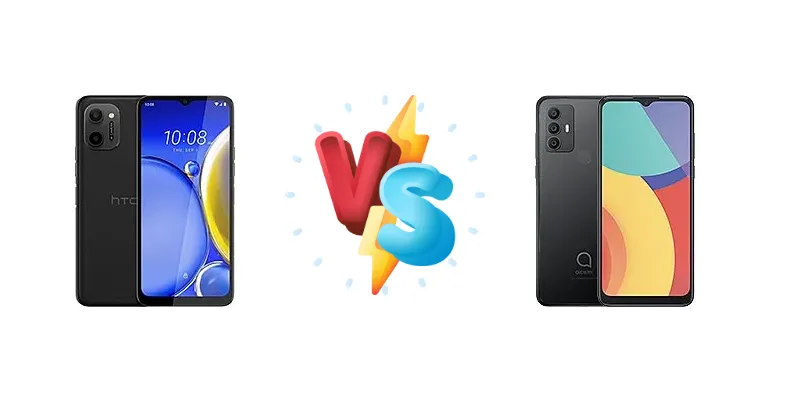
The HTC Wildfire E plus and Alcatel 1V (2021) represent the extreme end of the smartphone price spectrum. Both devices target first-time smartphone buyers or those needing a reliable secondary device. This comparison dissects their core components to determine which offers the best value for users prioritizing basic functionality and affordability.
🏆 Quick Verdict
For the average user seeking a functional, ultra-budget smartphone, the Alcatel 1V (2021) emerges as the slightly better choice. Its newer Mediatek Helio A22 chipset, fabricated on a 12nm process, provides a noticeable performance boost over the HTC Wildfire E plus’s older 28nm MT6739, despite both utilizing Cortex-A53 cores.
| Network |
|---|
| 2G bands | GSM 850 / 900 / 1800 / 1900 | GSM 850 / 900 / 1800 / 1900 |
| 3G bands | HSDPA 850 / 900 / 2100 | HSDPA 850 / 900 / 1700(AWS) / 1900 / 2100 - 6002A |
| 4G bands | LTE | 2, 3, 4, 5, 7, 8, 12, 13, 17, 26, 28, 66 - 6002A |
| Speed | HSPA, LTE | HSPA 42.2/11.5 Mbps, LTE Cat4 150/50 Mbps |
| Technology | GSM / HSPA / LTE | GSM / HSPA / LTE |
| | - | 1, 3, 5, 7, 8, 20, 28, 38, 40, 41 - 6002D |
| Launch |
|---|
| Announced | 2022, October 24 | 2021, February |
| Status | Available. Released 2022, October 24 | Available. Released 2021, April |
| Body |
|---|
| Build | Glass front, plastic back, plastic frame | Glass front, plastic back, plastic frame |
| Dimensions | 164.1 x 75.9 x 8.8 mm (6.46 x 2.99 x 0.35 in) | 165.2 x 75.5 x 8.9 mm (6.50 x 2.97 x 0.35 in) |
| SIM | Nano-SIM + Nano-SIM | · Nano-SIM· Nano-SIM + Nano-SIM |
| Weight | 190 g (6.70 oz) | 190 g (6.70 oz) |
| Display |
|---|
| Resolution | 720 x 1600 pixels, 20:9 ratio (~269 ppi density) | 720 x 1600 pixels, 20:9 ratio (~269 ppi density) |
| Size | 6.52 inches, 102.6 cm2 (~82.4% screen-to-body ratio) | 6.52 inches, 102.6 cm2 (~82.3% screen-to-body ratio) |
| Type | IPS LCD | IPS LCD |
| Platform |
|---|
| CPU | Quad-core 1.5 GHz Cortex-A53 | Quad-core 2.0 GHz Cortex-A53 |
| Chipset | Mediatek MT6739 (28 nm) | Mediatek MT6761 Helio A22 (12 nm) |
| GPU | PowerVR GE8100 | PowerVR GE8320 |
| OS | Android 12 (Go edition) | Android 11 (Go edition) |
| Memory |
|---|
| Card slot | microSDXC (dedicated slot) | microSDXC (dedicated slot) |
| Internal | 32GB 2GB RAM | 32GB 2GB RAM, 64GB 2GB RAM |
| | eMMC 5.1 | eMMC 5.1 |
| Main Camera |
|---|
| Dual | 13 MP, (wide), AF
5 MP | 13 MP, f/2.2, (wide), 1/3.0", 1.12µm, AF
2 MP (macro)
Auxiliary lens |
| Features | LED flash | LED flash, HDR, panorama |
| Single | - | 5 MP, f/2.2, (wide), 1/5", 1.12µm |
| Video | 1080p@30fps | 1080p@30fps |
| Selfie camera |
|---|
| Features | - | HDR |
| Single | 5 MP | 5 MP, f/2.2, (wide), 1/5.0", 1.12µm |
| Video | Yes | 1080p@30fps |
| Sound |
|---|
| 3.5mm jack | Yes | Yes |
| 35mm jack | Yes | Yes |
| Loudspeaker | Yes | Yes |
| Comms |
|---|
| Bluetooth | 4.2, A2DP | 5.0, A2DP, LE |
| NFC | No | No |
| Positioning | GPS, GLONASS, BDS | GPS, GLONASS, GALILEO, BDS |
| Radio | Unspecified | FM radio (market/operator dependent) |
| USB | USB Type-C 2.0 | USB Type-C 2.0 |
| WLAN | Wi-Fi 802.11 b/g/n | Wi-Fi 802.11 b/g/n, Wi-Fi Direct |
| Features |
|---|
| Sensors | Accelerometer, compass | Fingerprint (rear-mounted), accelerometer, proximity, compass |
| Battery |
|---|
| Charging | - | 10W wired |
| Type | Li-Po 5150 mAh | Li-Ion 5000 mAh |
| Misc |
|---|
| Colors | Black | Space Gray, Atlantic Blue |
| Models | - | 6002A, 6002D |
| Price | About 130 EUR | About 100 EUR |
HTC Wildfire E plus
- Established Brand (HTC)
- Potentially more durable build quality (based on brand reputation)
- Simple Android experience
- Older, less efficient chipset (MT6739)
- Slower performance compared to Alcatel 1V
- Charging specifications unknown
alcatel 1V (2021)
- More modern chipset (Helio A22)
- Improved power efficiency
- 10W wired charging support
- Less established brand (Alcatel)
- Potentially lower build quality
- Basic camera performance
Display Comparison
Neither HTC nor Alcatel provide detailed display specifications for these models. Given their price points, it’s safe to assume both utilize LCD panels with resolutions around 720p+. The absence of information regarding brightness levels or color accuracy suggests neither device will excel in outdoor visibility or color reproduction. Bezels are likely to be substantial on both, maximizing screen real estate within a compact form factor.
Camera Comparison
Camera performance on both devices is expected to be basic. Detailed sensor information is unavailable, but given the target market, both likely feature a primary camera around 8-13MP. The Alcatel 1V may have a slight edge due to potentially newer image processing algorithms within the Helio A22 chipset. Expect limited low-light performance and average image quality. Any secondary cameras (depth or macro) are likely to be of very low resolution and offer minimal practical benefit.
Performance
The core difference lies in the chipsets. The Alcatel 1V (2021) features the Mediatek MT6761 Helio A22, built on a more efficient 12nm process, and clocked at 2.0 GHz. This contrasts with the HTC Wildfire E plus’s older Mediatek MT6739, fabricated on a less efficient 28nm process and clocked at 1.5 GHz. While both CPUs utilize the same quad-core Cortex-A53 architecture, the 12nm process and higher clock speed of the Helio A22 translate to better performance and improved power efficiency. This means the Alcatel 1V will likely handle everyday tasks – browsing, social media, messaging – with less lag and potentially longer battery life. The GPU within the Helio A22 will also offer a modest gaming improvement.
Battery Life
Battery capacity is not specified for either device. However, given their similar form factors and target markets, they likely house batteries in the 3000-4000 mAh range. The Alcatel 1V (2021) supports 10W wired charging, a feature absent from publicly available information regarding the Wildfire E plus. The more efficient Helio A22 chipset in the Alcatel 1V will contribute to longer battery life, and the 10W charging will allow for quicker top-ups compared to potentially slower charging on the HTC.
Buying Guide
Buy the HTC Wildfire E plus if you prioritize brand recognition within the Android ecosystem and are comfortable with potentially slower performance in demanding applications. Buy the Alcatel 1V (2021) if you prefer a more modern chipset offering improved efficiency and a slightly snappier user experience, and if 10W charging is sufficient for your needs. Both are suitable for basic communication and light app usage.
Frequently Asked Questions
❓ Will the Alcatel 1V (2021) be able to run popular social media apps like Facebook and Instagram smoothly?
Yes, the Mediatek Helio A22 chipset in the Alcatel 1V (2021) is capable of running popular social media apps like Facebook and Instagram without significant lag. While it won't offer a high-end experience, it provides a usable experience for basic social media browsing and interaction.
❓ Is the 10W charging on the Alcatel 1V (2021) significantly faster than what the HTC Wildfire E plus might offer?
Yes, the Alcatel 1V's 10W charging is likely to be considerably faster than the HTC Wildfire E plus, as charging specifications for the Wildfire E plus are unavailable and it likely uses a slower charging method. 10W will allow for a more reasonable recharge time, especially considering the likely battery capacity of both devices.
❓ Can either of these phones handle basic mobile gaming?
Both phones can handle very basic mobile gaming, but don't expect a smooth experience with graphically demanding titles. The Alcatel 1V (2021) will offer slightly better performance due to its more capable GPU, allowing for playable frame rates in less intensive games.