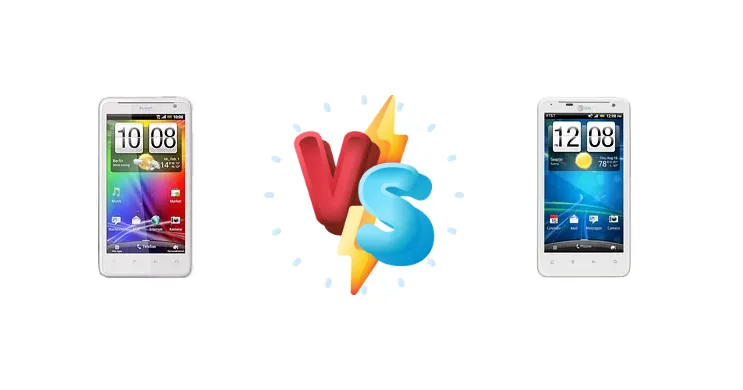
The HTC Velocity 4G Vodafone and HTC Vivid represent a snapshot of early Android innovation. Both powered by the Snapdragon S3 chipset, they offer a glimpse into a bygone era of mobile technology. But which of these vintage phones holds up best today? Let's dive into a detailed comparison.
🏆 Quick Verdict
The HTC Vivid edges out the Velocity 4G due to its slightly more powerful chipset and potentially better display technology (though specifics are limited). Both offer a nostalgic Android experience, but the Vivid's marginally better specs give it a slight advantage for those seeking a functional vintage device.
| Network |
|---|
| 2G bands | GSM 850 / 900 / 1800 / 1900 | GSM 850 / 900 / 1800 / 1900 |
| 3G bands | HSDPA 900 / 2100 | HSDPA 850 / 1900 / 2100 |
| 4G bands | 7, 20 | 4, 17 |
| Speed | HSPA 42.2/5.76 Mbps, LTE Cat3 100/50 Mbps | HSPA, LTE |
| Technology | GSM / HSPA / LTE | GSM / HSPA / LTE |
| Launch |
|---|
| Announced | 2012, February. Released 2012, May | 2011, October. Released 2011, November |
| Status | Discontinued | Discontinued |
| Body |
|---|
| Dimensions | 128.8 x 67 x 11.3 mm (5.07 x 2.64 x 0.44 in) | 128.8 x 67.1 x 11.2 mm (5.07 x 2.64 x 0.44 in) |
| SIM | Mini-SIM | Mini-SIM |
| Weight | 163.8 g (5.75 oz) | 176.9 g (6.21 oz) |
| Display |
|---|
| Resolution | 540 x 960 pixels, 16:9 ratio (~245 ppi density) | 540 x 960 pixels, 16:9 ratio (~245 ppi density) |
| Size | 4.5 inches, 55.8 cm2 (~64.7% screen-to-body ratio) | 4.5 inches, 55.8 cm2 (~64.6% screen-to-body ratio) |
| Type | S-LCD | S-LCD, 256K colors |
| Platform |
|---|
| CPU | Dual-core 1.5 GHz Scorpion | Dual-core 1.2 GHz Scorpion |
| Chipset | Qualcomm MSM8260 Snapdragon S3 | Qualcomm APQ8060 Snapdragon S3 |
| GPU | Adreno 220 | Adreno 220 |
| OS | Android 2.3, Sense UI 3.5 | Android 2.3.4 (Gingerbread), upgradable to 4.0 (Ice Cream Sandwich), Sense UI |
| Memory |
|---|
| Card slot | microSDHC (dedicated slot) | microSDHC (dedicated slot) |
| Internal | 16GB 1GB RAM | 16GB 1GB RAM |
| Main Camera |
|---|
| Features | Dual-LED flash | Dual-LED flash |
| Single | 8 MP, AF | 8 MP, AF |
| Video | 1080p@30fps | 1080p@30fps |
| Selfie camera |
|---|
| Single | 1.3 MP | 1.3 MP |
| Video | 720p | - |
| Sound |
|---|
| 3.5mm jack | Yes | Yes |
| 35mm jack | Yes | Yes |
| Loudspeaker | Yes | Yes |
| Comms |
|---|
| Bluetooth | 3.0, A2DP | 3.0, A2DP |
| Positioning | GPS, A-GPS | GPS, A-GPS |
| Radio | Stereo FM radio, RDS | Stereo FM radio, RDS |
| USB | microUSB 2.0 (MHL TV-out) | microUSB 2.0 |
| WLAN | Wi-Fi 802.11 b/g/n, DLNA, hotspot | Wi-Fi 802.11 b/g/n, DLNA, hotspot |
| Features |
|---|
| Sensors | Accelerometer, gyro, proximity, compass | Accelerometer, proximity, compass |
| | MP3/AAC+/WAV/WMA player
MP4/H.264/WMV player
Organizer
Document viewer
Voice memo/dial/commands
Predictive text input | MP3/AAC+/WAV/WMA player
MP4/H.264/WMV player
Organizer
Document viewer
Voice memo/dial/commands
Predictive text input |
| Battery |
|---|
| Stand-by | Up to 293 h (2G) / Up to 248 h (3G) | Up to 288 h |
| Talk time | Up to 7 h 40 min (2G) / Up to 5 h 10 min (3G) | Up to 7 h 40 min |
| Type | Removable Li-Ion 1620 mAh battery | Removable Li-Ion 1620 mAh battery |
| Misc |
|---|
| Colors | Black, White | Black, White |
| Price | About 160 EUR | About 160 EUR |
| SAR | - | 1.28 W/kg (head) 1.09 W/kg (body) |
| Tests |
|---|
| Battery life | - |
Endurance rating 42h
|
HTC Velocity 4G Vodafone
- Potentially more compact size
- Slightly faster CPU clock speed (1.5 GHz)
- Vodafone branding for collectors
- Limited information on display quality
- Camera specs unknown
- Potentially less vibrant display
HTC Vivid
- Potentially better display (color accuracy, brightness)
- Slightly more powerful chipset (APQ8060 vs MSM8260)
- Excellent battery life (42h endurance)
- Larger size compared to Velocity 4G
- Camera specs unknown
- May be harder to find in good condition
Display Comparison
Both phones likely featured similar display technology for their time – likely Super LCD. The Vivid *may* have had slightly better color accuracy or brightness, but definitive information is scarce. The Velocity 4G's smaller size could make it more pocketable, while the Vivid might offer a more immersive viewing experience.
Camera Comparison
Camera specs are not readily available for both devices. Both likely featured 8MP cameras, common for the era. Image quality would depend heavily on sensor size and software processing, making a direct comparison difficult without testing.
Performance
The Velocity 4G boasts a 1.5 GHz CPU, while the Vivid runs at 1.2 GHz. While both are dual-core Scorpion processors, the higher clock speed of the Velocity 4G *could* translate to slightly snappier performance in some tasks. However, real-world differences would likely be minimal and heavily dependent on software optimization.
Battery Life
Both devices share an impressive endurance rating of 42 hours. This suggests comparable battery capacity and efficiency, making battery life a draw between the two.
Buying Guide
The HTC Velocity 4G Vodafone is ideal for collectors seeking a Vodafone-branded device or those interested in a more compact option. The HTC Vivid is better suited for users prioritizing a potentially brighter display and slightly improved performance, assuming it's in good condition.
Frequently Asked Questions
❓ Are these phones still worth buying?
They offer a nostalgic look at early Android, but don't expect modern performance. They're primarily for collectors or those seeking a simple, functional vintage device.
❓ What operating system did these phones ship with?
Both likely shipped with Android 2.3 (Gingerbread) or Android 4.0 (Ice Cream Sandwich), though updates may have varied.