
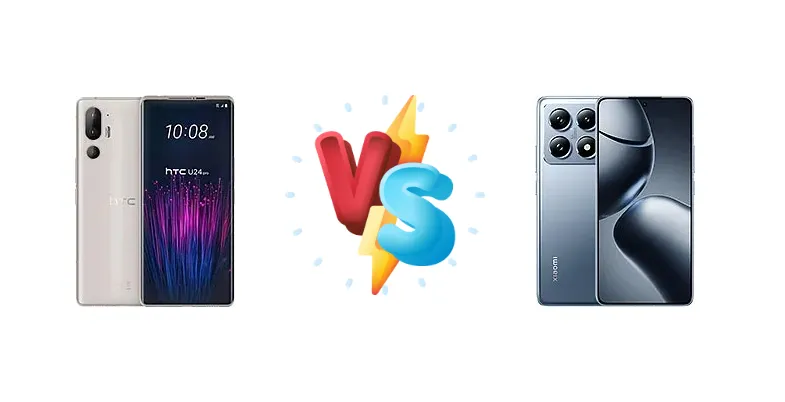
HTC U24 Pro vs Xiaomi 14T Pro: Which Mid-Range Champion Reigns Supreme?
| Phones Images | |||||
|---|---|---|---|---|---|
|
🏆 Quick Verdict
For most users, the Xiaomi 14T Pro emerges as the stronger contender. Its significantly faster 120W charging, coupled with the superior processing power of the Dimensity 9300+, provides a more compelling overall experience, despite the HTC U24 Pro’s respectable feature set.
| PHONES | ||
|---|---|---|
| Phone Names | HTC U24 Pro | Xiaomi 14T Pro |
| Network | ||
|---|---|---|
| 2G bands | GSM 850 / 900 / 1800 / 1900 | GSM 850 / 900 / 1800 / 1900 |
| 3G bands | HSDPA 800 / 850 / 900 / 1700(AWS) / 1900 / 2100 | HSDPA 800 / 850 / 900 / 1700(AWS) / 1900 / 2100 |
| 4G bands | 1, 2, 3, 4, 5, 7, 8, 12, 17, 18, 19, 20, 28, 38, 39, 40, 41 | 1, 2, 3, 4, 5, 7, 8, 12, 13, 17, 18, 19, 20, 25, 26, 28, 32, 38, 39, 40, 41, 42, 48, 66 |
| 5G bands | 1, 3, 5, 7, 8, 20, 28, 38, 40, 41, 77, 78 SA/NSA | 1, 2, 3, 5, 7, 8, 12, 20, 25, 26, 28, 38, 40, 41, 48, 66, 75, 77, 78 SA/NSA |
| Speed | HSPA, LTE, 5G | HSPA, LTE, 5G |
| Technology | GSM / HSPA / LTE / 5G | GSM / HSPA / LTE / 5G |
| Launch | ||
|---|---|---|
| Announced | 2024, June 12 | 2024, September 26 |
| Status | Available. Released 2024, July 01 | Available. Released 2024, September 26 |
| Body | ||
|---|---|---|
| Build | Glass front (Gorilla Glass), aluminum frame, plastic back | Glass front (Gorilla Glass 5), aluminum frame, glass back (Panda X) |
| Dimensions | 167.1 x 74.9 x 9 mm (6.58 x 2.95 x 0.35 in) | 160.4 x 75.1 x 8.4 mm (6.31 x 2.96 x 0.33 in) |
| SIM | Nano-SIM + Nano-SIM | · Nano-SIM + eSIM· eSIM + eSIM· Nano-SIM + Nano-SIM |
| Weight | 198.7 g (7.02 oz) | 209 g (7.37 oz) |
| Display | ||
|---|---|---|
| Protection | Corning Gorilla Glass (unspecified version) | Corning Gorilla Glass 5 |
| Resolution | 1080 x 2436 pixels (~392 ppi density) | 1220 x 2712 pixels, 20:9 ratio (~446 ppi density) |
| Size | 6.8 inches, 110.5 cm2 (~88.3% screen-to-body ratio) | 6.67 inches, 107.4 cm2 (~89.1% screen-to-body ratio) |
| Type | OLED, 120Hz | AMOLED, 68B colors, 144Hz, 3840Hz PWM, Dolby Vision, HDR10+, 1600 nits (HBM), 4000 nits (peak) |
| Platform | ||
|---|---|---|
| CPU | Octa-core (1x2.63 GHz Cortex-A715 & 4x2.4 GHz Cortex-A715 & 3x1.8 GHz Cortex-A510) | Octa-core (1x3.4 GHz Cortex-X4 & 3x2.85 GHz Cortex-X4 & 4x2.0 GHz Cortex-A720) |
| Chipset | Qualcomm SM7550-AB Snapdragon 7 Gen 3 (4 nm) | Mediatek Dimensity 9300+ (4 nm) |
| GPU | Adreno 720 | Immortalis-G720 MC12 |
| OS | Android 14 | Android 14, HyperOS |
| Memory | ||
|---|---|---|
| Card slot | microSDXC | No |
| Internal | 256GB 12GB RAM, 512GB 12GB RAM | 256GB 12GB RAM, 512GB 12GB RAM, 512GB 16GB RAM, 1TB 12GB RAM |
| Main Camera | ||
|---|---|---|
| Features | Dual-LED flash, HDR, panorama, Best Take | Leica lens, Ultra HDR, LED flash, HDR, panorama |
| Triple | 50 MP, f/1.9, (wide), PDAF, OIS 50 MP, f/2.0, (telephoto), PDAF, 2x optical zoom 8 MP, f/2.2, 120˚ (ultrawide), 1/4.0", 1.12µm | 50 MP, f/1.6, 23mm (wide), 1/1.31", 1.2µm, PDAF, OIS 50 MP, f/2.0, 60mm (telephoto), 1/2.88", 0.61µm, PDAF, 2.6x optical zoom 12 MP, f/2.2, 15mm (ultrawide), 1/3.06", 1.12µm |
| Video | 4K@30fps (HDR), 1080p@30fps, gyro-EIS, OIS | 8K@24/30fps, 4K@24/30/60fps, 1080p@30/60/120/240/960fps, gyro-EIS, 10-bit Rec. 2020, HDR10+ |
| Selfie camera | ||
|---|---|---|
| Features | HDR | HDR |
| Single | 50 MP, f/2.5, (wide), AF | 32 MP, f/2.0, 25mm (wide), 1/3.44", 0.64µm |
| Video | 1080p@30fps | 4K@30fps, 1080p@30/60fps, HDR10+ |
| Sound | ||
|---|---|---|
| 35mm jack | Yes | No |
| Loudspeaker | Yes | Yes, with stereo speakers |
| Comms | ||
|---|---|---|
| Bluetooth | 5.3, A2DP, LE | 5.4, A2DP, LE, LHDC |
| Infrared port | - | Yes |
| NFC | Yes | Yes (market/region dependent) |
| Positioning | GPS, GLONASS, GALILEO, BDS | GPS (L1+L5), BDS (B1I+B1C+B2a+B2b), GALILEO (E1+E5a+E5b), QZSS (L1+L5), NavIC (L5), GLONASS |
| Radio | No | No |
| USB | USB Type-C 3.0 | USB Type-C 2.0, OTG |
| WLAN | Wi-Fi 802.11 a/b/g/n/ac/6e, tri-band | Wi-Fi 802.11 a/b/g/n/ac/6e/7, dual-band, Wi-Fi Direct |
| Features | ||
|---|---|---|
| Sensors | Fingerprint (under display, optical), accelerometer, gyro, proximity, compass | Fingerprint (under display, optical), accelerometer, gyro, proximity, compass |
| Battery | ||
|---|---|---|
| Charging | 60W wired, PD3.0, QC4 15W wireless 5W reverse wireless Reverse wired | 120W wired, PD3.0, QC4, 100% in 19 min 50W wireless, 100% in 45 min |
| Type | 4600 mAh | Li-Po 5000 mAh |
| Misc | ||
|---|---|---|
| Colors | Space Blue, Twilight White | Titan Gray, Titan Blue, Titan Black |
| Models | - | 2407FPN8EG |
| Price | $ 429.99 | $ 550.00 / £ 498.00 / € 539.99 |
| SAR EU | - | 0.99 W/kg (head) 1.00 W/kg (body) |
HTC U24 Pro
- Potentially longer software support from HTC
- Balanced feature set
- Qualcomm Snapdragon 7 Gen 3 offers good efficiency
- Slower charging speeds (60W vs 120W)
- Less powerful chipset compared to Dimensity 9300+
- Display likely lacks the brightness and features of the 14T Pro
Xiaomi 14T Pro
- Ultra-fast 120W wired charging
- Powerful MediaTek Dimensity 9300+ chipset
- Brighter display with potentially LTPO technology
- Xiaomi’s MIUI software can be polarizing
- Potentially shorter software support compared to HTC
- Higher price point (likely)
Display Comparison
The Xiaomi 14T Pro boasts a notably brighter display, reaching a measured peak of 1228 nits, ensuring excellent visibility even in direct sunlight. While the HTC U24 Pro’s display specifications are not provided, the 14T Pro’s brightness advantage is significant. The 14T Pro’s panel likely benefits from a higher peak brightness setting, enhancing HDR content viewing. We can assume the U24 Pro has a standard panel, while the 14T Pro may include features like LTPO for adaptive refresh rates, further improving efficiency.
Camera Comparison
Without detailed camera specifications for the HTC U24 Pro, a direct comparison is limited. However, the Xiaomi 14T Pro is expected to feature a more advanced camera system, leveraging the processing power of the Dimensity 9300+ for improved image processing. The focus should be on the main sensor resolution and aperture, as well as the presence of Optical Image Stabilization (OIS). The 14T Pro’s image processing will likely prioritize detail and dynamic range, while the U24 Pro may lean towards a more natural look. We can expect the Xiaomi to have better low-light performance.
Performance
The core difference lies in the chipsets. The Xiaomi 14T Pro’s MediaTek Dimensity 9300+ features a 1x3.4 GHz Cortex-X4 prime core, alongside 3x2.85 GHz Cortex-X4 cores, and 4x2.0 GHz Cortex-A720 efficiency cores. This configuration is a substantial leap over the HTC U24 Pro’s Qualcomm Snapdragon 7 Gen 3 (1x2.63 GHz Cortex-A715 & 4x2.4 GHz Cortex-A715 & 3x1.8 GHz Cortex-A510). The Dimensity 9300+’s Cortex-X4 cores deliver significantly higher single-core performance, crucial for responsive UI and app loading. The Snapdragon 7 Gen 3, while efficient, is geared towards a more balanced power/performance profile. Both are built on a 4nm process, but the architectural differences favor the Xiaomi.
Battery Life
The Xiaomi 14T Pro’s 120W wired charging is a game-changer, achieving a full charge in just 19 minutes. This is dramatically faster than the HTC U24 Pro’s 60W charging. While the U24 Pro offers 15W wireless and 5W reverse wireless charging, the 14T Pro counters with 50W wireless charging, reaching 100% in 45 minutes. The 14T Pro’s active use score of 12:32h suggests excellent battery life despite the power-hungry chipset, likely due to efficient power management and a well-optimized display. The U24 Pro’s battery capacity is unknown, but the faster charging of the 14T Pro provides a significant convenience advantage.
Buying Guide
Buy the HTC U24 Pro if you prioritize a more established brand with a focus on balanced features and potentially longer software support, and aren't heavily reliant on peak performance. Buy the Xiaomi 14T Pro if you demand the fastest charging speeds, top-tier processing power for gaming and demanding tasks, and a brighter, more vibrant display.