
HTC U24 Pro vs. Samsung Galaxy S24+: A Detailed Comparison
| Phones Images | |||||
|---|---|---|---|---|---|
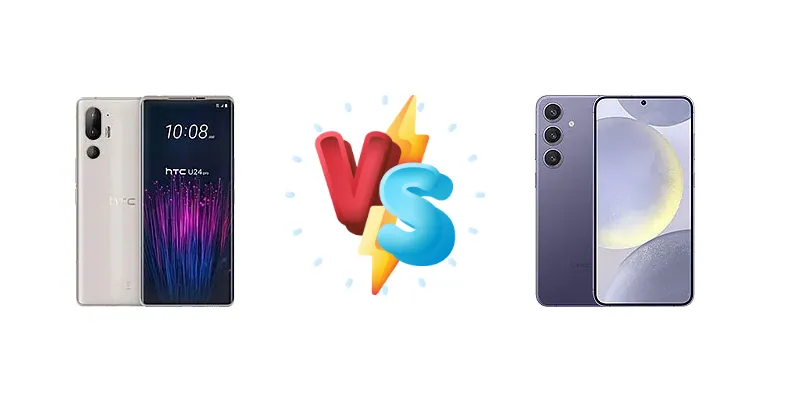
|
🏆 Quick Verdict
For most users, the Samsung Galaxy S24+ is the superior choice. Its Snapdragon 8 Gen 3 (or Exynos 2400) chipset provides significantly faster performance, a brighter display, and a more refined camera system. However, the HTC U24 Pro offers excellent value for budget-conscious buyers.
| PHONES | ||
|---|---|---|
| Phone Names | HTC U24 Pro | Samsung Galaxy S24+ |
| Network | ||
|---|---|---|
| 2G bands | GSM 850 / 900 / 1800 / 1900 | GSM 850 / 900 / 1800 / 1900 |
| 3G bands | HSDPA 800 / 850 / 900 / 1700(AWS) / 1900 / 2100 | HSDPA 850 / 900 / 1700(AWS) / 1900 / 2100 |
| 4G bands | 1, 2, 3, 4, 5, 7, 8, 12, 17, 18, 19, 20, 28, 38, 39, 40, 41 | 1, 2, 3, 4, 5, 7, 8, 12, 13, 17, 18, 19, 20, 25, 26, 28, 32, 38, 39, 40, 41, 66 - International |
| 5G bands | 1, 3, 5, 7, 8, 20, 28, 38, 40, 41, 77, 78 SA/NSA | 1, 2, 3, 5, 7, 8, 12, 20, 25, 26, 28, 38, 40, 41, 66, 75, 77, 78 SA/NSA/Sub6 - International |
| Speed | HSPA, LTE, 5G | HSPA, LTE (up to 7CA), 5G |
| Technology | GSM / HSPA / LTE / 5G | GSM / CDMA / HSPA / EVDO / LTE / 5G |
| Launch | ||
|---|---|---|
| Announced | 2024, June 12 | 2024, January 17 |
| Status | Available. Released 2024, July 01 | Available. Released 2024, January 24 |
| Body | ||
|---|---|---|
| Build | Glass front (Gorilla Glass), aluminum frame, plastic back | Glass front (Gorilla Glass Victus 2), glass back (Gorilla Glass Victus 2), aluminum frame |
| Dimensions | 167.1 x 74.9 x 9 mm (6.58 x 2.95 x 0.35 in) | 158.5 x 75.9 x 7.7 mm (6.24 x 2.99 x 0.30 in) |
| SIM | Nano-SIM + Nano-SIM | · Nano-SIM + Nano-SIM + eSIM + eSIM (max 2 at a time) - INT· Nano-SIM + eSIM + eSIM (max 2 at a time) - USA· Nano-SIM + Nano-SIM - CN |
| Weight | 198.7 g (7.02 oz) | 196 g or 197 g (6.91 oz) |
| Display | ||
|---|---|---|
| Protection | Corning Gorilla Glass (unspecified version) | Corning Gorilla Glass Victus 2 |
| Resolution | 1080 x 2436 pixels (~392 ppi density) | 1440 x 3120 pixels, 19.5:9 ratio (~513 ppi density) |
| Size | 6.8 inches, 110.5 cm2 (~88.3% screen-to-body ratio) | 6.7 inches, 110.2 cm2 (~91.6% screen-to-body ratio) |
| Type | OLED, 120Hz | Dynamic LTPO AMOLED 2X, 120Hz, HDR10+, 2600 nits (peak) |
| Platform | ||
|---|---|---|
| CPU | Octa-core (1x2.63 GHz Cortex-A715 & 4x2.4 GHz Cortex-A715 & 3x1.8 GHz Cortex-A510) | 8-core (1x3.39GHz Cortex-X4 & 3x3.1GHz Cortex-A720 & 2x2.9GHz Cortex-A720 & 2x2.2GHz Cortex-A520)10-core (1x3.2GHz Cortex-X4 & 2x2.9GHz Cortex-A720 & 3x2.6GHz Cortex-A720 & 4x1.95GHz Cortex-A520) |
| Chipset | Qualcomm SM7550-AB Snapdragon 7 Gen 3 (4 nm) | Qualcomm SM8650-AC Snapdragon 8 Gen 3 (4 nm) - USA/Canada/ChinaExynos 2400 (4 nm) - International |
| GPU | Adreno 720 | Adreno 750 (1 GHz) - USA/Canada/ChinaXclipse 940 - International |
| OS | Android 14 | Android 14, up to 7 major Android upgrades, One UI 8.0 |
| Memory | ||
|---|---|---|
| Card slot | microSDXC | No |
| Internal | 256GB 12GB RAM, 512GB 12GB RAM | 256GB 12GB RAM, 512GB 12GB RAM |
| Main Camera | ||
|---|---|---|
| Features | Dual-LED flash, HDR, panorama, Best Take | LED flash, auto-HDR, panorama |
| Triple | 50 MP, f/1.9, (wide), PDAF, OIS 50 MP, f/2.0, (telephoto), PDAF, 2x optical zoom 8 MP, f/2.2, 120˚ (ultrawide), 1/4.0", 1.12µm | 50 MP, f/1.8, 24mm (wide), 1/1.56", 1.0µm, dual pixel PDAF, OIS 10 MP, f/2.4, 67mm (telephoto), 1/3.94", 1.0µm, PDAF, OIS, 3x optical zoom 12 MP, f/2.2, 13mm, 120˚ (ultrawide), 1/2.55" 1.4µm, Super Steady video |
| Video | 4K@30fps (HDR), 1080p@30fps, gyro-EIS, OIS | 8K@24/30fps, 4K@30/60fps, 1080p@30/60/120/240fps, HDR10+, stereo sound rec., gyro-EIS |
| Selfie camera | ||
|---|---|---|
| Features | HDR | HDR, HDR10+ |
| Single | 50 MP, f/2.5, (wide), AF | 12 MP, f/2.2, 26mm (wide), 1/3.2", 1.12µm, dual pixel PDAF |
| Video | 1080p@30fps | 4K@30/60fps, 1080p@30fps |
| Sound | ||
|---|---|---|
| 35mm jack | Yes | No |
| Loudspeaker | Yes | Yes, with stereo speakers |
| Comms | ||
|---|---|---|
| Bluetooth | 5.3, A2DP, LE | 5.3, A2DP, LE |
| NFC | Yes | Yes |
| Positioning | GPS, GLONASS, GALILEO, BDS | GPS, GLONASS, BDS, GALILEO, QZSS |
| Radio | No | No |
| USB | USB Type-C 3.0 | USB Type-C 3.2, DisplayPort 1.2, OTG |
| WLAN | Wi-Fi 802.11 a/b/g/n/ac/6e, tri-band | Wi-Fi 802.11 a/b/g/n/ac/6e, tri-band, Wi-Fi Direct |
| Features | ||
|---|---|---|
| Sensors | Fingerprint (under display, optical), accelerometer, gyro, proximity, compass | Fingerprint (under display, ultrasonic), accelerometer, gyro, proximity, compass, barometer |
| Battery | ||
|---|---|---|
| Charging | 60W wired, PD3.0, QC4 15W wireless 5W reverse wireless Reverse wired | 45W wired, PD3.0, 65% in 30 min 15W wireless (Qi) 4.5W reverse wireless |
| Type | 4600 mAh | Li-Ion 4900 mAh |
| Misc | ||
|---|---|---|
| Colors | Space Blue, Twilight White | Onyx Black, Marble Grey, Cobalt Violet, Amber Yellow, Jade Green, Sandstone Orange, Sapphire Blue |
| Models | - | SM-S926B, SM-S926B/DS, SM-S926U, SM-S926U1, SM-S926W, SM-S926N, SM-S9260, SM-S926E, SM-S926E/DS |
| Price | $ 429.99 | $ 429.50 / € 549.00 / £ 445.98 |
| SAR | - | 1.16 W/kg (head) 0.84 W/kg (body) |
| SAR EU | - | 0.74 W/kg (head) 1.25 W/kg (body) |
HTC U24 Pro
- Faster wired charging (60W vs 45W)
- Reverse wired charging capability
- More affordable price point
- Significantly less powerful processor
- Likely inferior camera performance
- Display likely lacks LTPO and high peak brightness
Samsung Galaxy S24+
- Superior performance with Snapdragon 8 Gen 3/Exynos 2400
- Brighter and more vibrant display
- More advanced camera system
- Higher price tag
- Slower wired charging (45W)
- Lower reverse wireless charging wattage (4.5W)
Display Comparison
The Samsung Galaxy S24+ boasts a significantly brighter display, reaching a measured 1452 nits, ensuring excellent visibility even in direct sunlight. While the U24 Pro’s display specs are not provided, Samsung’s panel technology and peak brightness represent a clear advantage for outdoor use and HDR content consumption. The S24+ likely utilizes LTPO technology for adaptive refresh rates, contributing to better battery efficiency, a feature not confirmed for the U24 Pro. Bezels are expected to be slimmer on the S24+, enhancing the immersive viewing experience.
Camera Comparison
The context data lacks detailed camera specifications for both devices, but we can infer differences based on brand positioning. The Galaxy S24+ is expected to feature a more sophisticated camera system with larger sensors, advanced image processing algorithms, and optical image stabilization (OIS) on multiple lenses. While the U24 Pro may offer a capable camera for everyday photography, the S24+ will likely excel in low-light conditions and offer more versatile shooting modes, including higher-quality video recording. The presence of a 2MP macro camera on the U24 Pro is likely a marketing feature with limited practical benefit compared to the S24+'s more robust setup.
Performance
The core difference lies in the chipsets. The Galaxy S24+ utilizes the Qualcomm SM8650-AC Snapdragon 8 Gen 3 (in USA/Canada/China) or the Exynos 2400 (International), both built on a 4nm process. This translates to a substantial performance leap over the HTC U24 Pro’s Snapdragon 7 Gen 3 (also 4nm). The S24+'s CPU, with its Cortex-X4 prime core clocked at 3.39GHz, offers significantly faster single-core performance, crucial for responsive app launches and smooth multitasking. The S24+ also benefits from faster LPDDR5x RAM, further enhancing performance. While both chips are 4nm, the architectural improvements in the 8 Gen 3/Exynos 2400 provide a considerable advantage in sustained performance and thermal management, potentially reducing throttling during extended gaming sessions.
Battery Life
The Galaxy S24+ achieves an active use score of 12:30h, demonstrating solid battery life. The HTC U24 Pro’s battery capacity is unknown, but its 60W wired charging (with PD3.0 and QC4 support) is faster than the S24+'s 45W charging, potentially allowing for quicker top-ups. Both devices offer 15W wireless charging, but the U24 Pro uniquely includes 5W reverse wireless charging *and* reverse wired charging, offering greater flexibility for charging accessories. The S24+ reaches 65% charge in 30 minutes, while the U24 Pro’s 60W charging should provide comparable results.
Buying Guide
Buy the HTC U24 Pro if you prioritize affordability and efficient performance for everyday tasks, and appreciate the convenience of reverse wired charging. Buy the Samsung Galaxy S24+ if you demand top-tier performance for gaming and demanding applications, a brighter and more vibrant display, and a more versatile camera system with advanced features.