
HTC U24 Pro vs OnePlus 12R: A Deep Dive into Mid-Range Power
| Phones Images | |||||
|---|---|---|---|---|---|
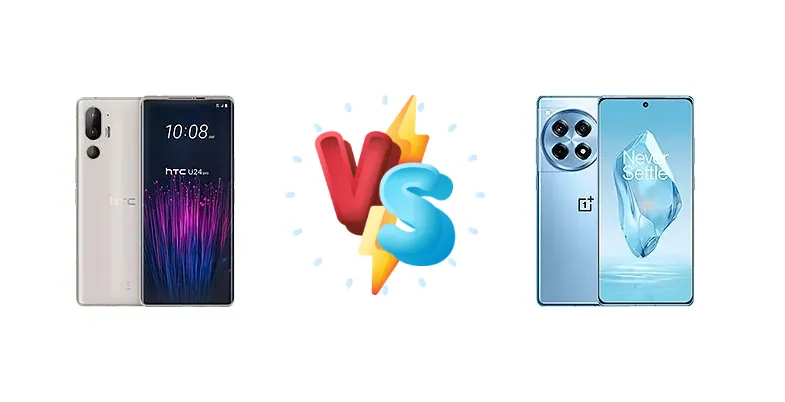
|
🏆 Quick Verdict
For most users, the OnePlus 12R emerges as the stronger choice. Its Snapdragon 8 Gen 2 chipset provides a significant performance advantage over the U24 Pro’s Snapdragon 7 Gen 3, translating to smoother multitasking, faster app loading, and superior gaming. While the U24 Pro offers respectable features, the 12R’s raw power and faster charging justify its slightly higher price.
| PHONES | ||
|---|---|---|
| Phone Names | HTC U24 Pro | OnePlus 12R |
| Network | ||
|---|---|---|
| 2G bands | GSM 850 / 900 / 1800 / 1900 | GSM 850 / 900 / 1800 / 1900 |
| 3G bands | HSDPA 800 / 850 / 900 / 1700(AWS) / 1900 / 2100 | HSDPA 850 / 900 / 1700(AWS) / 1900 / 2100 |
| 4G bands | 1, 2, 3, 4, 5, 7, 8, 12, 17, 18, 19, 20, 28, 38, 39, 40, 41 | 1, 2, 3, 4, 5, 7, 8, 12, 17, 18, 19, 20, 26, 28, 32, 38, 39, 40, 41, 66 |
| 5G bands | 1, 3, 5, 7, 8, 20, 28, 38, 40, 41, 77, 78 SA/NSA | 1, 2, 3, 5, 7, 8, 12, 20, 28, 38, 40, 41, 66, 77, 78 SA/NSA |
| Speed | HSPA, LTE, 5G | HSPA, LTE, 5G |
| Technology | GSM / HSPA / LTE / 5G | GSM / CDMA / HSPA / LTE / 5G |
| Launch | ||
|---|---|---|
| Announced | 2024, June 12 | 2024, January 23 |
| Status | Available. Released 2024, July 01 | Available. Released 2024, February 06 |
| Body | ||
|---|---|---|
| Build | Glass front (Gorilla Glass), aluminum frame, plastic back | Glass front (Gorilla Glass Victus 2), aluminum frame, glass back |
| Dimensions | 167.1 x 74.9 x 9 mm (6.58 x 2.95 x 0.35 in) | 163.3 x 75.3 x 8.8 mm (6.43 x 2.96 x 0.35 in) |
| SIM | Nano-SIM + Nano-SIM | · Nano-SIM + Nano-SIM + eSIM (max 2 at a time)· Nano-SIM + Nano-SIM |
| Weight | 198.7 g (7.02 oz) | 207 g (7.30 oz) |
| Display | ||
|---|---|---|
| Protection | Corning Gorilla Glass (unspecified version) | Corning Gorilla Glass Victus 2 |
| Resolution | 1080 x 2436 pixels (~392 ppi density) | 1264 x 2780 pixels (~450 ppi density) |
| Size | 6.8 inches, 110.5 cm2 (~88.3% screen-to-body ratio) | 6.78 inches, 111.7 cm2 (~90.9% screen-to-body ratio) |
| Type | OLED, 120Hz | LTPO4 AMOLED, 1B colors, 120Hz, HDR10+, Dolby Vision, 1600 nits (HBM), 4500 nits (peak) |
| Platform | ||
|---|---|---|
| CPU | Octa-core (1x2.63 GHz Cortex-A715 & 4x2.4 GHz Cortex-A715 & 3x1.8 GHz Cortex-A510) | Octa-core (1x3.2 GHz Cortex-X3 & 2x2.8 GHz Cortex-A715 & 2x2.8 GHz Cortex-A710 & 3x2.0 GHz Cortex-A510) |
| Chipset | Qualcomm SM7550-AB Snapdragon 7 Gen 3 (4 nm) | Qualcomm SM8550-AB Snapdragon 8 Gen 2 (4 nm) |
| GPU | Adreno 720 | Adreno 740 |
| OS | Android 14 | Android 14, up to 3 major Android upgrades, OxygenOS 15 |
| Memory | ||
|---|---|---|
| Card slot | microSDXC | No |
| Internal | 256GB 12GB RAM, 512GB 12GB RAM | 128GB 8GB RAM, 256GB 8GB RAM, 256GB 12GB RAM, 256GB 16GB RAM |
| Main Camera | ||
|---|---|---|
| Features | Dual-LED flash, HDR, panorama, Best Take | Laser AF, color spectrum sensor, LED flash, HDR, panorama |
| Triple | 50 MP, f/1.9, (wide), PDAF, OIS 50 MP, f/2.0, (telephoto), PDAF, 2x optical zoom 8 MP, f/2.2, 120˚ (ultrawide), 1/4.0", 1.12µm | 50 MP, f/1.8, 24mm (wide), 1/1.56", 1.0µm, multi-directional PDAF, OIS 8 MP, f/2.2, 16mm, 112˚ (ultrawide), 1/4.0", 1.12µm 2 MP (macro) |
| Video | 4K@30fps (HDR), 1080p@30fps, gyro-EIS, OIS | 4K@30/60fps, 1080p@30/60/120/240fps, gyro-EIS, OIS |
| Selfie camera | ||
|---|---|---|
| Features | HDR | HDR, panorama |
| Single | 50 MP, f/2.5, (wide), AF | 16 MP, f/2.4, 26mm (wide), 1/3", 1.0µm |
| Video | 1080p@30fps | 1080p@30fps, gyro-EIS |
| Sound | ||
|---|---|---|
| 35mm jack | Yes | No |
| Loudspeaker | Yes | Yes, with stereo speakers |
| Comms | ||
|---|---|---|
| Bluetooth | 5.3, A2DP, LE | 5.3, A2DP, LE, aptX HD |
| Infrared port | - | Yes |
| NFC | Yes | Yes |
| Positioning | GPS, GLONASS, GALILEO, BDS | GPS, GALILEO, GLONASS, BDS, QZSS |
| Radio | No | No |
| USB | USB Type-C 3.0 | USB Type-C 2.0 |
| WLAN | Wi-Fi 802.11 a/b/g/n/ac/6e, tri-band | Wi-Fi 802.11 a/b/g/n/ac/6/7, dual-band |
| Features | ||
|---|---|---|
| Sensors | Fingerprint (under display, optical), accelerometer, gyro, proximity, compass | Fingerprint (under display, optical), accelerometer, gyro, proximity, compass |
| Battery | ||
|---|---|---|
| Charging | 60W wired, PD3.0, QC4 15W wireless 5W reverse wireless Reverse wired | 100W wired, 100% in 26 min |
| Type | 4600 mAh | Li-Ion 5500 mAh |
| Misc | ||
|---|---|---|
| Colors | Space Blue, Twilight White | Iron Gray, Cool Blue, Electric Violet, Sunset Dune |
| Models | - | CPH2609, CPH2585, CPH2611 |
| Price | $ 429.99 | € 410.84 / $ 399.95 / £ 649.00 |
| SAR | - | 1.19 W/kg (head) 0.82 W/kg (body) |
HTC U24 Pro
- Potentially more efficient chipset (Snapdragon 7 Gen 3)
- Wireless and reverse wireless charging support
- May offer a more refined software experience (depending on HTC's customizations)
- Significantly less powerful processor than the OnePlus 12R
- Slower charging speeds (60W wired)
- Limited camera details available
OnePlus 12R
- Flagship-level performance with Snapdragon 8 Gen 2
- Incredibly fast 100W charging (26 minutes to full)
- Bright display (1181 nits)
- Potentially higher power consumption
- May lack some of the niche features found on other devices
- Software experience may not appeal to all users
Display Comparison
The OnePlus 12R boasts a significantly brighter display, reaching a measured peak of 1181 nits, which will provide superior visibility outdoors compared to the HTC U24 Pro (brightness data unavailable). While both utilize 4nm chipsets, the display’s impact on overall power draw isn’t specified, but the 12R’s brightness suggests a potentially higher consumption. Details regarding panel technology (LTPO vs standard OLED) and color accuracy are missing for the U24 Pro, making a comprehensive display comparison difficult, but the 12R’s brightness is a clear advantage.
Camera Comparison
Camera details for the HTC U24 Pro are limited. The OnePlus 12R’s camera system, while not detailed in the provided data, is generally known for its strong image processing and reliable performance. Without sensor size or aperture information for the U24 Pro, it’s difficult to assess its camera capabilities. The absence of details suggests the U24 Pro likely targets a more mainstream camera experience, while the 12R likely offers more advanced features and potentially better low-light performance. We can assume the 12R will have a more versatile camera system.
Performance
The core difference lies in the chipsets. The OnePlus 12R’s Snapdragon 8 Gen 2 (4nm) is a substantial upgrade over the HTC U24 Pro’s Snapdragon 7 Gen 3 (4nm). The 8 Gen 2 features a Cortex-X3 prime core clocked at 3.2 GHz, alongside faster Cortex-A715 and A710 cores, offering significantly higher CPU and GPU performance. The U24 Pro’s CPU configuration, with a mix of A715 and A510 cores, is geared towards efficiency rather than outright speed. This translates to a noticeable difference in demanding tasks like video editing and graphically intensive games. The 12R’s LPDDR5x RAM further enhances performance, while the U24 Pro’s RAM specification is unknown.
Battery Life
The OnePlus 12R excels in charging speed with its 100W wired charging, achieving a full charge in just 26 minutes. The HTC U24 Pro offers a more modest 60W wired charging, alongside 15W wireless and 5W reverse wireless charging. While the 12R’s battery capacity isn’t specified, its active use score of 14:32h demonstrates excellent battery life. The U24 Pro’s battery capacity is also unknown, but the slower charging speed suggests it may require more time to replenish its power reserves. The 12R’s charging speed is a significant convenience factor for users who prioritize quick top-ups.
Buying Guide
Buy the HTC U24 Pro if you prioritize a balanced experience with a focus on efficient power consumption and potentially a more refined software experience (depending on HTC’s Sense customizations). Buy the OnePlus 12R if you demand top-tier performance for gaming, demanding applications, or future-proofing, and value the convenience of incredibly fast 100W charging. The 12R is the clear choice for power users.