
HTC U24 Pro vs Motorola Edge 50 Ultra: A Deep Dive into Performance and Value
| Phones Images | |||||
|---|---|---|---|---|---|
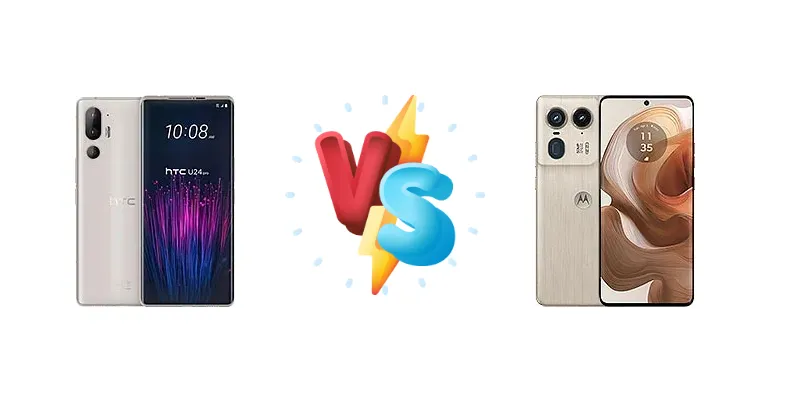
|
🏆 Quick Verdict
For most users, the Motorola Edge 50 Ultra emerges as the stronger choice. Its Snapdragon 8s Gen 3 chipset delivers significantly faster performance, complemented by a brighter, more vibrant display and blazing-fast 125W charging. While the HTC U24 Pro offers respectable specs, the Edge 50 Ultra provides a more premium and future-proof experience.
| PHONES | ||
|---|---|---|
| Phone Names | HTC U24 Pro | Motorola Edge 50 Ultra |
| Network | ||
|---|---|---|
| 2G bands | GSM 850 / 900 / 1800 / 1900 | GSM 850 / 900 / 1800 / 1900 |
| 3G bands | HSDPA 800 / 850 / 900 / 1700(AWS) / 1900 / 2100 | HSDPA 850 / 900 / 1700(AWS) / 1900 / 2100 |
| 4G bands | 1, 2, 3, 4, 5, 7, 8, 12, 17, 18, 19, 20, 28, 38, 39, 40, 41 | 1, 2, 3, 4, 5, 7, 8, 12, 13, 17, 18, 19, 20, 25, 26, 28, 32, 38, 39, 40, 41, 42, 43, 66 |
| 5G bands | 1, 3, 5, 7, 8, 20, 28, 38, 40, 41, 77, 78 SA/NSA | 1, 2, 3, 5, 7, 8, 20, 26, 28, 38, 40, 41, 66, 71, 75, 77, 78 SA/NSA/Sub6 |
| Speed | HSPA, LTE, 5G | HSPA, LTE, 5G |
| Technology | GSM / HSPA / LTE / 5G | GSM / HSPA / LTE / 5G |
| Launch | ||
|---|---|---|
| Announced | 2024, June 12 | 2024, April 16 |
| Status | Available. Released 2024, July 01 | Available. Released 2024, May 15 |
| Body | ||
|---|---|---|
| Build | Glass front (Gorilla Glass), aluminum frame, plastic back | Glass front (Gorilla Glass Victus), wooden back or silicone polymer back (eco leather), aluminum frame |
| Dimensions | 167.1 x 74.9 x 9 mm (6.58 x 2.95 x 0.35 in) | 161.1 x 72.4 x 8.6 mm (6.34 x 2.85 x 0.34 in) |
| SIM | Nano-SIM + Nano-SIM | Nano-SIM + eSIM |
| Weight | 198.7 g (7.02 oz) | 197 g (6.95 oz) |
| Display | ||
|---|---|---|
| Protection | Corning Gorilla Glass (unspecified version) | Corning Gorilla Glass Victus |
| Resolution | 1080 x 2436 pixels (~392 ppi density) | 1220 x 2712 pixels, 20:9 ratio (~446 ppi density) |
| Size | 6.8 inches, 110.5 cm2 (~88.3% screen-to-body ratio) | 6.7 inches, 107.4 cm2 (~92.1% screen-to-body ratio) |
| Type | OLED, 120Hz | P-OLED, 1B colors, 144Hz, HDR10+, 2500 nits (peak) |
| Platform | ||
|---|---|---|
| CPU | Octa-core (1x2.63 GHz Cortex-A715 & 4x2.4 GHz Cortex-A715 & 3x1.8 GHz Cortex-A510) | Octa-core (1x3.0 GHz Cortex-X4 & 4x2.8 GHz Cortex-A720 & 3x2.0 GHz Cortex-A520) |
| Chipset | Qualcomm SM7550-AB Snapdragon 7 Gen 3 (4 nm) | Qualcomm SM8635 Snapdragon 8s Gen 3 (4 nm) |
| GPU | Adreno 720 | Adreno 735 |
| OS | Android 14 | Android 14, upgradable to Android 16, up to 3 major Android upgrades |
| Memory | ||
|---|---|---|
| Card slot | microSDXC | No |
| Internal | 256GB 12GB RAM, 512GB 12GB RAM | 512GB 12GB RAM, 512GB 16GB RAM, 1TB 16GB RAM |
| Main Camera | ||
|---|---|---|
| Features | Dual-LED flash, HDR, panorama, Best Take | Laser AF, Dual-LED flash, HDR, panorama |
| Triple | 50 MP, f/1.9, (wide), PDAF, OIS 50 MP, f/2.0, (telephoto), PDAF, 2x optical zoom 8 MP, f/2.2, 120˚ (ultrawide), 1/4.0", 1.12µm | 50 MP, f/1.6, 23mm (wide), 1/1.3", 1.2µm, multi-directional PDAF, OIS 64 MP, f/2.4, 72mm (periscope telephoto), 1/2.0", 0.7µm, PDAF, OIS, 3x optical zoom 50 MP, f/2.0, 12mm, 122˚ (ultrawide), 1/2.76", 0.64µm, PDAF |
| Video | 4K@30fps (HDR), 1080p@30fps, gyro-EIS, OIS | 4K@30/60fps, 1080p@30/60/120/240/960fps, 10-bit HDR10+, gyro-EIS |
| Selfie camera | ||
|---|---|---|
| Features | HDR | HDR |
| Single | 50 MP, f/2.5, (wide), AF | 50 MP, f/1.9, 21mm (wide), 1/2.76", 0.64µm, PDAF |
| Video | 1080p@30fps | 4K@30/60fps, 1080p@30/60/120fps, HDR |
| Sound | ||
|---|---|---|
| 35mm jack | Yes | No |
| Loudspeaker | Yes | Yes, with stereo speakers |
| Comms | ||
|---|---|---|
| Bluetooth | 5.3, A2DP, LE | 5.4, A2DP, LE |
| NFC | Yes | Yes |
| Positioning | GPS, GLONASS, GALILEO, BDS | GPS, GLONASS, GALILEO, BDS, NavIC |
| Radio | No | No |
| USB | USB Type-C 3.0 | USB Type-C 3.1 Gen2, OTG, DisplayPort 1.4 |
| WLAN | Wi-Fi 802.11 a/b/g/n/ac/6e, tri-band | Wi-Fi 802.11 a/b/g/n/ac/6e/7, tri-band, Wi-Fi Direct |
| Features | ||
|---|---|---|
| Sensors | Fingerprint (under display, optical), accelerometer, gyro, proximity, compass | Fingerprint (under display, optical), accelerometer, gyro, proximity, compass |
| Battery | ||
|---|---|---|
| Charging | 60W wired, PD3.0, QC4 15W wireless 5W reverse wireless Reverse wired | 125W wired 50W wireless 10W reverse wireless |
| Type | 4600 mAh | 4500 mAh |
| Misc | ||
|---|---|---|
| Colors | Space Blue, Twilight White | Forest Grey, Nordic Wood, Peach Fuzz |
| Price | $ 429.99 | $ 939.00 / C$ 1,299.00 / £ 490.00 / € 609.90 / ₹ 59,999 |
HTC U24 Pro
- More affordable price point
- Reliable Snapdragon 7 Gen 3 performance for everyday tasks
- Reverse wired charging offers added versatility
- Significantly slower charging speeds
- Less powerful chipset compared to the Edge 50 Ultra
- Display likely lacks the brightness and features of the Edge 50 Ultra
Motorola Edge 50 Ultra
- Blazing-fast 125W wired charging
- Powerful Snapdragon 8s Gen 3 chipset for demanding tasks
- Bright and vibrant display with potential LTPO technology
- Higher price tag
- May require more frequent charging due to higher performance demands
- Larger size and weight compared to the U24 Pro (assumed)
Display Comparison
The Motorola Edge 50 Ultra boasts a significantly brighter display, reaching a measured 1473 nits, ensuring excellent visibility even in direct sunlight. While the U24 Pro’s display specs are not provided, the Edge 50 Ultra’s brightness advantage is substantial. The Edge 50 Ultra likely utilizes an LTPO panel for adaptive refresh rates, contributing to improved battery efficiency, a feature not confirmed for the U24 Pro. The Edge 50 Ultra’s superior brightness and potential for adaptive refresh rates make it the clear winner for outdoor use and media consumption.
Camera Comparison
Without detailed camera specifications for the HTC U24 Pro, a direct comparison is limited. However, the Motorola Edge 50 Ultra is expected to feature a high-resolution main sensor (likely 50MP or higher) with optical image stabilization (OIS). The Edge 50 Ultra’s image processing capabilities, powered by the Snapdragon 8s Gen 3’s ISP, will likely result in superior image quality, particularly in low-light conditions. The absence of detailed camera information for the U24 Pro suggests it won’t compete with the Edge 50 Ultra in this area.
Performance
The core difference lies in the chipsets: the HTC U24 Pro utilizes the Qualcomm SM7550-AB Snapdragon 7 Gen 3, while the Motorola Edge 50 Ultra features the more powerful SM8635 Snapdragon 8s Gen 3. The 8s Gen 3’s Cortex-X4 prime core (3.0 GHz) represents a significant architectural leap over the U24 Pro’s Cortex-A715 (2.63 GHz), translating to faster app launches and smoother multitasking. The Edge 50 Ultra’s GPU will also provide a substantially better gaming experience. While both are built on a 4nm process, the 8s Gen 3’s superior architecture and clock speeds deliver a noticeable performance advantage.
Battery Life
The Motorola Edge 50 Ultra’s 125W wired charging is a game-changer, allowing for a full charge in under 30 minutes. The HTC U24 Pro’s 60W charging, while respectable, is significantly slower. The Edge 50 Ultra also supports 50W wireless charging, compared to the U24 Pro’s 15W, further accelerating charging times. The Edge 50 Ultra’s active use score of 12:56h demonstrates solid battery life, and the faster charging mitigates any concerns about needing to top up frequently. The U24 Pro’s battery capacity is unknown, but the Edge 50 Ultra’s charging speed and demonstrated endurance give it a clear advantage.
Buying Guide
Buy the HTC U24 Pro if you prioritize a more budget-friendly option and value a reliable, everyday experience without demanding the absolute highest performance. It's ideal for users who primarily browse, use social media, and occasionally play less intensive games. Buy the Motorola Edge 50 Ultra if you demand top-tier performance for gaming, content creation, or multitasking, and appreciate a stunning display and incredibly fast charging capabilities. This phone is for power users who want a flagship-level experience.