
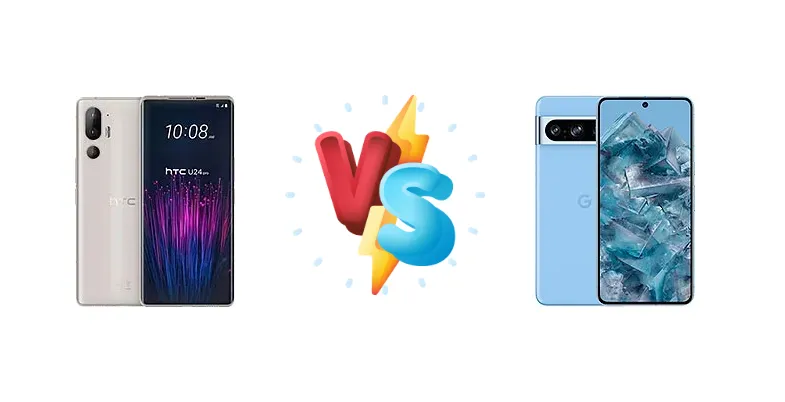
HTC U24 Pro vs Google Pixel 8 Pro: Which Android Flagship Reigns Supreme?
| Phones Images | |||||
|---|---|---|---|---|---|
|
🏆 Quick Verdict
For the average user prioritizing camera quality, software experience, and long-term support, the Google Pixel 8 Pro is the clear winner. However, the HTC U24 Pro offers a strong value proposition with its efficient Snapdragon 7 Gen 3 and faster 60W charging, making it ideal for budget-conscious users who don't need the absolute best in every category.
| PHONES | ||
|---|---|---|
| Phone Names | HTC U24 Pro | Google Pixel 8 Pro |
| Network | ||
|---|---|---|
| 2G bands | GSM 850 / 900 / 1800 / 1900 | GSM 850 / 900 / 1800 / 1900 |
| 3G bands | HSDPA 800 / 850 / 900 / 1700(AWS) / 1900 / 2100 | HSDPA 800 / 850 / 900 / 1700(AWS) / 1900 / 2100 |
| 4G bands | 1, 2, 3, 4, 5, 7, 8, 12, 17, 18, 19, 20, 28, 38, 39, 40, 41 | 1, 2, 3, 4, 5, 7, 8, 12, 13, 14, 17, 18, 19, 20, 25, 26, 28, 29, 30, 38, 39, 40, 41, 46, 48, 66, 71 - G1MNW |
| 5G bands | 1, 3, 5, 7, 8, 20, 28, 38, 40, 41, 77, 78 SA/NSA | 1, 2, 3, 5, 7, 8, 12, 20, 25, 26, 28, 29, 30, 38, 40, 41, 48, 66, 70, 71, 77, 78, 257, 258, 260, 261 SA/NSA/Sub6/mmWave - G1MNW |
| Speed | HSPA, LTE, 5G | HSPA, LTE, 5G |
| Technology | GSM / HSPA / LTE / 5G | GSM / HSPA / LTE / 5G |
| Launch | ||
|---|---|---|
| Announced | 2024, June 12 | 2023, October 04 |
| Status | Available. Released 2024, July 01 | Available. Released 2023, October 12 |
| Body | ||
|---|---|---|
| Build | Glass front (Gorilla Glass), aluminum frame, plastic back | Glass front (Gorilla Glass Victus 2), glass back (Gorilla Glass Victus 2), aluminum frame |
| Dimensions | 167.1 x 74.9 x 9 mm (6.58 x 2.95 x 0.35 in) | 162.6 x 76.5 x 8.8 mm (6.40 x 3.01 x 0.35 in) |
| SIM | Nano-SIM + Nano-SIM | Nano-SIM + eSIM |
| Weight | 198.7 g (7.02 oz) | 213 g (7.51 oz) |
| Display | ||
|---|---|---|
| Protection | Corning Gorilla Glass (unspecified version) | Corning Gorilla Glass Victus 2 |
| Resolution | 1080 x 2436 pixels (~392 ppi density) | 1344 x 2992 pixels, 20:9 ratio (~489 ppi density) |
| Size | 6.8 inches, 110.5 cm2 (~88.3% screen-to-body ratio) | 6.7 inches, 108.7 cm2 (~87.4% screen-to-body ratio) |
| Type | OLED, 120Hz | LTPO OLED, 120Hz, HDR10+, 1600 nits (HBM), 2400 nits (peak) |
| Platform | ||
|---|---|---|
| CPU | Octa-core (1x2.63 GHz Cortex-A715 & 4x2.4 GHz Cortex-A715 & 3x1.8 GHz Cortex-A510) | Nona-core (1x3.0 GHz Cortex-X3 & 4x2.45 GHz Cortex-A715 & 4x2.15 GHz Cortex-A510) |
| Chipset | Qualcomm SM7550-AB Snapdragon 7 Gen 3 (4 nm) | Google Tensor G3 (4 nm) |
| GPU | Adreno 720 | Immortalis-G715s MC10 |
| OS | Android 14 | Android 14, upgradable to Android 16, up to 7 major Android upgrades |
| Memory | ||
|---|---|---|
| Card slot | microSDXC | No |
| Internal | 256GB 12GB RAM, 512GB 12GB RAM | 128GB 12GB RAM, 256GB 12GB RAM, 512GB 12GB RAM, 1TB 12GB RAM |
| Main Camera | ||
|---|---|---|
| Features | Dual-LED flash, HDR, panorama, Best Take | Multi-zone Laser AF, Dual-LED flash, Pixel Shift, Ultra-HDR, panorama, Best Take, Zoom Enhance |
| Triple | 50 MP, f/1.9, (wide), PDAF, OIS 50 MP, f/2.0, (telephoto), PDAF, 2x optical zoom 8 MP, f/2.2, 120˚ (ultrawide), 1/4.0", 1.12µm | 50 MP, f/1.7, 25mm (wide), 1/1.31", 1.2µm, dual pixel PDAF, OIS 48 MP, f/2.8, 113mm (periscope telephoto), 1/2.55", 0.7µm, dual pixel PDAF, OIS, 5x optical zoom 48 MP, f/2.0, 126˚ (ultrawide), 1/2.0", 0.8µm, dual pixel PDAF |
| Video | 4K@30fps (HDR), 1080p@30fps, gyro-EIS, OIS | 4K@30/60fps, 1080p@24/30/60/120/240fps; gyro-EIS, OIS, 10-bit HDR |
| Selfie camera | ||
|---|---|---|
| Features | HDR | HDR, panorama |
| Single | 50 MP, f/2.5, (wide), AF | 10.5 MP, f/2.2, 20mm (ultrawide), 1/3.1", 1.22µm, PDAF |
| Video | 1080p@30fps | 4K@24/30/60fps, 1080p@30/60fps |
| Sound | ||
|---|---|---|
| 35mm jack | Yes | No |
| Loudspeaker | Yes | Yes, with stereo speakers |
| Comms | ||
|---|---|---|
| Bluetooth | 5.3, A2DP, LE | 5.3, A2DP, LE, aptX HD |
| NFC | Yes | Yes |
| Positioning | GPS, GLONASS, GALILEO, BDS | GPS (L1+L5), GLONASS (G1), GALILEO (E1+E5a), QZSS (L1+L5) |
| Radio | No | No |
| USB | USB Type-C 3.0 | USB Type-C 3.2 |
| WLAN | Wi-Fi 802.11 a/b/g/n/ac/6e, tri-band | Wi-Fi 802.11 a/b/g/n/ac/6e/7, tri-band, Wi-Fi Direct |
| Features | ||
|---|---|---|
| Sensors | Fingerprint (under display, optical), accelerometer, gyro, proximity, compass | Fingerprint (under display, optical), accelerometer, gyro, proximity, compass, barometer, thermometer (skin temperature) |
| Battery | ||
|---|---|---|
| Charging | 60W wired, PD3.0, QC4 15W wireless 5W reverse wireless Reverse wired | 30W wired, PD3.0, PPS, 50% in 30 min 23W wireless Reverse wireless Bypass charging |
| Type | 4600 mAh | Li-Ion 5050 mAh |
| Misc | ||
|---|---|---|
| Colors | Space Blue, Twilight White | Obsidian, Porcelain, Bay, Mint |
| Models | - | GC3VE, G1MNW |
| Price | $ 429.99 | € 362.00 / $ 289.97 / £ 329.95 / ₹ 54,999 |
HTC U24 Pro
- Faster 60W wired charging
- Reverse wired charging capability
- Potentially better thermal management due to efficient chipset
- Less powerful processor than the Pixel 8 Pro
- Software support likely shorter than Pixel 8 Pro
Google Pixel 8 Pro
- Superior camera system and image processing
- Long-term software support and updates
- Brighter and more vibrant display
- Slower 30W wired charging
- Higher price point
Display Comparison
The Pixel 8 Pro’s display shines with a measured peak brightness of 1600 nits, offering superior visibility in direct sunlight compared to the U24 Pro (brightness data unavailable). While the U24 Pro’s panel specifics are unknown, the Pixel 8 Pro’s likely utilizes LTPO technology for adaptive refresh rates, conserving battery life. The Pixel 8 Pro’s larger display and higher resolution contribute to a more immersive viewing experience, though the U24 Pro may offer a more manageable size for some users.
Camera Comparison
The Pixel 8 Pro is renowned for its computational photography prowess, leveraging Google’s image processing algorithms. While specific sensor details for the U24 Pro are missing, the Pixel 8 Pro’s camera system (details unavailable in context) benefits from advanced features like Magic Editor and Best Take. The Pixel 8 Pro’s video capabilities are also likely superior, benefiting from the Tensor G3’s dedicated image signal processor (ISP). The U24 Pro will likely offer a competent camera experience, but it won’t match the Pixel 8 Pro’s consistently high image quality and innovative features.
Performance
The Google Pixel 8 Pro’s Tensor G3, a nona-core processor with a Cortex-X3 prime core clocked at 3.0 GHz, offers a theoretical performance advantage over the HTC U24 Pro’s Snapdragon 7 Gen 3. The Snapdragon 7 Gen 3, while efficient with its 4nm process, features an octa-core configuration with a Cortex-A715 prime core at 2.63 GHz. The Tensor G3’s focus on AI and machine learning tasks gives the Pixel 8 Pro an edge in features like Magic Eraser and real-time translation. However, the Snapdragon 7 Gen 3’s efficiency may translate to better sustained performance under heavy load due to potentially superior thermal management. Both chips are built on a 4nm process, suggesting comparable efficiency, but the Tensor G3’s more complex architecture may generate more heat.
Battery Life
The Pixel 8 Pro boasts an impressive active use battery score of 11:14 hours and an endurance rating of 90 hours, indicating excellent battery life. The HTC U24 Pro’s battery capacity is unknown, but its 60W wired charging (with PD3.0 and QC4 support) significantly surpasses the Pixel 8 Pro’s 30W charging. The U24 Pro also offers 15W wireless and 5W reverse wireless charging, while the Pixel 8 Pro provides 23W wireless and reverse wireless charging. The U24 Pro’s faster charging speeds will allow for quicker top-ups, potentially mitigating any capacity disadvantage. The Pixel 8 Pro’s ‘Bypass Charging’ feature, which allows direct power from the charger to the phone, bypassing the battery, is a unique feature that can extend battery lifespan.
Buying Guide
Buy the HTC U24 Pro if you need a reliable daily driver with fast charging and a focus on efficiency, and are comfortable with a less polished software experience. You'll appreciate the 60W wired charging and reverse wireless capabilities. Buy the Google Pixel 8 Pro if you prioritize computational photography, a seamless software experience with guaranteed updates, and a brighter, more vibrant display. The Tensor G3’s AI features and Google’s image processing are key differentiators.