
HTC U24 Pro vs. Asus ROG Phone 8 Pro: A Deep Dive into Performance, Battery, and Value
| Phones Images | |||||
|---|---|---|---|---|---|
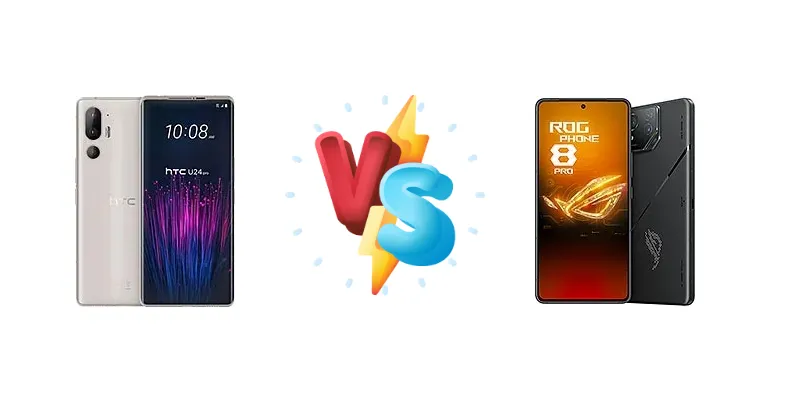
|
🏆 Quick Verdict
For the average user prioritizing a balanced experience, the Asus ROG Phone 8 Pro emerges as the winner. Its significantly more powerful Snapdragon 8 Gen 3 chipset, coupled with a brighter display and longer battery life, justifies the higher price tag. However, the HTC U24 Pro presents a compelling value proposition for those seeking a capable daily driver without the gaming-centric features.
| PHONES | ||
|---|---|---|
| Phone Names | HTC U24 Pro | Asus ROG Phone 8 Pro |
| Network | ||
|---|---|---|
| 2G bands | GSM 850 / 900 / 1800 / 1900 | GSM 850 / 900 / 1800 / 1900 |
| 3G bands | HSDPA 800 / 850 / 900 / 1700(AWS) / 1900 / 2100 | HSDPA 850 / 900 / 1700(AWS) / 1800 / 1900 / 2100 - International |
| 4G bands | 1, 2, 3, 4, 5, 7, 8, 12, 17, 18, 19, 20, 28, 38, 39, 40, 41 | 1, 2, 3, 4, 5, 7, 8, 12, 17, 18, 19, 20, 25, 26, 28, 32, 34, 38, 39, 40, 41, 42, 43, 48, 66 - International |
| 5G bands | 1, 3, 5, 7, 8, 20, 28, 38, 40, 41, 77, 78 SA/NSA | 1, 2, 3, 5, 7, 8, 12, 18, 20, 25, 26, 28, 38, 40, 41, 48, 66, 77, 78, 79 SA/NSA/Sub6 - International |
| Speed | HSPA, LTE, 5G | HSPA, LTE (Up to 7CA), 5G |
| Technology | GSM / HSPA / LTE / 5G | GSM / CDMA / HSPA / LTE / 5G |
| Launch | ||
|---|---|---|
| Announced | 2024, June 12 | 2024, January 08 |
| Status | Available. Released 2024, July 01 | Available. Released 2024, January 18 |
| Body | ||
|---|---|---|
| Build | Glass front (Gorilla Glass), aluminum frame, plastic back | Glass front (Gorilla Glass Victus 2), glass back (Gorilla Glass), aluminum frame |
| Dimensions | 167.1 x 74.9 x 9 mm (6.58 x 2.95 x 0.35 in) | 163.8 x 76.8 x 8.9 mm (6.45 x 3.02 x 0.35 in) |
| SIM | Nano-SIM + Nano-SIM | Nano-SIM + Nano-SIM |
| Weight | 198.7 g (7.02 oz) | 225 g (7.94 oz) |
| Display | ||
|---|---|---|
| Protection | Corning Gorilla Glass (unspecified version) | Corning Gorilla Glass Victus 2 |
| Resolution | 1080 x 2436 pixels (~392 ppi density) | 1080 x 2400 pixels, 20:9 ratio (~388 ppi density) |
| Size | 6.8 inches, 110.5 cm2 (~88.3% screen-to-body ratio) | 6.78 inches, 111.0 cm2 (~88.2% screen-to-body ratio) |
| Type | OLED, 120Hz | LTPO AMOLED, 1B colors, 165Hz, HDR10, 1600 nits (HBM), 2500 nits (peak) |
| Platform | ||
|---|---|---|
| CPU | Octa-core (1x2.63 GHz Cortex-A715 & 4x2.4 GHz Cortex-A715 & 3x1.8 GHz Cortex-A510) | Octa-core (1x3.3 GHz Cortex-X4 & 3x3.2 GHz Cortex-A720 & 2x3.0 GHz Cortex-A720 & 2x2.3 GHz Cortex-A520) |
| Chipset | Qualcomm SM7550-AB Snapdragon 7 Gen 3 (4 nm) | Qualcomm SM8650-AB Snapdragon 8 Gen 3 (4 nm) |
| GPU | Adreno 720 | Adreno 750 |
| OS | Android 14 | Android 14, up to 2 major Android upgrades |
| Memory | ||
|---|---|---|
| Card slot | microSDXC | No |
| Internal | 256GB 12GB RAM, 512GB 12GB RAM | 512GB 16GB RAM, 1TB 24GB RAM |
| Main Camera | ||
|---|---|---|
| Features | Dual-LED flash, HDR, panorama, Best Take | LED flash, HDR, panorama |
| Triple | 50 MP, f/1.9, (wide), PDAF, OIS 50 MP, f/2.0, (telephoto), PDAF, 2x optical zoom 8 MP, f/2.2, 120˚ (ultrawide), 1/4.0", 1.12µm | 50 MP, f/1.9, 24mm (wide), 1/1.56", 1.0µm, PDAF, gimbal OIS 32 MP, f/2.4, (telephoto), 1/3.2", 0.7µm, PDAF, OIS, 3x optical zoom 13 MP, f/2.2, 13mm, 120˚ (ultrawide) |
| Video | 4K@30fps (HDR), 1080p@30fps, gyro-EIS, OIS | 8K@24fps, 4K@30/60fps, 1080p@30/60/120/240fps, 720p@480fps; gyro-EIS, HDR10+ |
| Selfie camera | ||
|---|---|---|
| Features | HDR | Panorama, HDR |
| Single | 50 MP, f/2.5, (wide), AF | 32 MP, f/2.5, 22mm (wide), 1/3.2", 0.7µm |
| Video | 1080p@30fps | 1080p@30fps |
| Sound | ||
|---|---|---|
| 35mm jack | Yes | Yes |
| Loudspeaker | Yes | Yes, with stereo speakers |
| Comms | ||
|---|---|---|
| Bluetooth | 5.3, A2DP, LE | 5.4, A2DP, LE, aptX HD, aptX Adaptive, aptX Lossless |
| NFC | Yes | Yes |
| Positioning | GPS, GLONASS, GALILEO, BDS | GPS (L1+L5), BDS (B1I+B1c+B2a), GALILEO (E1+E5a), QZSS (L1+L5), NavIC (L5), GLONASS |
| Radio | No | No |
| USB | USB Type-C 3.0 | USB Type-C (side), DisplayPort 1.4; USB Type-C (bottom), OTG |
| WLAN | Wi-Fi 802.11 a/b/g/n/ac/6e, tri-band | Wi-Fi 802.11 a/b/g/n/ac/6e/7, tri-band, Wi-Fi Direct |
| Features | ||
|---|---|---|
| Sensors | Fingerprint (under display, optical), accelerometer, gyro, proximity, compass | Fingerprint (under display, optical), accelerometer, gyro, proximity, compass |
| Battery | ||
|---|---|---|
| Charging | 60W wired, PD3.0, QC4 15W wireless 5W reverse wireless Reverse wired | 65W wired, PD3.0, PPS, QC5, 100% in 39 min - International 30W wired, PD3.0, PPS - India 15W wireless (Qi) 10W reverse wired |
| Type | 4600 mAh | 5500 mAh |
| Misc | ||
|---|---|---|
| Colors | Space Blue, Twilight White | Phantom Black |
| Models | - | AI2401, AI2401_A, AI2401_D |
| Price | $ 429.99 | $ 1,157.98 / £ 1,693.75 / € 632.66 |
HTC U24 Pro
- Potentially more affordable price point
- Clean and streamlined software experience (typical of HTC)
- 60W wired charging with wireless and reverse wireless options
- Significantly less powerful Snapdragon 7 Gen 3 chipset
- Limited information available on display and camera specifications
- Likely shorter battery life compared to the ROG Phone 8 Pro
Asus ROG Phone 8 Pro
- Flagship Snapdragon 8 Gen 3 performance
- Exceptionally bright and high-refresh-rate display
- Long battery life (14:43h active use)
- Fast 65W wired charging (international)
- Higher price tag
- Gaming-focused design may not appeal to all users
- 30W charging in India
Display Comparison
The Asus ROG Phone 8 Pro boasts a significantly brighter display, reaching a measured peak of 1765 nits, ensuring excellent visibility even in direct sunlight. While the U24 Pro’s display specifications are not provided, the ROG Phone’s brightness advantage is substantial. The ROG Phone 8 Pro likely utilizes an AMOLED panel with a high refresh rate (typically 165Hz or higher), contributing to smoother visuals during gaming and scrolling. The ROG Phone’s display is geared towards immersive gaming, while the U24 Pro likely prioritizes efficiency.
Camera Comparison
Detailed camera specifications for the HTC U24 Pro are unavailable. However, the Asus ROG Phone 8 Pro is expected to feature a versatile camera system, likely including a high-resolution main sensor with optical image stabilization (OIS) for sharp, detailed photos and stable videos. The ROG Phone’s image processing algorithms are optimized for both photo and video capture, offering a range of shooting modes and features. Without specific details on the U24 Pro’s camera, it’s difficult to make a direct comparison, but the ROG Phone 8 Pro is likely to offer a more refined and feature-rich camera experience.
Performance
The core difference lies in the chipsets: the Asus ROG Phone 8 Pro features the Snapdragon 8 Gen 3 (4nm), while the HTC U24 Pro utilizes the Snapdragon 7 Gen 3 (4nm). This represents a significant performance gap. The 8 Gen 3’s Cortex-X4 prime core, clocked at 3.3 GHz, and more powerful Adreno GPU deliver substantially faster processing speeds and superior graphics performance. The U24 Pro’s Cortex-A715 cores, while efficient, cannot match the raw power of the 8 Gen 3’s architecture. This translates to smoother multitasking, faster app loading times, and a far more enjoyable gaming experience on the ROG Phone 8 Pro. The ROG Phone 8 Pro also benefits from faster LPDDR5x RAM, further enhancing performance.
Battery Life
The Asus ROG Phone 8 Pro demonstrates impressive battery life, achieving an active use score of 14 hours and 43 minutes. While the U24 Pro’s battery capacity is unknown, the ROG Phone’s endurance is a significant advantage. The ROG Phone 8 Pro supports 65W wired charging (international markets) and can reach 100% charge in approximately 39 minutes, while India receives a 30W charging solution. The U24 Pro offers 60W wired charging, 15W wireless, and 5W reverse wireless, providing flexibility but potentially slower charging speeds than the ROG Phone 8 Pro. The ROG Phone’s larger battery and faster charging capabilities make it ideal for power users and gamers.
Buying Guide
Buy the HTC U24 Pro if you need a reliable smartphone for everyday tasks, appreciate a clean software experience, and prioritize value for money. It’s ideal for users who occasionally game but aren’t seeking a dedicated gaming device. Buy the Asus ROG Phone 8 Pro if you’re a serious mobile gamer, demand the highest possible performance, and value features like a high refresh rate display, advanced cooling, and fast charging. It’s built for sustained gaming sessions and power users.