
HTC U23 Pro vs Xiaomi 13 Pro: A Deep Dive into Flagship Performance and Value
| Phones Images | |||||
|---|---|---|---|---|---|
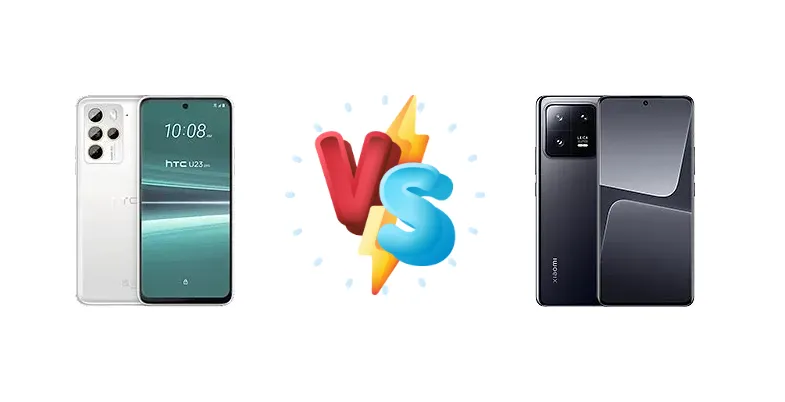
|
🏆 Quick Verdict
For most users, the Xiaomi 13 Pro is the superior choice. Its significantly faster Snapdragon 8 Gen 2 chipset, brighter display, and substantially faster charging outweigh the U23 Pro’s potential affordability. However, the U23 Pro remains a viable option for those prioritizing a more budget-conscious flagship.
| PHONES | ||
|---|---|---|
| Phone Names | HTC U23 Pro | Xiaomi 13 Pro |
| Network | ||
|---|---|---|
| 2G bands | GSM 850 / 900 / 1800 / 1900 | GSM 850 / 900 / 1800 / 1900 |
| 3G bands | HSDPA 850 / 900 / 1700(AWS) / 1900 / 2100 | HSDPA 800 / 850 / 900 / 1700(AWS) / 1900 / 2100 |
| 4G bands | 1, 3, 5, 7, 8, 12, 17, 20, 28, 38, 39, 40, 41 | 1, 2, 3, 4, 5, 7, 8, 12, 13, 17, 18, 19, 20, 25, 26, 28, 32, 38, 39, 40, 41, 42, 48, 66 - International |
| 5G bands | 1, 3, 7, 20, 28, 41, 78 SA/NSA | 1, 3, 5, 7, 8, 20, 28, 38, 40, 41, 66, 71, 75, 77, 78 SA/NSA - International |
| Speed | HSPA, LTE, 5G | HSPA, LTE, 5G |
| Technology | GSM / HSPA / LTE / 5G | GSM / CDMA / HSPA / CDMA2000 / LTE / 5G |
| - | 1, 3, 5, 8, 28, 38, 40, 41, 77, 78, 79 SA/NSA - China | |
| Launch | ||
|---|---|---|
| Announced | 2023, May 18 | 2022, December 11 |
| Status | Available. Released 2023, May 18 | Available. Released 2022, December 14 |
| Body | ||
|---|---|---|
| Build | Glass front (Gorilla Glass Victus), plastic frame, plastic back | Glass front (Gorilla Glass Victus), ceramic back or silicone polymer back, aluminum frame |
| Dimensions | 166.6 x 77.1 x 8.9 mm (6.56 x 3.04 x 0.35 in) | 162.9 x 74.6 x 8.4 mm or 8.7 mm |
| SIM | Nano-SIM + Nano-SIM | · Nano-SIM + eSIM· Nano-SIM + Nano-SIM |
| Weight | 205 g (7.23 oz) | 210 g or 229 g (7.41 oz) |
| IP67 dust/water resistant (up to 1m for 30 min) | IP68 dust/water resistant (up to 1.5m for 30 min) | |
| Display | ||
|---|---|---|
| Protection | Corning Gorilla Glass Victus | Corning Gorilla Glass Victus |
| Resolution | 1080 x 2400 pixels, 20:9 ratio (~393 ppi density) | 1440 x 3200 pixels, 20:9 ratio (~522 ppi density) |
| Size | 6.7 inches, 108.4 cm2 (~84.4% screen-to-body ratio) | 6.73 inches, 108.9 cm2 (~89.6% screen-to-body ratio) |
| Type | OLED, 120Hz | LTPO AMOLED, 1B colors, 120Hz, Dolby Vision, HDR10+, 1200 nits (HBM), 1900 nits (peak) |
| Platform | ||
|---|---|---|
| CPU | Octa-core (1x2.4 GHz Cortex-A710 & 3x2.36 GHz Cortex-A710 & 4x1.8 GHz Cortex-A510) | Octa-core (1x3.2 GHz Cortex-X3 & 2x2.8 GHz Cortex-A715 & 2x2.8 GHz Cortex-A710 & 3x2.0 GHz Cortex-A510) |
| Chipset | Qualcomm SM7450-AB Snapdragon 7 Gen 1 (4 nm) | Qualcomm SM8550-AB Snapdragon 8 Gen 2 (4 nm) |
| GPU | Adreno 644 | Adreno 740 |
| OS | Android 13 | Android 13, upgradable to Android 14, HyperOS |
| Memory | ||
|---|---|---|
| Card slot | microSDXC | No |
| Internal | 256GB 8GB RAM, 256GB 12GB RAM | 128GB 8GB RAM, 256GB 8GB RAM, 256GB 12GB RAM, 512GB 12GB RAM |
| - | UFS 3.1 - 128GB UFS 4.0 - 256/512GB | |
| Main Camera | ||
|---|---|---|
| Features | Dual-LED flash, HDR, panorama | Laser AF, color spectrum sensor, Leica lens, Dual-LED dual-tone flash, HDR, panorama |
| Quad | 108 MP, f/1.7, (wide), 1/1.67", 0.64μm, PDAF, OIS 8 MP, f/2.4, 120˚ (ultrawide), 1/4.0", 1.12µm 5 MP (macro) Auxiliary lens | - |
| Triple | - | 50.3 MP, f/1.9, 23mm (wide), 1.0"-type, 1.6µm, dual pixel PDAF, OIS 50 MP, f/2.0, 75mm (telephoto), PDAF (10cm - ∞), 3.2x optical zoom 50 MP, f/2.2, 14mm, 115˚ (ultrawide), AF |
| Video | 4K@30fps, 1080p@30fps, gyro-EIS | 8K@24fps (HDR), 4K@24/30/60fps (HDR10+, 10-bit Dolby Vision HDR, 10-bit LOG), 1080p@30/120/240/960fps, 1080p@1920fps, gyro-EIS |
| Selfie camera | ||
|---|---|---|
| Features | HDR | HDR, panorama |
| Single | 32 MP, f/2.5, (wide), 1/3.2", 0.7µm | 32 MP, f/2.0, 22mm (wide), 1/3.14", 0.7µm |
| Video | 1080p@30fps | 1080p@30fps |
| Sound | ||
|---|---|---|
| 3.5mm jack | Yes | No |
| 35mm jack | Yes | No |
| Loudspeaker | Yes | Yes, with stereo speakers |
| - | 24-bit/192kHz audio | |
| Comms | ||
|---|---|---|
| Bluetooth | 5.2, A2DP, LE | 5.3, A2DP, aptX HD, aptX Adaptive |
| Infrared port | - | Yes |
| NFC | Yes | Yes |
| Positioning | GPS, GLONASS, GALILEO, BDS | GPS (L1+L5), GLONASS (G1), BDS (B1I+B1c+B2a), GALILEO (E1+E5a), QZSS (L1+L5), NavIC (L5) |
| Radio | No | No |
| USB | USB Type-C 3.0 | USB Type-C 2.0, OTG |
| WLAN | Wi-Fi 802.11 a/b/g/n/ac/6, dual-band | Wi-Fi 802.11 a/b/g/n/ac/6e, dual-band, Wi-Fi Direct |
| Features | ||
|---|---|---|
| Sensors | Fingerprint (side-mounted), accelerometer, gyro, proximity, compass | Fingerprint (under display, optical), accelerometer, proximity, gyro, compass, barometer |
| Battery | ||
|---|---|---|
| Charging | 30W wired 15W wireless 5W reverse wireless Reverse wired | 120W wired, PD3.0, QC4, 100% in 19 min 50W wireless, 100% in 36 min 10W reverse wireless |
| Type | Li-Ion 4600 mAh | Li-Po 4820 mAh |
| Misc | ||
|---|---|---|
| Colors | Snow White, Coffee Black | Ceramic White, Ceramic Black, Ceramic Flora Green, Mountain Blue |
| Models | 2QC9200, 2QC9100, 2QCB100 | 2210132G, 2210132C |
| Price | About 220 EUR | About 750 EUR |
| Tests | ||
|---|---|---|
| Battery life | - | Endurance rating 115h |
| Camera | - | Photo / Video |
| Display | - | Contrast ratio: Infinite (nominal) |
| Loudspeaker | - | -25.6 LUFS (Very good) |
| Performance | - | AnTuTu: 1281666 (v9) GeekBench: 5087 (v5.1), 5323 (v6) GFXBench: 64fps (ES 3.1 onscreen) |
HTC U23 Pro
- Potentially more affordable price point
- Respectable battery endurance
- Capable camera system (details unknown)
- Significantly slower chipset
- Less bright display
- Slower charging speeds
Xiaomi 13 Pro
- Top-tier Snapdragon 8 Gen 2 performance
- Extremely bright and vibrant display
- Ultra-fast 120W wired and 50W wireless charging
- Higher price tag
- Potentially larger and heavier design
- May require more frequent charging with heavy use
Display Comparison
The Xiaomi 13 Pro boasts a significantly brighter display, reaching a measured 1253 nits compared to the HTC U23 Pro’s 727 nits. This translates to vastly improved visibility in direct sunlight. While both utilize 4nm chipsets, the display’s impact on overall power draw shouldn’t be underestimated; a brighter panel will consume more energy. The Xiaomi 13 Pro’s ‘Infinite’ contrast ratio (nominal) suggests a superior OLED panel capable of deeper blacks, enhancing the viewing experience. We lack PWM frequency data for both, but the brightness difference alone makes the Xiaomi 13 Pro the clear winner for outdoor usability.
Camera Comparison
Both phones feature capable photo and video systems, but detailed sensor information is missing. However, given Xiaomi’s history with flagship cameras, it’s reasonable to assume the 13 Pro utilizes a larger, more advanced sensor. The Snapdragon 8 Gen 2’s ISP (Image Signal Processor) is also significantly more powerful than the 7 Gen 1’s, enabling superior image processing, noise reduction, and dynamic range. While both can record video, the 13 Pro’s processing power will likely result in higher-quality footage, especially in challenging lighting conditions. The absence of details on the U23 Pro’s camera system makes a definitive comparison difficult, but Xiaomi typically prioritizes camera innovation in its Pro models.
Performance
The core difference lies in the chipsets: the Xiaomi 13 Pro’s Snapdragon 8 Gen 2 is a generational leap ahead of the U23 Pro’s Snapdragon 7 Gen 1. The 8 Gen 2 features a Cortex-X3 prime core clocked at 3.2 GHz, alongside upgraded Cortex-A715 and A710 performance cores, offering substantial gains in CPU and GPU performance. The U23 Pro’s CPU configuration, while octa-core, relies on older Cortex-A710 cores and a less efficient Cortex-A510 cluster. This difference will be most noticeable in demanding tasks like gaming and video editing, where the Xiaomi 13 Pro will maintain higher frame rates and smoother performance. The Xiaomi 13 Pro also benefits from faster LPDDR5x RAM, further enhancing responsiveness.
Battery Life
The Xiaomi 13 Pro’s endurance rating of 115 hours significantly surpasses the HTC U23 Pro’s 83 hours. This is a combination of a more efficient chipset and optimized power management. While the U23 Pro offers respectable battery life, the 13 Pro’s advantage is substantial. Furthermore, the charging speeds are dramatically different: the Xiaomi 13 Pro supports 120W wired charging (0-100% in 19 minutes), 50W wireless charging (100% in 36 minutes), and even 10W reverse wireless charging. The U23 Pro’s 30W wired, 15W wireless, and 5W reverse wireless charging are comparatively slow. The Xiaomi 13 Pro’s charging capabilities are a game-changer for users who value convenience and minimal downtime.
Buying Guide
Buy the HTC U23 Pro if you need a solid, well-rounded flagship experience without breaking the bank, and aren't heavily reliant on peak gaming performance. You'll appreciate its respectable battery life and capable camera. Buy the Xiaomi 13 Pro if you demand the absolute best performance, a stunning display, and incredibly fast charging – and are willing to pay a premium for it. This is the phone for power users and photography enthusiasts.