
HTC U23 Pro vs. Sony Xperia 1 VII: A Deep Dive into Performance and Value
| Phones Images | |||||
|---|---|---|---|---|---|
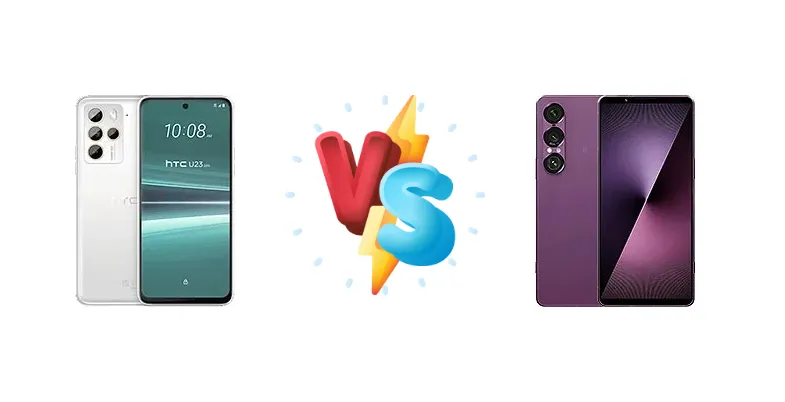
|
🏆 Quick Verdict
For the average user prioritizing raw performance and a superior display, the Sony Xperia 1 VII is the clear winner. Its Snapdragon 8 Elite chipset and significantly brighter display deliver a noticeably smoother and more immersive experience. However, the HTC U23 Pro remains a viable option for budget-conscious buyers who don't demand top-tier processing power.
| PHONES | ||
|---|---|---|
| Phone Names | HTC U23 Pro | Sony Xperia 1 VII |
| Network | ||
|---|---|---|
| 2G bands | GSM 850 / 900 / 1800 / 1900 | GSM 850 / 900 / 1800 / 1900 |
| 3G bands | HSDPA 850 / 900 / 1700(AWS) / 1900 / 2100 | HSDPA 800 / 850 / 900 / 1700(AWS) / 1900 / 2100 |
| 4G bands | 1, 3, 5, 7, 8, 12, 17, 20, 28, 38, 39, 40, 41 | 1, 2, 3, 4, 5, 7, 8, 12, 13, 17, 19, 20, 25, 26, 28, 32, 34, 38, 39, 40, 41, 66 - Europe |
| 5G bands | 1, 3, 7, 20, 28, 41, 78 SA/NSA | 1, 3, 5, 7, 8, 20, 28, 38, 40, 41, 75, 77, 78 SA/NSA/Sub6 - Europe |
| Speed | HSPA, LTE, 5G | HSPA, LTE, 5G |
| Technology | GSM / HSPA / LTE / 5G | GSM / HSPA / LTE / 5G |
| Launch | ||
|---|---|---|
| Announced | 2023, May 18 | 2025, May 13 |
| Status | Available. Released 2023, May 18 | Available. Released 2025, June 04 |
| Body | ||
|---|---|---|
| Build | Glass front (Gorilla Glass Victus), plastic frame, plastic back | Glass front (Gorilla Glass Victus 2), glass back (Gorilla Glass Victus), aluminum frame |
| Dimensions | 166.6 x 77.1 x 8.9 mm (6.56 x 3.04 x 0.35 in) | 162 x 74 x 8.2 mm (6.38 x 2.91 x 0.32 in) |
| SIM | Nano-SIM + Nano-SIM | · Nano-SIM + eSIM· Nano-SIM + Nano-SIM |
| Weight | 205 g (7.23 oz) | 197 g (6.95 oz) |
| IP67 dust/water resistant (up to 1m for 30 min) | - | |
| Display | ||
|---|---|---|
| Protection | Corning Gorilla Glass Victus | Corning Gorilla Glass Victus 2, Mohs level 5 |
| Resolution | 1080 x 2400 pixels, 20:9 ratio (~393 ppi density) | 1080 x 2340 pixels, 19.5:9 ratio (~396 ppi density) |
| Size | 6.7 inches, 108.4 cm2 (~84.4% screen-to-body ratio) | 6.5 inches, 103.7 cm2 (~86.5% screen-to-body ratio) |
| Type | OLED, 120Hz | LTPO OLED, 1B colors, 120Hz, HDR BT.2020 |
| Platform | ||
|---|---|---|
| CPU | Octa-core (1x2.4 GHz Cortex-A710 & 3x2.36 GHz Cortex-A710 & 4x1.8 GHz Cortex-A510) | Octa-core (2x4.32 GHz Oryon V2 Phoenix L + 6x3.53 GHz Oryon V2 Phoenix M) |
| Chipset | Qualcomm SM7450-AB Snapdragon 7 Gen 1 (4 nm) | Qualcomm SM8750-AB Snapdragon 8 Elite (3 nm) |
| GPU | Adreno 644 | Adreno 830 |
| OS | Android 13 | Android 15, up to 4 major Android upgrades |
| Memory | ||
|---|---|---|
| Card slot | microSDXC | microSDXC (uses shared SIM slot) |
| Internal | 256GB 8GB RAM, 256GB 12GB RAM | 256GB 12GB RAM, 512GB 12GB RAM |
| Main Camera | ||
|---|---|---|
| Features | Dual-LED flash, HDR, panorama | Zeiss optics, Zeiss T* lens coating, color spectrum sensor, LED flash, panorama, HDR, eye tracking |
| Quad | 108 MP, f/1.7, (wide), 1/1.67", 0.64μm, PDAF, OIS 8 MP, f/2.4, 120˚ (ultrawide), 1/4.0", 1.12µm 5 MP (macro) Auxiliary lens | - |
| Triple | - | 48 MP, f/1.9, 24mm (wide), 1/1.35", 1.12µm, dual pixel PDAF, OIS 12 MP, f/2.3, 85mm (telephoto), f/3.5, 170mm (telephoto), 1/3.5", 1.0µm, dual pixel PDAF, 3.5x-7.1x continuous optical zoom, OIS, 4cm macro @ 120mm, no AF 48 MP, f/2.0, 16mm (ultrawide), 1/1.56", 1.0µm, PDAF |
| Video | 4K@30fps, 1080p@30fps, gyro-EIS | 4K@24/30/60/120fps HDR, 1080p@30/60/120fps; 5-axis gyro-EIS, OIS |
| Selfie camera | ||
|---|---|---|
| Features | HDR | HDR |
| Single | 32 MP, f/2.5, (wide), 1/3.2", 0.7µm | 12 MP, f/2.0, 24mm (wide), 1/2.9", 1.22µm |
| Video | 1080p@30fps | 4K@30/60fps, 1080p@30/60fps, 5-axis gyro-EIS |
| Sound | ||
|---|---|---|
| 3.5mm jack | Yes | - |
| 35mm jack | Yes | Yes |
| Loudspeaker | Yes | Yes, with stereo speakers |
| Comms | ||
|---|---|---|
| Bluetooth | 5.2, A2DP, LE | 6.0, A2DP, LE Audio, aptX HD, aptX Adaptive, aptX Lossless |
| NFC | Yes | Yes |
| Positioning | GPS, GLONASS, GALILEO, BDS | GPS, GLONASS, BDS, GALILEO, QZSS |
| Radio | No | No |
| USB | USB Type-C 3.0 | USB Type-C 3.2, OTG, video output |
| WLAN | Wi-Fi 802.11 a/b/g/n/ac/6, dual-band | Wi-Fi 802.11 a/b/g/n/ac/6e/7, tri-band, Wi-Fi Direct, DLNA |
| Features | ||
|---|---|---|
| Sensors | Fingerprint (side-mounted), accelerometer, gyro, proximity, compass | Fingerprint (side-mounted), accelerometer, gyro, proximity, barometer, compass |
| Battery | ||
|---|---|---|
| Charging | 30W wired 15W wireless 5W reverse wireless Reverse wired | 30W wired, PD3.0, PPS, 50% in 30 min 15W wireless Reverse wireless |
| Type | Li-Ion 4600 mAh | 5000 mAh |
| Misc | ||
|---|---|---|
| Colors | Snow White, Coffee Black | Moss Green, Orchid Purple, Slate Black |
| Models | 2QC9200, 2QC9100, 2QCB100 | XQ-FS54, XQFS54EUKCG.GC, XQFS54EUKCV.GC, XQFS54EUKCB.GC, PDX256 |
| Price | About 220 EUR | € 1,338.99 / $ 1,394.99 / £ 1,149.94 |
| EU LABEL | ||
|---|---|---|
| Battery | - | 43:30h endurance, 1400 cycles |
| Energy | - | Class B |
| Free fall | - | Class B (181 falls) |
| Repairability | - | Class D |
HTC U23 Pro
- More affordable price point
- Good battery endurance (83h)
- Supports reverse wireless charging
- Significantly less powerful chipset
- Dimmer display compared to the Xperia 1 VII
- Less advanced camera system (likely)
Sony Xperia 1 VII
- Exceptional performance with Snapdragon 8 Elite
- Brighter and potentially more advanced display
- Faster charging with PD3.0 and PPS
- Higher price tag
- May experience more heat under sustained load (though 3nm helps)
- Similar wireless charging speed to U23 Pro
Display Comparison
The Sony Xperia 1 VII boasts a significantly brighter display, reaching 1475 nits, compared to the HTC U23 Pro's 727 nits. This difference translates to vastly improved visibility in direct sunlight. While both support wireless charging, the Xperia 1 VII's display likely utilizes a more advanced panel technology, potentially LTPO, for variable refresh rates and improved power efficiency, though this isn't explicitly stated. The higher brightness of the Xperia 1 VII benefits users who frequently consume media outdoors or in brightly lit environments.
Camera Comparison
While both phones feature camera systems, the context data lacks specifics to make a detailed comparison. However, given Sony's expertise in imaging sensors and the Xperia 1 VII's flagship positioning, it's reasonable to assume a more sophisticated camera setup with larger sensors, improved image stabilization (OIS), and advanced image processing algorithms. The U23 Pro likely offers a competent camera experience, but the Xperia 1 VII is expected to deliver superior image quality, particularly in low-light conditions and for video recording. We can infer that the Xperia 1 VII will likely have more advanced video recording capabilities, potentially including 8K recording and cinematic modes.
Performance
The core difference lies in the chipsets: the HTC U23 Pro utilizes the Qualcomm SM7450-AB Snapdragon 7 Gen 1 (4nm), while the Sony Xperia 1 VII is powered by the Snapdragon 8 Elite (3nm). The 3nm process node of the 8 Elite offers substantial gains in power efficiency and transistor density, leading to significantly higher performance. The Xperia 1 VII's CPU, with its Oryon V2 Phoenix cores (2x4.32 GHz + 6x3.53 GHz), dwarfs the U23 Pro's Octa-core configuration (1x2.4 GHz Cortex-A710 & 3x2.36 GHz Cortex-A710 & 4x1.8 GHz Cortex-A510). This translates to faster app loading times, smoother multitasking, and superior gaming performance on the Xperia 1 VII. The 8 Elite's advanced GPU will also handle graphically demanding tasks with ease.
Battery Life
The Xperia 1 VII's endurance rating of 43:30h and active use score of 15:32h significantly surpasses the HTC U23 Pro's 83h endurance rating. While endurance ratings are based on standardized tests, the Xperia 1 VII's more efficient chipset and potentially larger battery capacity contribute to its longer battery life. Both phones support 30W wired and 15W wireless charging, but the Xperia 1 VII adds PD3.0 and PPS support, enabling faster charging speeds – reaching 50% in just 30 minutes. The Xperia 1 VII also boasts a claimed 1400 battery cycles, suggesting greater long-term battery health.
Buying Guide
Buy the HTC U23 Pro if you need a reliable daily driver with good battery life and don't require the absolute fastest performance. It's ideal for users who prioritize value and are content with a solid, if not spectacular, experience. Buy the Sony Xperia 1 VII if you're a power user, content creator, or mobile gamer who demands the best possible performance, a stunning display, and a long-lasting battery with fast charging capabilities. This phone is for those who want a no-compromise flagship experience.