
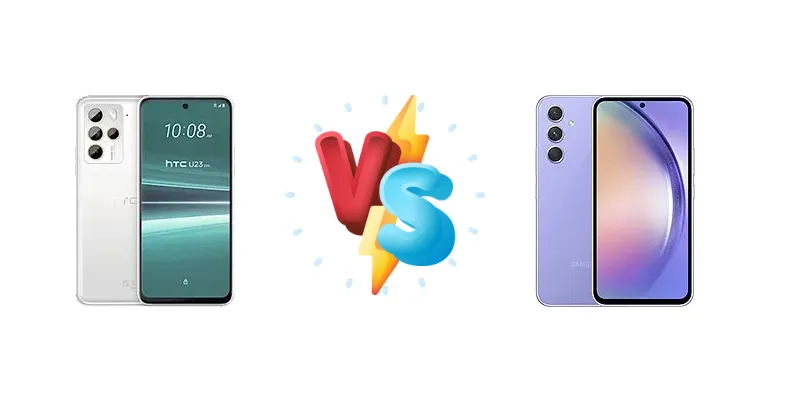
HTC U23 Pro vs Samsung Galaxy A54: A Detailed Showdown
| Phones Images | |||||
|---|---|---|---|---|---|
|
🏆 Quick Verdict
The Samsung Galaxy A54 emerges as the overall winner thanks to its superior display brightness, longer battery life, and established software support. While the HTC U23 Pro boasts a capable chipset, the A54's consistent performance and brand recognition give it the edge.
| PHONES | ||
|---|---|---|
| Phone Names | HTC U23 Pro | Samsung Galaxy A54 |
| Network | ||
|---|---|---|
| 2G bands | GSM 850 / 900 / 1800 / 1900 | GSM 850 / 900 / 1800 / 1900 |
| 3G bands | HSDPA 850 / 900 / 1700(AWS) / 1900 / 2100 | HSDPA 850 / 900 / 1700(AWS) / 1900 / 2100 |
| 4G bands | 1, 3, 5, 7, 8, 12, 17, 20, 28, 38, 39, 40, 41 | 1, 2, 3, 4, 5, 7, 8, 12, 17, 20, 26, 28, 32, 38, 40, 41, 66 - International |
| 5G bands | 1, 3, 7, 20, 28, 41, 78 SA/NSA | 1, 3, 7, 8, 20, 28, 38, 40, 41, 77, 78 SA/NSA/Sub6 - International |
| Speed | HSPA, LTE, 5G | HSPA, LTE, 5G |
| Technology | GSM / HSPA / LTE / 5G | GSM / HSPA / LTE / 5G |
| - | 25, 41, 66, 71 SA/NSA/Sub6/mmWave - USA | |
| Launch | ||
|---|---|---|
| Announced | 2023, May 18 | 2023, March 15 |
| Status | Available. Released 2023, May 18 | Available. Released 2023, March 24 |
| Body | ||
|---|---|---|
| Build | Glass front (Gorilla Glass Victus), plastic frame, plastic back | Glass front (Gorilla Glass 5), glass back (Gorilla Glass 5), plastic frame |
| Dimensions | 166.6 x 77.1 x 8.9 mm (6.56 x 3.04 x 0.35 in) | 158.2 x 76.7 x 8.2 mm (6.23 x 3.02 x 0.32 in) |
| SIM | Nano-SIM + Nano-SIM | · Nano-SIM + eSIM· Nano-SIM + Nano-SIM |
| Weight | 205 g (7.23 oz) | 202 g (7.13 oz) |
| IP67 dust/water resistant (up to 1m for 30 min) | IP67 dust/water resistant (up to 1m for 30 min) | |
| Display | ||
|---|---|---|
| Protection | Corning Gorilla Glass Victus | Corning Gorilla Glass 5 |
| Resolution | 1080 x 2400 pixels, 20:9 ratio (~393 ppi density) | 1080 x 2340 pixels, 19.5:9 ratio (~403 ppi density) |
| Size | 6.7 inches, 108.4 cm2 (~84.4% screen-to-body ratio) | 6.4 inches, 100.5 cm2 (~82.9% screen-to-body ratio) |
| Type | OLED, 120Hz | Super AMOLED, 120Hz, HDR10+, 1000 nits (HBM) |
| Platform | ||
|---|---|---|
| CPU | Octa-core (1x2.4 GHz Cortex-A710 & 3x2.36 GHz Cortex-A710 & 4x1.8 GHz Cortex-A510) | Octa-core (4x2.4 GHz Cortex-A78 & 4x2.0 GHz Cortex-A55) |
| Chipset | Qualcomm SM7450-AB Snapdragon 7 Gen 1 (4 nm) | Exynos 1380 (5 nm) |
| GPU | Adreno 644 | Mali-G68 MP5 |
| OS | Android 13 | Android 13, up to 4 major Android upgrades, One UI 7 |
| Memory | ||
|---|---|---|
| Card slot | microSDXC | microSDXC (uses shared SIM slot) |
| Internal | 256GB 8GB RAM, 256GB 12GB RAM | 128GB 4GB RAM, 128GB 6GB RAM, 128GB 8GB RAM, 256GB 6GB RAM, 256GB 8GB RAM |
| Main Camera | ||
|---|---|---|
| Features | Dual-LED flash, HDR, panorama | LED flash, panorama, HDR |
| Quad | 108 MP, f/1.7, (wide), 1/1.67", 0.64μm, PDAF, OIS 8 MP, f/2.4, 120˚ (ultrawide), 1/4.0", 1.12µm 5 MP (macro) Auxiliary lens | - |
| Single | - | 32 MP, f/2.2, 26mm (wide), 1/2.8", 0.8µm |
| Triple | - | 50 MP, f/1.8, 23mm (wide), 1/1.56", 1.0µm, PDAF, OIS 12 MP, f/2.2, 13mm, 123˚ (ultrawide), 1/3.X", 1.12µm 5 MP (macro) |
| Video | 4K@30fps, 1080p@30fps, gyro-EIS | 4K@30fps, 1080p@30/60fps, 720p@480fps, gyro-EIS |
| Selfie camera | ||
|---|---|---|
| Features | HDR | - |
| Single | 32 MP, f/2.5, (wide), 1/3.2", 0.7µm | 32 MP, f/2.2, 26mm (wide), 1/2.8", 0.8µm |
| Video | 1080p@30fps | 4K@30fps, 1080p@30/60fps |
| Sound | ||
|---|---|---|
| 3.5mm jack | Yes | No |
| 35mm jack | Yes | No |
| Loudspeaker | Yes | Yes, with stereo speakers |
| Comms | ||
|---|---|---|
| Bluetooth | 5.2, A2DP, LE | 5.3, A2DP, LE |
| NFC | Yes | Yes (market/region dependent) |
| Positioning | GPS, GLONASS, GALILEO, BDS | GPS, GLONASS, GALILEO, BDS |
| Radio | No | No |
| USB | USB Type-C 3.0 | USB Type-C 2.0, OTG |
| WLAN | Wi-Fi 802.11 a/b/g/n/ac/6, dual-band | Wi-Fi 802.11 a/b/g/n/ac/6, dual-band, Wi-Fi Direct |
| Features | ||
|---|---|---|
| Sensors | Fingerprint (side-mounted), accelerometer, gyro, proximity, compass | Fingerprint (under display, optical), accelerometer, gyro, compass, barometer (USA only) |
| - | Virtual proximity sensing | |
| Battery | ||
|---|---|---|
| Charging | 30W wired 15W wireless 5W reverse wireless Reverse wired | 25W wired |
| Type | Li-Ion 4600 mAh | 5000 mAh |
| Misc | ||
|---|---|---|
| Colors | Snow White, Coffee Black | Lime, Graphite, Violet, White |
| Models | 2QC9200, 2QC9100, 2QCB100 | SM-A546V, SM-A546U, SM-A546U1, SM-A546B, SM-A546B/DS, SM-A546E, SM-A546E/DS, SM-A5460, SM-A546M, SM-A546M/DS, SM-A546W |
| Price | About 220 EUR | € 210.00 / $ 119.11 / £ 169.95 / ₹ 28,999 |
| SAR | - | 0.81 W/kg (head) 0.67 W/kg (body) |
| SAR EU | - | 0.69 W/kg (head) 1.34 W/kg (body) |
| Tests | ||
|---|---|---|
| Battery life | - | Endurance rating 119h |
| Camera | - | Photo / Video |
| Display | - | Contrast ratio: Infinite (nominal) |
| Loudspeaker | - | -26.6 LUFS (Good) |
| Performance | - | AnTuTu: 506678 (v9) GeekBench: 2703 (v5.1), 2797 (v6) GFXBench: 25fps (ES 3.1 onscreen) |
HTC U23 Pro
- Unique design
- Decent performance for the price
- Reverse wireless charging
- Lower display brightness
- Shorter battery life
- Less established software support
Samsung Galaxy A54
- Bright and vibrant display
- Excellent battery life
- Reliable software and updates
- Strong camera performance
- Charging speed could be faster
- Exynos chipset can be slightly less efficient than Snapdragon in some scenarios
Display Comparison
The Samsung Galaxy A54 takes a clear lead in the display department. Its 980 nits peak brightness significantly outshines the HTC U23 Pro's 727 nits, making it much easier to view content outdoors. The A54's 'Infinite' contrast ratio (nominal) suggests excellent blacks and vibrant colors, while the U23 Pro's display, though good, doesn't reach the same level of visual impact. Both offer vibrant colors and good resolution.
Camera Comparison
Camera performance is subjective, but both phones offer versatile camera setups. The Galaxy A54 is generally known for its consistently good image processing and reliable results across various lighting conditions. The HTC U23 Pro's camera is capable, but may not match the A54's overall image quality and software features. Both offer photo and video capabilities.
Performance
Both phones utilize octa-core processors. The HTC U23 Pro's Snapdragon 7 Gen 1 (4nm) offers competitive performance, particularly in gaming. The Samsung Galaxy A54's Exynos 1380 (5nm) provides smooth everyday performance and efficient power management. While benchmarks might show slight differences, real-world usage will likely feel similar for most users. The A54's software optimization contributes to a fluid experience.
Battery Life
The Samsung Galaxy A54 dominates in battery life. Its endurance rating of 119h significantly surpasses the HTC U23 Pro's 83h. The A54's efficient Exynos chipset and optimized software contribute to its impressive longevity. While the U23 Pro offers 30W wired charging, the A54's 25W charging is still adequate, and the A54's battery life minimizes the need for frequent charging.
Buying Guide
The HTC U23 Pro is ideal for users seeking a unique design and a decent performance for everyday tasks, especially if they appreciate HTC's design aesthetic. The Samsung Galaxy A54 is a better choice for those prioritizing a vibrant display, long-lasting battery, and the reliability of Samsung's software and ecosystem.