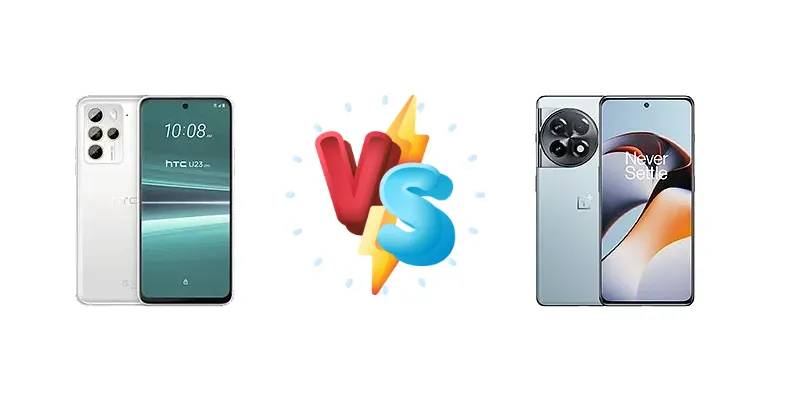
The HTC U23 Pro and OnePlus 11R represent compelling options in the increasingly competitive mid-range smartphone market. While both devices utilize Qualcomm Snapdragon chipsets, they target slightly different priorities – the U23 Pro emphasizing endurance and a balanced experience, while the 11R prioritizes raw performance and blazing-fast charging. This comparison dissects their key differences to help you determine which best suits your needs.
🏆 Quick Verdict
For most users, the OnePlus 11R emerges as the stronger choice. Its Snapdragon 8+ Gen 1 chipset delivers significantly superior performance, making it ideal for demanding tasks and gaming. While the U23 Pro boasts a longer endurance rating, the 11R’s 100W charging mitigates battery concerns, offering a faster path to a full charge.
| Network |
|---|
| 2G bands | GSM 850 / 900 / 1800 / 1900 | GSM 850 / 900 / 1800 / 1900 |
| 3G bands | HSDPA 850 / 900 / 1700(AWS) / 1900 / 2100 | HSDPA 850 / 900 / 1700(AWS) / 2100 |
| 4G bands | 1, 3, 5, 7, 8, 12, 17, 20, 28, 38, 39, 40, 41 | 1, 3, 4, 5, 8, 28, 34, 38, 39, 40, 41 |
| 5G bands | 1, 3, 7, 20, 28, 41, 78 SA/NSA | 1, 3, 5, 8, 28, 40, 41, 77, 78 SA/NSA |
| Speed | HSPA, LTE, 5G | HSPA, LTE (3CA), 5G |
| Technology | GSM / HSPA / LTE / 5G | GSM / CDMA / HSPA / LTE / 5G |
| | - | CDMA 800 |
| Launch |
|---|
| Announced | 2023, May 18 | 2023, February 07 |
| Status | Available. Released 2023, May 18 | Available. Released 2023, February 21 |
| Body |
|---|
| Build | Glass front (Gorilla Glass Victus), plastic frame, plastic back | Glass front, glass back (Gorilla Glass 5), plastic frame |
| Dimensions | 166.6 x 77.1 x 8.9 mm (6.56 x 3.04 x 0.35 in) | 163.4 x 74.3 x 8.7 mm (6.43 x 2.93 x 0.34 in) |
| SIM | Nano-SIM + Nano-SIM | Nano-SIM + Nano-SIM |
| Weight | 205 g (7.23 oz) | 204 g (7.20 oz) |
| | IP67 dust/water resistant (up to 1m for 30 min) | - |
| Display |
|---|
| Protection | Corning Gorilla Glass Victus | - |
| Resolution | 1080 x 2400 pixels, 20:9 ratio (~393 ppi density) | 1240 x 2772 pixels, 20:9 ratio (~451 ppi density) |
| Size | 6.7 inches, 108.4 cm2 (~84.4% screen-to-body ratio) | 6.74 inches, 109.2 cm2 (~90.0% screen-to-body ratio) |
| Type | OLED, 120Hz | Fluid AMOLED, 1B colors, 120Hz, HDR10+, 1450 nits (peak) |
| Platform |
|---|
| CPU | Octa-core (1x2.4 GHz Cortex-A710 & 3x2.36 GHz Cortex-A710 & 4x1.8 GHz Cortex-A510) | Octa-core (1x3.0 GHz Cortex-X2 & 3x2.5 GHz Cortex-A710 & 4x1.80 GHz Cortex-A510) |
| Chipset | Qualcomm SM7450-AB Snapdragon 7 Gen 1 (4 nm) | Qualcomm SM8475 Snapdragon 8+ Gen 1 (4 nm) |
| GPU | Adreno 644 | Adreno 730 |
| OS | Android 13 | Android 13, upgradable to Android 15, OxygenOS 15 |
| Memory |
|---|
| Card slot | microSDXC | No |
| Internal | 256GB 8GB RAM, 256GB 12GB RAM | 128GB 8GB RAM, 256GB 16GB RAM, 512GB 18GB RAM |
| | - | UFS 3.1 |
| Main Camera |
|---|
| Features | Dual-LED flash, HDR, panorama | Color spectrum sensor, LED flash, HDR, panorama |
| Quad | 108 MP, f/1.7, (wide), 1/1.67", 0.64μm, PDAF, OIS
8 MP, f/2.4, 120˚ (ultrawide), 1/4.0", 1.12µm
5 MP (macro)
Auxiliary lens | - |
| Single | - | 16 MP, f/2.4, 24mm (wide), 1/3.09", 1.0µm |
| Triple | - | 50 MP, f/1.8, 24mm (wide), 1/1.56", 1.0µm, multi-directional PDAF, OIS
8 MP, f/2.2, 120˚ (ultrawide), 1/4.0", 1.12µm
2 MP (macro) |
| Video | 4K@30fps, 1080p@30fps, gyro-EIS | 4K@30/60fps, 1080p@30/60/240fps, gyro-EIS |
| Selfie camera |
|---|
| Features | HDR | HDR |
| Single | 32 MP, f/2.5, (wide), 1/3.2", 0.7µm | 16 MP, f/2.4, 24mm (wide), 1/3.09", 1.0µm |
| Video | 1080p@30fps | 1080p@30fps |
| Sound |
|---|
| 3.5mm jack | Yes | No |
| 35mm jack | Yes | No |
| Loudspeaker | Yes | Yes, with stereo speakers |
| | - | 24-bit/192kHz audio |
| Comms |
|---|
| Bluetooth | 5.2, A2DP, LE | 5.3, A2DP, LE, aptX HD |
| Infrared port | - | Yes |
| NFC | Yes | Yes |
| Positioning | GPS, GLONASS, GALILEO, BDS | GPS (L1+L5), GLONASS (G1), BDS (B1I+B1c+B2a), GALILEO (E1+E5a), QZSS (L1+L5) |
| Radio | No | No |
| USB | USB Type-C 3.0 | USB Type-C 2.0 |
| WLAN | Wi-Fi 802.11 a/b/g/n/ac/6, dual-band | Wi-Fi 802.11 a/b/g/n/ac/6, dual-band |
| Features |
|---|
| Sensors | Fingerprint (side-mounted), accelerometer, gyro, proximity, compass | Fingerprint (under display, optical), accelerometer, gyro, proximity, compass |
| Battery |
|---|
| Charging | 30W wired
15W wireless
5W reverse wireless
Reverse wired | 100W wired |
| Type | Li-Ion 4600 mAh | Li-Po 5000 mAh |
| Misc |
|---|
| Colors | Snow White, Coffee Black | Galactic Silver, Sonic Black, Solar Red |
| Models | 2QC9200, 2QC9100, 2QCB100 | CPH2487 |
| Price | About 220 EUR | About 600 EUR |
| SAR | - | 1.16 W/kg (head) 0.61 W/kg (body) |
HTC U23 Pro
- Excellent battery endurance (83h rating)
- Wireless and reverse wireless charging support
- Balanced performance for everyday tasks
- Significantly slower charging speed (30W)
- Less powerful chipset compared to the 11R
- Limited camera information available
OnePlus 11R
- Superior performance with Snapdragon 8+ Gen 1
- Blazing-fast 100W wired charging
- Likely better gaming experience
- No wireless charging support
- Potentially shorter battery life compared to U23 Pro
- Camera specifications are unknown
Display Comparison
The HTC U23 Pro features a display capable of reaching 727 nits of peak brightness, a respectable figure for outdoor visibility. However, the OnePlus 11R’s display specifications are not provided, making a direct brightness comparison difficult. Given OnePlus’s history, it’s likely comparable or superior. Both phones utilize a 4nm chipset, which indirectly benefits display efficiency. The U23 Pro’s display technology isn’t specified, but the absence of high refresh rate information suggests it’s a standard 60Hz panel, potentially limiting smoothness compared to some competitors.
Camera Comparison
Detailed camera specifications beyond 'Photo / Video' are absent for the HTC U23 Pro, hindering a thorough comparison. The OnePlus 11R’s camera details are also missing. Without sensor size, aperture, or OIS information, it’s difficult to assess image quality. However, given the market positioning, it’s reasonable to assume both phones will offer competent camera systems, but likely won’t compete with flagship-level photography. The absence of information suggests neither phone prioritizes camera innovation as a key selling point.
Performance
The core difference lies in the chipsets. The OnePlus 11R’s Snapdragon 8+ Gen 1 (4nm) is a significant step up from the HTC U23 Pro’s Snapdragon 7 Gen 1 (4nm). The 8+ Gen 1 features a Cortex-X2 prime core clocked at 3.0 GHz, alongside three Cortex-A710 performance cores at 2.5 GHz, and four Cortex-A510 efficiency cores at 1.8 GHz. This contrasts with the U23 Pro’s configuration of one Cortex-A710 at 2.4 GHz, three more at 2.36 GHz, and four Cortex-A510 cores at 1.8 GHz. The 8+ Gen 1’s architectural advantages translate to substantially faster CPU and GPU performance, making the 11R the clear winner for gaming and demanding applications. The U23 Pro’s 7 Gen 1 is still capable, but will exhibit more noticeable slowdowns under heavy load.
Battery Life
The HTC U23 Pro boasts an endurance rating of 83 hours, indicating excellent battery life. However, the OnePlus 11R compensates for potentially lower endurance with its 100W wired charging, a massive advantage over the U23 Pro’s 30W charging. The 11R can likely achieve a full charge in under 30 minutes, while the U23 Pro will take considerably longer. The U23 Pro also offers 15W wireless and 5W reverse wireless charging, features absent on the 11R. This makes the U23 Pro more versatile for users who prefer cable-free charging or need to top up accessories.
Buying Guide
Buy the HTC U23 Pro if you prioritize long-term battery life and appreciate the convenience of wireless charging, even at the cost of peak performance. It’s a solid all-rounder for everyday use. Buy the OnePlus 11R if you’re a power user, gamer, or frequently find yourself needing to quickly top up your battery. The Snapdragon 8+ Gen 1 provides a noticeable performance boost, and the 100W charging is a game-changer.
Frequently Asked Questions
❓ How much faster is the OnePlus 11R's charging compared to the HTC U23 Pro?
The OnePlus 11R's 100W charging is dramatically faster. It can likely charge from 0-100% in under 30 minutes, while the HTC U23 Pro's 30W charging will take well over an hour, potentially closer to two hours for a full charge. This difference is crucial for users who prioritize quick top-ups.
❓ Will the Snapdragon 7 Gen 1 in the HTC U23 Pro struggle with demanding games?
While the Snapdragon 7 Gen 1 is a capable chipset, it will likely exhibit more throttling and lower frame rates in graphically intensive games compared to the Snapdragon 8+ Gen 1 in the OnePlus 11R. The 11R is the better choice for serious mobile gamers.
❓ Does the lack of wireless charging on the OnePlus 11R significantly impact its usability?
For users heavily reliant on wireless charging, the absence of this feature on the 11R is a drawback. However, the 100W wired charging is so fast that it often negates the convenience of wireless charging, as you'll spend less time tethered to a cable.