
HTC U23 Pro vs. Nothing Phone (2): A Detailed Comparison of Mid-Range Powerhouses
| Phones Images | |||||
|---|---|---|---|---|---|
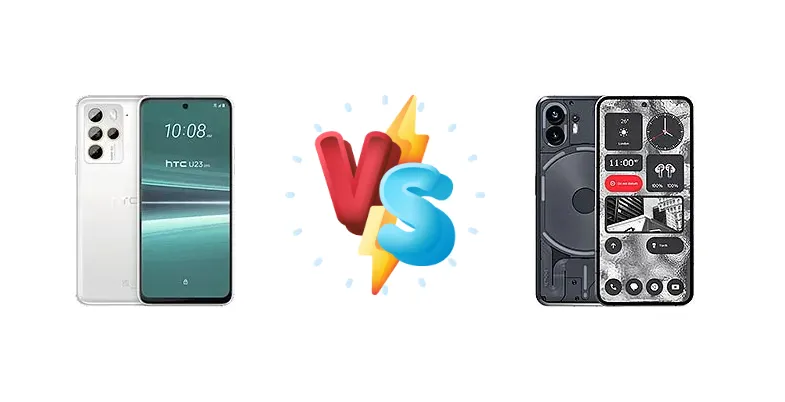
|
🏆 Quick Verdict
For most users, the Nothing Phone (2) is the superior choice. Its Snapdragon 8+ Gen 1 chipset provides a substantial performance boost over the U23 Pro’s Snapdragon 7 Gen 1, translating to smoother multitasking and gaming. While the U23 Pro offers respectable battery endurance, the Nothing Phone (2) compensates with faster charging speeds and a brighter display.
| PHONES | ||
|---|---|---|
| Phone Names | HTC U23 Pro | Nothing Phone (2) |
| Network | ||
|---|---|---|
| 2G bands | GSM 850 / 900 / 1800 / 1900 | GSM 850 / 900 / 1800 / 1900 |
| 3G bands | HSDPA 850 / 900 / 1700(AWS) / 1900 / 2100 | HSDPA 800 / 850 / 900 / 1700(AWS) / 1900 / 2100 |
| 4G bands | 1, 3, 5, 7, 8, 12, 17, 20, 28, 38, 39, 40, 41 | 1, 2, 3, 4, 5, 7, 8, 12, 17, 18, 19, 20, 25, 26, 28, 30, 32, 34, 38, 39, 40, 41, 42, 48, 66, 71 |
| 5G bands | 1, 3, 7, 20, 28, 41, 78 SA/NSA | 1, 2, 3, 5, 7, 8, 12, 20, 25, 28, 30, 38, 40, 41, 66, 71, 75, 77, 78 SA/NSA |
| Speed | HSPA, LTE, 5G | HSPA, LTE, 5G |
| Technology | GSM / HSPA / LTE / 5G | GSM / HSPA / LTE / 5G |
| Launch | ||
|---|---|---|
| Announced | 2023, May 18 | 2023, July 11 |
| Status | Available. Released 2023, May 18 | Available. Released 2023, July 17 |
| Body | ||
|---|---|---|
| Build | Glass front (Gorilla Glass Victus), plastic frame, plastic back | Glass front (Gorilla Glass 5), glass back (Gorilla Glass 5), aluminum frame |
| Dimensions | 166.6 x 77.1 x 8.9 mm (6.56 x 3.04 x 0.35 in) | 162.1 x 76.4 x 8.6 mm (6.38 x 3.01 x 0.34 in) |
| SIM | Nano-SIM + Nano-SIM | Nano-SIM + Nano-SIM |
| Weight | 205 g (7.23 oz) | 201.2 g (7.09 oz) |
| IP67 dust/water resistant (up to 1m for 30 min) | - | |
| Display | ||
|---|---|---|
| Protection | Corning Gorilla Glass Victus | Corning Gorilla Glass 5 |
| Resolution | 1080 x 2400 pixels, 20:9 ratio (~393 ppi density) | 1080 x 2412 pixels, 20:9 ratio (~394 ppi density) |
| Size | 6.7 inches, 108.4 cm2 (~84.4% screen-to-body ratio) | 6.7 inches, 108.0 cm2 (~87.2% screen-to-body ratio) |
| Type | OLED, 120Hz | LTPO OLED, 1B colors, 120Hz, 1920Hz PWM, HDR10+, 1600 nits (HBM), 1600 nits (peak) |
| Platform | ||
|---|---|---|
| CPU | Octa-core (1x2.4 GHz Cortex-A710 & 3x2.36 GHz Cortex-A710 & 4x1.8 GHz Cortex-A510) | Octa-core (1x3.0 GHz Cortex-X2 & 3x2.5 GHz Cortex-A710 & 4x1.80 GHz Cortex-A510) |
| Chipset | Qualcomm SM7450-AB Snapdragon 7 Gen 1 (4 nm) | Qualcomm SM8475 Snapdragon 8+ Gen 1 (4 nm) |
| GPU | Adreno 644 | Adreno 730 |
| OS | Android 13 | Android 13, upgradable to Android 15, up to 3 major Android upgrades, Nothing OS 3.0 |
| Memory | ||
|---|---|---|
| Card slot | microSDXC | No |
| Internal | 256GB 8GB RAM, 256GB 12GB RAM | 128GB 8GB RAM, 256GB 12GB RAM, 512GB 12GB RAM |
| Main Camera | ||
|---|---|---|
| Dual | - | 50 MP, f/1.9, 24mm (wide), 1/1.56", 1.0µm, PDAF, OIS 50 MP, f/2.2, 114˚ (ultrawide), 1/2.76", 0.64µm, AF |
| Features | Dual-LED flash, HDR, panorama | LED flash, panorama, HDR |
| Quad | 108 MP, f/1.7, (wide), 1/1.67", 0.64μm, PDAF, OIS 8 MP, f/2.4, 120˚ (ultrawide), 1/4.0", 1.12µm 5 MP (macro) Auxiliary lens | - |
| Video | 4K@30fps, 1080p@30fps, gyro-EIS | 4K@30/60fps, 1080p@30/60fps, gyro-EIS, live HDR, OIS |
| Selfie camera | ||
|---|---|---|
| Features | HDR | HDR |
| Single | 32 MP, f/2.5, (wide), 1/3.2", 0.7µm | 32 MP, f/2.5, (wide), 1/2.74", 0.8µm |
| Video | 1080p@30fps | 1080p@30fps |
| Sound | ||
|---|---|---|
| 3.5mm jack | Yes | - |
| 35mm jack | Yes | No |
| Loudspeaker | Yes | Yes, with stereo speakers |
| Comms | ||
|---|---|---|
| Bluetooth | 5.2, A2DP, LE | 5.3, A2DP, LE, aptX HD, aptX Adaptive |
| NFC | Yes | Yes |
| Positioning | GPS, GLONASS, GALILEO, BDS | GPS (L1+L5), GLONASS (L1), BDS (B1I+B1c), GALILEO (E1), QZSS (L1), NavIC |
| Radio | No | No |
| USB | USB Type-C 3.0 | USB Type-C 2.0, OTG |
| WLAN | Wi-Fi 802.11 a/b/g/n/ac/6, dual-band | Wi-Fi 802.11 a/b/g/n/ac/6, dual-band, Wi-Fi Direct |
| Features | ||
|---|---|---|
| Sensors | Fingerprint (side-mounted), accelerometer, gyro, proximity, compass | Fingerprint (under display, optical), accelerometer, proximity, gyro, compass |
| Battery | ||
|---|---|---|
| Charging | 30W wired 15W wireless 5W reverse wireless Reverse wired | 45W wired, PD3.0, PPS, QC4, 100% in 55 min 15W wireless, 100% in 130 min 5W reverse wireless |
| Type | Li-Ion 4600 mAh | Li-Ion 4700 mAh |
| Misc | ||
|---|---|---|
| Colors | Snow White, Coffee Black | White, Dark Gray |
| Models | 2QC9200, 2QC9100, 2QCB100 | A065 |
| Price | About 220 EUR | $ 379.99 / £ 370.00 |
HTC U23 Pro
- Potentially longer battery endurance with light use
- Reverse wireless charging for accessories
- More understated design
- Significantly slower performance compared to the Nothing Phone (2)
- Dimmer display, less visible outdoors
- Slower charging speeds
Nothing Phone (2)
- Flagship-level performance with Snapdragon 8+ Gen 1
- Brighter display for better outdoor visibility
- Faster wired and wireless charging
- Slightly lower endurance rating than the U23 Pro
- More polarizing design
- Potentially higher price
Display Comparison
The Nothing Phone (2) boasts a significantly brighter display, reaching 998 nits measured, compared to the HTC U23 Pro’s 727 nits. This difference is immediately noticeable in outdoor visibility. While both utilize OLED technology, the higher peak brightness of the Nothing Phone (2) provides a more vibrant and usable experience in direct sunlight. Neither specification details refresh rate or panel type (LTPO), but the brightness difference is a clear win for the Nothing Phone (2).
Camera Comparison
Both devices feature capable photo and video capabilities, but detailed sensor information is lacking. Without knowing sensor sizes or specific lens apertures, a direct comparison is difficult. However, the Snapdragon 8+ Gen 1’s superior image signal processor (ISP) in the Nothing Phone (2) will likely result in better image processing, particularly in low-light conditions. The absence of details on features like OIS makes it hard to definitively declare a winner, but the Nothing Phone (2)'s chipset gives it an edge.
Performance
The core difference between these two phones lies in their chipsets. The Nothing Phone (2) is powered by the Qualcomm SM8475 Snapdragon 8+ Gen 1 (4 nm), featuring a Cortex-X2 prime core clocked at 3.0 GHz. This is a substantial upgrade over the HTC U23 Pro’s Snapdragon 7 Gen 1 (SM7450-AB, 4 nm) which tops out at 2.4 GHz. The Snapdragon 8+ Gen 1’s architectural advantages, including the faster prime core and improved GPU, will result in significantly faster app loading times, smoother multitasking, and a better gaming experience. The Nothing Phone (2) is the clear winner for performance-intensive tasks.
Battery Life
The Nothing Phone (2) achieves an active use score of 14:21h and an endurance rating of 103h, surpassing the HTC U23 Pro’s 83h endurance rating. While the U23 Pro’s endurance suggests it can last longer on a single charge with moderate use, the Nothing Phone (2) compensates with significantly faster charging. The Nothing Phone (2) supports 45W wired charging (100% in 55 minutes) and 15W wireless charging, while the U23 Pro is limited to 30W wired, 15W wireless, and offers reverse wired and wireless charging. The faster charging speeds of the Nothing Phone (2) are a major convenience factor.
Buying Guide
Buy the HTC U23 Pro if you prioritize a more conservative design and value a slightly longer endurance rating, potentially benefiting users who frequently find themselves away from a charger for extended periods. Buy the Nothing Phone (2) if you demand flagship-level performance for gaming and demanding applications, appreciate a distinctive aesthetic, and want the convenience of significantly faster wired charging.