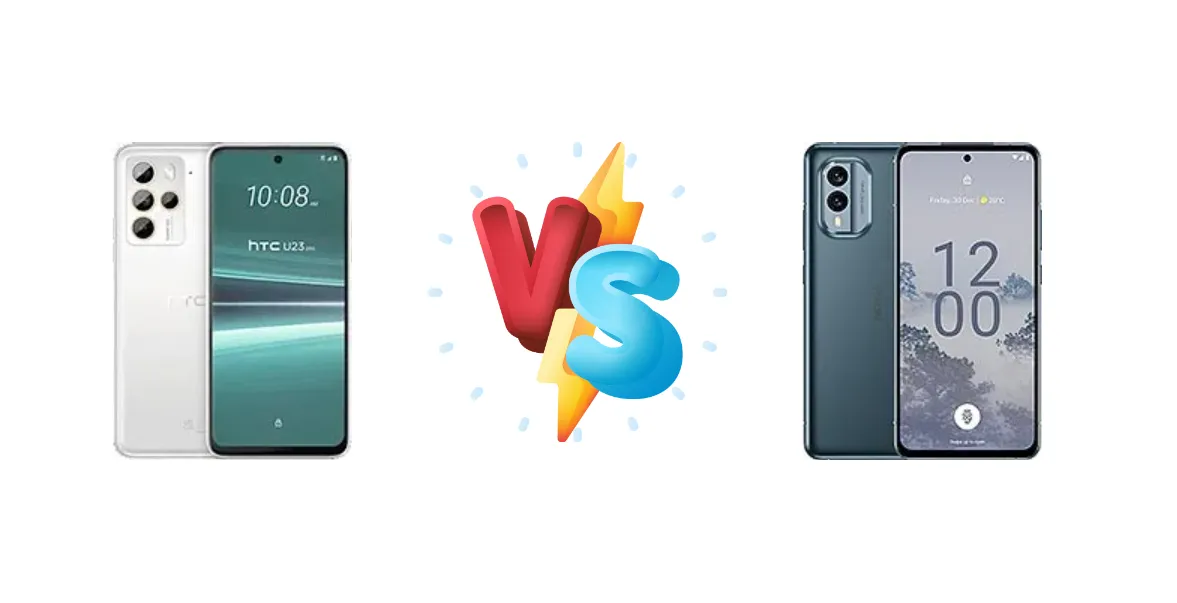
The mid-range smartphone market is fiercely competitive, and the HTC U23 Pro and Nokia X30 are two compelling contenders. Both offer a blend of features and affordability, but which one truly delivers the best experience? This comprehensive comparison will delve into their key aspects to help you make an informed decision.
🏆 Quick Verdict
The Nokia X30 edges out the HTC U23 Pro thanks to its superior battery life and slightly brighter display. While the U23 Pro boasts a more powerful chipset, the X30's longevity and commitment to sustainability make it a more well-rounded choice for most users.
| Network |
|---|
| 2G bands | GSM 850 / 900 / 1800 / 1900 | GSM 850 / 900 / 1800 / 1900 |
| 3G bands | HSDPA 850 / 900 / 1700(AWS) / 1900 / 2100 | HSDPA 850 / 900 / 1700(AWS) / 1900 / 2100 |
| 4G bands | 1, 3, 5, 7, 8, 12, 17, 20, 28, 38, 39, 40, 41 | 1, 2, 3, 4, 5, 7, 8, 12, 17, 20, 28, 32, 38, 39, 40, 41 |
| 5G bands | 1, 3, 7, 20, 28, 41, 78 SA/NSA | 1, 3, 5, 7, 8, 28, 38, 40, 41, 77, 78 SA/NSA/Sub6 |
| Speed | HSPA, LTE, 5G | HSPA, LTE, 5G |
| Technology | GSM / HSPA / LTE / 5G | GSM / HSPA / LTE / 5G |
| Launch |
|---|
| Announced | 2023, May 18 | 2022, September 01 |
| Status | Available. Released 2023, May 18 | Available. Released 2022, September 21 |
| Body |
|---|
| Build | Glass front (Gorilla Glass Victus), plastic frame, plastic back | Glass front (Gorilla Glass Victus), aluminum frame, plastic back |
| Dimensions | 166.6 x 77.1 x 8.9 mm (6.56 x 3.04 x 0.35 in) | 158.9 x 73.9 x 8 mm (6.26 x 2.91 x 0.31 in) |
| SIM | Nano-SIM + Nano-SIM | · Nano-SIM + eSIM· Nano-SIM + Nano-SIM |
| Weight | 205 g (7.23 oz) | 185 g (6.53 oz) |
| | IP67 dust/water resistant (up to 1m for 30 min) | IP67 dust/water resistant (up to 1m for 30 min) |
| Display |
|---|
| Protection | Corning Gorilla Glass Victus | Corning Gorilla Glass Victus |
| Resolution | 1080 x 2400 pixels, 20:9 ratio (~393 ppi density) | 1080 x 2400 pixels, 20:9 ratio (~409 ppi density) |
| Size | 6.7 inches, 108.4 cm2 (~84.4% screen-to-body ratio) | 6.43 inches, 99.8 cm2 (~85.0% screen-to-body ratio) |
| Type | OLED, 120Hz | AMOLED, 90Hz, 450 nits (typ), 700 nits (peak) |
| Platform |
|---|
| CPU | Octa-core (1x2.4 GHz Cortex-A710 & 3x2.36 GHz Cortex-A710 & 4x1.8 GHz Cortex-A510) | Octa-core (2x2.2 GHz Kryo 660 Gold & 6x1.7 GHz Kryo 660 Silver) |
| Chipset | Qualcomm SM7450-AB Snapdragon 7 Gen 1 (4 nm) | Qualcomm SM6375 Snapdragon 695 5G (6 nm) |
| GPU | Adreno 644 | Adreno 619 |
| OS | Android 13 | Android 12, upgradable to Android 13 |
| Memory |
|---|
| Card slot | microSDXC | No |
| Internal | 256GB 8GB RAM, 256GB 12GB RAM | 128GB 6GB RAM, 128GB 8GB RAM, 256GB 8GB RAM |
| | - | UFS 2.2 - 128GB
UFS 3.0 - 256GB |
| Main Camera |
|---|
| Dual | - | 50 MP, f/1.9, (wide), 1/1.56", 1.0µm, PDAF, OIS
13 MP, f/2.4, 123˚ (ultrawide), 1/3.06" |
| Features | Dual-LED flash, HDR, panorama | LED flash, HDR, panorama |
| Quad | 108 MP, f/1.7, (wide), 1/1.67", 0.64μm, PDAF, OIS
8 MP, f/2.4, 120˚ (ultrawide), 1/4.0", 1.12µm
5 MP (macro)
Auxiliary lens | - |
| Single | - | 16 MP, f/2.4, (wide), 1/3.06", 1.0µm |
| Video | 4K@30fps, 1080p@30fps, gyro-EIS | 1080p@30/60fps |
| Selfie camera |
|---|
| Features | HDR | - |
| Single | 32 MP, f/2.5, (wide), 1/3.2", 0.7µm | 16 MP, f/2.4, (wide), 1/3.06", 1.0µm |
| Video | 1080p@30fps | 1080p@30fps |
| Sound |
|---|
| 3.5mm jack | Yes | No |
| 35mm jack | Yes | No |
| Loudspeaker | Yes | Yes |
| Comms |
|---|
| Bluetooth | 5.2, A2DP, LE | 5.1, A2DP, LE, aptX HD |
| NFC | Yes | Yes |
| Positioning | GPS, GLONASS, GALILEO, BDS | GPS, GLONASS, GALILEO, BDS |
| Radio | No | FM radio, RDS |
| USB | USB Type-C 3.0 | USB Type-C 2.0, OTG |
| WLAN | Wi-Fi 802.11 a/b/g/n/ac/6, dual-band | Wi-Fi 802.11 a/b/g/n/ac/6, dual-band, Wi-Fi Direct |
| Features |
|---|
| Sensors | Fingerprint (side-mounted), accelerometer, gyro, proximity, compass | Fingerprint (under display, optical), accelerometer, gyro, proximity, compass |
| Battery |
|---|
| Charging | 30W wired
15W wireless
5W reverse wireless
Reverse wired | 33W wired, PD3.0 |
| Type | Li-Ion 4600 mAh | Li-Po 4200 mAh |
| Misc |
|---|
| Colors | Snow White, Coffee Black | Cloudy Blue, Ice White |
| Models | 2QC9200, 2QC9100, 2QCB100 | TA-1450, TA-1443 |
| Price | About 220 EUR | $ 399.00 |
| SAR EU | - | 0.79 W/kg (head) 1.37 W/kg (body) |
| Tests |
|---|
| Battery life | - |
Endurance rating 94h
|
| Camera | - |
Photo / Video |
| Display | - |
Contrast ratio: Infinite (nominal) |
| Loudspeaker | - |
-27.5 LUFS (Good)
|
| Performance | - |
AnTuTu: 403732 (v9)
GeekBench: 1920 (v5.1)
GFXBench: 17fps (ES 3.1 onscreen) |
HTC U23 Pro
- More powerful chipset (Snapdragon 7 Gen 1)
- Potentially better gaming performance
- 30W wired charging
- Shorter battery life
- Less sustainable materials
- Potentially less refined software experience
Nokia X30
- Exceptional battery life (94h endurance)
- Brighter display
- Sustainable design (recycled materials)
- 33W PD3.0 charging
- Less powerful chipset (Snapdragon 695 5G)
- Potentially slower performance in demanding tasks
- Nominal 'infinite' contrast ratio claim
Display Comparison
Both phones feature vibrant displays, but the Nokia X30 takes a slight lead with a measured peak brightness of 746 nits compared to the HTC U23 Pro's 727 nits. The X30 also advertises an 'infinite' contrast ratio, suggesting excellent blacks and vibrant colors, though this is a nominal claim. Both displays are likely OLED, offering excellent viewing angles and color accuracy.
Camera Comparison
Camera performance is likely comparable, with both phones offering capable photo and video capabilities. However, detailed camera testing would be needed to determine which phone produces better images in various lighting conditions. Both likely feature a main sensor around 50MP and ultrawide lens. The U23 Pro might have slightly better image processing due to its more powerful chipset.
Performance
The HTC U23 Pro holds a significant advantage in processing power thanks to its Snapdragon 7 Gen 1 chipset. This translates to faster app loading times, smoother multitasking, and better performance in graphically intensive games. The Nokia X30's Snapdragon 695 5G is still capable, but it won't match the U23 Pro's raw speed.
Battery Life
The Nokia X30 shines in battery life, boasting an impressive endurance rating of 94 hours, significantly higher than the HTC U23 Pro's 83 hours. This means the X30 can easily last a full two days on a single charge, making it ideal for users who are away from a power outlet for extended periods.
Buying Guide
Who should buy the HTC U23 Pro? Gamers and power users who prioritize performance and a smoother experience with demanding apps. Who should buy the Nokia X30? Users who value long battery life, a commitment to sustainability (recycled materials), and a reliable, dependable smartphone experience.
Frequently Asked Questions
❓ Which phone is better for gaming?
The HTC U23 Pro is the better choice for gaming due to its more powerful Snapdragon 7 Gen 1 chipset.
❓ Is the Nokia X30 a sustainable phone?
Yes, the Nokia X30 is made with recycled materials and is part of Nokia's commitment to sustainability.
❓ Does the Nokia X30 support fast charging?
Yes, the Nokia X30 supports 33W wired charging with PD3.0 standard.
❓ Which phone has better software support?
Nokia is known for providing timely Android updates and security patches, so the X30 likely has an edge in long-term software support.