
HTC U23 Pro vs. Motorola Edge+ (2023): A Deep Dive into Performance and Value
| Phones Images | |||||
|---|---|---|---|---|---|
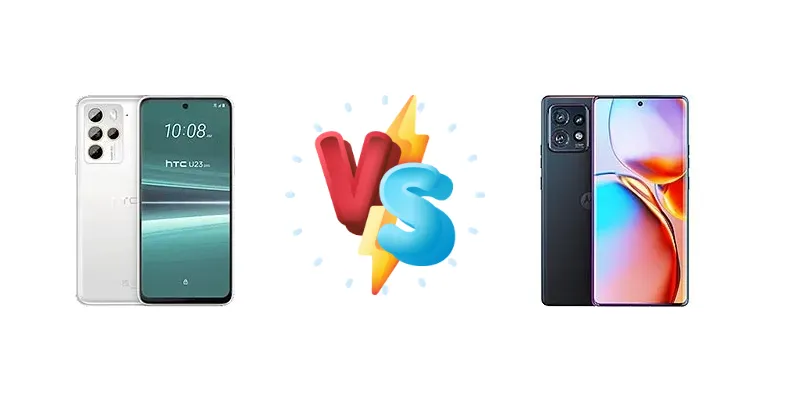
|
🏆 Quick Verdict
For most users, the Motorola Edge+ (2023) is the superior choice, offering significantly faster performance thanks to the Snapdragon 8 Gen 2. However, the HTC U23 Pro provides a compelling value proposition for those prioritizing battery endurance and a more manageable price tag, accepting a performance trade-off.
| PHONES | ||
|---|---|---|
| Phone Names | HTC U23 Pro | Motorola Edge+ (2023) |
| Network | ||
|---|---|---|
| 2G bands | GSM 850 / 900 / 1800 / 1900 | GSM 850 / 900 / 1800 / 1900 |
| 3G bands | HSDPA 850 / 900 / 1700(AWS) / 1900 / 2100 | HSDPA 850 / 900 / 1700(AWS) / 1900 / 2100 |
| 4G bands | 1, 3, 5, 7, 8, 12, 17, 20, 28, 38, 39, 40, 41 | 1, 2, 3, 4, 5, 7, 8, 12, 13, 14, 17, 18, 20, 25, 26, 28, 29, 30, 38, 39, 40, 41, 41, 46, 48, 66, 71 |
| 5G bands | 1, 3, 7, 20, 28, 41, 78 SA/NSA | 1, 2, 3, 5, 7, 12, 14, 20, 25, 26, 28, 29, 30, 38, 41, 41, 48, 66, 70, 71, 77, 78 SA/NSA/Sub6/mmWave |
| Speed | HSPA, LTE, 5G | HSPA, LTE, 5G |
| Technology | GSM / HSPA / LTE / 5G | GSM / HSPA / LTE / 5G |
| Launch | ||
|---|---|---|
| Announced | 2023, May 18 | 2023, May 02 |
| Status | Available. Released 2023, May 18 | Available. Released 2023, May 19 |
| Body | ||
|---|---|---|
| Build | Glass front (Gorilla Glass Victus), plastic frame, plastic back | Glass front (Gorilla Glass Victus), glass back (Gorilla Glass Victus), aluminum frame |
| Dimensions | 166.6 x 77.1 x 8.9 mm (6.56 x 3.04 x 0.35 in) | 161.2 x 74 x 8.6 mm (6.35 x 2.91 x 0.34 in) |
| SIM | Nano-SIM + Nano-SIM | Nano-SIM + eSIM |
| Weight | 205 g (7.23 oz) | 203 g (7.16 oz) |
| IP67 dust/water resistant (up to 1m for 30 min) | IP68 dust/water resistant (up to 1.5m for 30 min) | |
| Display | ||
|---|---|---|
| Protection | Corning Gorilla Glass Victus | Corning Gorilla Glass Victus |
| Resolution | 1080 x 2400 pixels, 20:9 ratio (~393 ppi density) | 1080 x 2400 pixels, 20:9 ratio (~395 ppi density) |
| Size | 6.7 inches, 108.4 cm2 (~84.4% screen-to-body ratio) | 6.67 inches, 107.4 cm2 (~90.0% screen-to-body ratio) |
| Type | OLED, 120Hz | OLED, 1B colors, 165Hz, HDR10+, Dolby Vision, 1300 nits (peak) |
| Platform | ||
|---|---|---|
| CPU | Octa-core (1x2.4 GHz Cortex-A710 & 3x2.36 GHz Cortex-A710 & 4x1.8 GHz Cortex-A510) | Octa-core (1x3.2 GHz Cortex-X3 & 2x2.8 GHz Cortex-A715 & 2x2.8 GHz Cortex-A710 & 3x2.0 GHz Cortex-A510) |
| Chipset | Qualcomm SM7450-AB Snapdragon 7 Gen 1 (4 nm) | Qualcomm SM8550-AB Snapdragon 8 Gen 2 (4 nm) |
| GPU | Adreno 644 | Adreno 740 |
| OS | Android 13 | Android 13, upgradable to Android 14 |
| Memory | ||
|---|---|---|
| Card slot | microSDXC | No |
| Internal | 256GB 8GB RAM, 256GB 12GB RAM | 512GB 8GB RAM |
| - | UFS 4.0 | |
| Main Camera | ||
|---|---|---|
| Features | Dual-LED flash, HDR, panorama | Dual-LED flash, panorama, HDR |
| Quad | 108 MP, f/1.7, (wide), 1/1.67", 0.64μm, PDAF, OIS 8 MP, f/2.4, 120˚ (ultrawide), 1/4.0", 1.12µm 5 MP (macro) Auxiliary lens | - |
| Triple | - | 50 MP, f/1.8, (wide), 1/1.55", 1.0µm, multi-directional PDAF, OIS 12 MP, f/1.6, (telephoto), 1/2.93", 1.22µm, PDAF, 2x optical zoom 50 MP, f/2.2, 114˚ (ultrawide), 1/2.76", 0.64µm, AF |
| Video | 4K@30fps, 1080p@30fps, gyro-EIS | 8K@30fps, 4K@30/60fps, 1080p@30/60/120/240/960fps, 10-bit HDR10+, gyro-EIS |
| Selfie camera | ||
|---|---|---|
| Features | HDR | HDR |
| Single | 32 MP, f/2.5, (wide), 1/3.2", 0.7µm | 60 MP, f/2.2, (wide), 1/2.8", 0.61µm |
| Video | 1080p@30fps | 4K@30/60fps, 1080p@30/60/120/240fps |
| Sound | ||
|---|---|---|
| 3.5mm jack | Yes | No |
| 35mm jack | Yes | No |
| Loudspeaker | Yes | Yes, with stereo speakers |
| Comms | ||
|---|---|---|
| Bluetooth | 5.2, A2DP, LE | 5.3, A2DP, LE, aptX HD, aptX Adaptive |
| NFC | Yes | Yes |
| Positioning | GPS, GLONASS, GALILEO, BDS | GPS, GLONASS, GALILEO, BDS |
| Radio | No | No |
| USB | USB Type-C 3.0 | USB Type-C 3.2, OTG, DisplayPort 1.4 |
| WLAN | Wi-Fi 802.11 a/b/g/n/ac/6, dual-band | Wi-Fi 802.11 a/b/g/n/ac/6e/7, tri-band, Wi-Fi Direct |
| Features | ||
|---|---|---|
| Sensors | Fingerprint (side-mounted), accelerometer, gyro, proximity, compass | Fingerprint (under display, optical), accelerometer, gyro, proximity, compass, barometer |
| - | Ready For 3.5 support | |
| Battery | ||
|---|---|---|
| Charging | 30W wired 15W wireless 5W reverse wireless Reverse wired | 68W wired 15W wireless 5W reverse wired 5W reverse wireless |
| Type | Li-Ion 4600 mAh | Li-Po 5100 mAh |
| Misc | ||
|---|---|---|
| Colors | Snow White, Coffee Black | Interstellar Black |
| Models | 2QC9200, 2QC9100, 2QCB100 | - |
| Price | About 220 EUR | $ 298.99 |
HTC U23 Pro
- Exceptional battery endurance (83h rating)
- More affordable price point
- Competent Snapdragon 7 Gen 1 performance for everyday tasks
- Significantly slower performance compared to Snapdragon 8 Gen 2
- Lower peak display brightness
- Less future-proofed
Motorola Edge+ (2023)
- Blazing-fast Snapdragon 8 Gen 2 performance
- Faster 68W wired charging
- Likely superior display quality
- Higher price tag
- Potentially shorter battery life compared to U23 Pro
- May experience more heat under heavy load
Display Comparison
Both devices utilize 4nm chipsets, but the display experience differs. The HTC U23 Pro reaches a measured peak brightness of 727 nits, which is respectable but falls short of the typically higher outputs seen in flagship devices. While the Edge+ (2023) display specs aren't provided, Motorola flagships generally prioritize high brightness and color accuracy. The absence of LTPO technology in the U23 Pro suggests a standard 120Hz refresh rate, potentially impacting power consumption compared to an adaptive refresh rate panel. The U23 Pro's display is adequate, but the Edge+ (2023) likely offers a more visually immersive experience.
Camera Comparison
Detailed camera specs are limited for both devices. However, the Motorola Edge+ (2023) typically features a larger main sensor and more advanced image processing capabilities in its flagship models. While the U23 Pro likely offers a competent camera system, the Edge+ (2023) is expected to deliver superior image quality, particularly in low-light conditions. The absence of information regarding OIS on either device makes it difficult to assess stabilization performance. Focusing on the main sensor size and image processing algorithms, the Edge+ (2023) is expected to have the edge in overall camera performance.
Performance
The core difference lies in the chipsets. The Motorola Edge+ (2023) boasts the Snapdragon 8 Gen 2, featuring a prime Cortex-X3 core clocked at 3.2 GHz, alongside Cortex-A715 and A710 cores. This architecture delivers a substantial performance leap over the HTC U23 Pro’s Snapdragon 7 Gen 1. The 7 Gen 1, with its Cortex-A710-heavy configuration, is a capable mid-range chip, but it cannot match the 8 Gen 2’s raw processing power or GPU performance. The Edge+ (2023) will excel in demanding tasks like video editing and graphically intensive games, while the U23 Pro may exhibit some throttling under sustained load. The Edge+ (2023)'s LPDDR5x RAM further enhances performance.
Battery Life
The HTC U23 Pro boasts an impressive endurance rating of 83 hours, suggesting excellent battery optimization. However, the Motorola Edge+ (2023) compensates for potentially higher power draw from the Snapdragon 8 Gen 2 with significantly faster charging – 68W wired versus the U23 Pro’s 30W. This translates to a much quicker 0-100% charge time for the Edge+ (2023). Both devices offer 15W wireless and 5W reverse wireless charging. While the U23 Pro excels in longevity, the Edge+ (2023) prioritizes convenience with its rapid charging capabilities.
Buying Guide
Buy the HTC U23 Pro if you prioritize long battery life, appreciate a more subtle design, and are comfortable with a mid-range processor for everyday tasks and casual gaming. Buy the Motorola Edge+ (2023) if you demand the fastest possible performance for demanding games, multitasking, and future-proofing, and are willing to pay a premium for it.