
HTC U23 Pro vs Google Pixel 7 Pro: A Detailed Showdown
| Phones Images | |||||
|---|---|---|---|---|---|
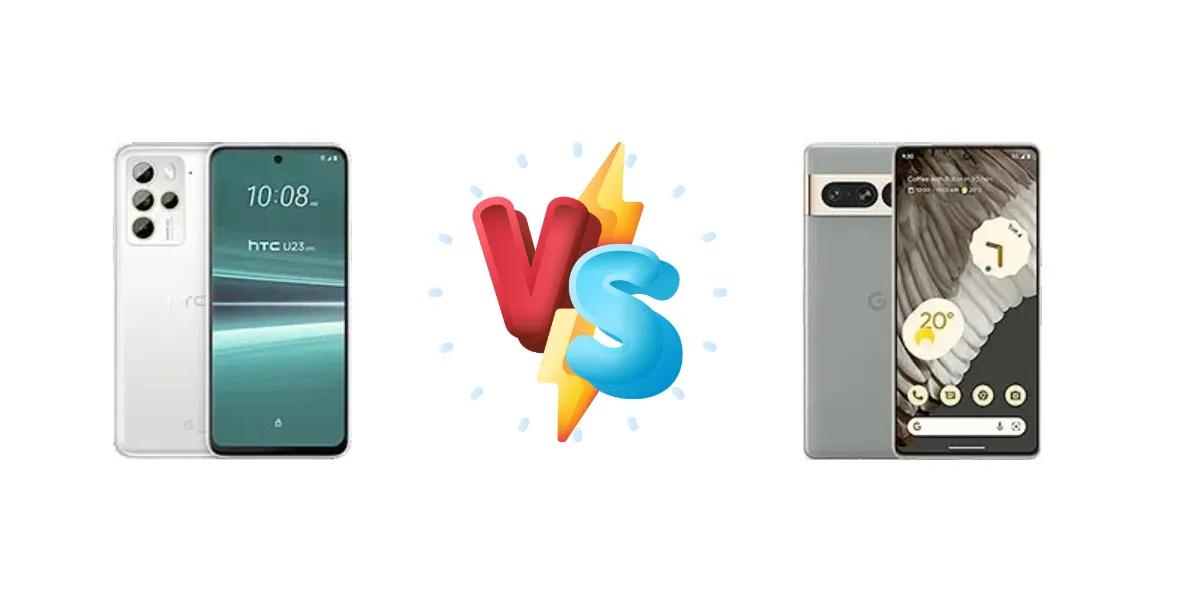
|
🏆 Quick Verdict
The Google Pixel 7 Pro emerges as the clear winner, boasting a significantly brighter display, superior camera capabilities, and the power of Google's Tensor G2 chip. While the HTC U23 Pro offers a competitive price and respectable battery life, the Pixel 7 Pro's premium features justify its higher cost.
| PHONES | ||
|---|---|---|
| Phone Names | HTC U23 Pro | Google Pixel 7 Pro |
| Network | ||
|---|---|---|
| 2G bands | GSM 850 / 900 / 1800 / 1900 | GSM 850 / 900 / 1800 / 1900 |
| 3G bands | HSDPA 850 / 900 / 1700(AWS) / 1900 / 2100 | HSDPA 800 / 850 / 900 / 1700(AWS) / 1900 / 2100 |
| 4G bands | 1, 3, 5, 7, 8, 12, 17, 20, 28, 38, 39, 40, 41 | 1, 2, 3, 4, 5, 7, 8, 12, 13, 14, 17, 18, 19, 20, 25, 26, 28, 29, 30, 38, 39, 40, 41, 42, 46, 48, 66, 71 - GE2AE |
| 5G bands | 1, 3, 7, 20, 28, 41, 78 SA/NSA | 1, 2, 3, 5, 7, 8, 12, 14, 20, 25, 28, 30, 38, 40, 41, 48, 66, 71, 77, 78, 257, 258, 260, 261 SA/NSA/Sub6/mmWave - GE2AE |
| Speed | HSPA, LTE, 5G | HSPA, LTE, 5G |
| Technology | GSM / HSPA / LTE / 5G | GSM / CDMA / HSPA / EVDO / LTE / 5G |
| - | 1, 2, 3, 5, 7, 8, 12, 14, 20, 25, 28, 30, 38, 40, 41, 48, 66, 71, 75, 76, 77, 78 SA/NSA/Sub6 - GP4BC | |
| Launch | ||
|---|---|---|
| Announced | 2023, May 18 | 2022, October 06 |
| Status | Available. Released 2023, May 18 | Available. Released 2022, October 13 |
| Body | ||
|---|---|---|
| Build | Glass front (Gorilla Glass Victus), plastic frame, plastic back | Glass front (Gorilla Glass Victus), glass back (Gorilla Glass Victus), aluminum frame |
| Dimensions | 166.6 x 77.1 x 8.9 mm (6.56 x 3.04 x 0.35 in) | 162.9 x 76.6 x 8.9 mm (6.41 x 3.02 x 0.35 in) |
| SIM | Nano-SIM + Nano-SIM | Nano-SIM + eSIM |
| Weight | 205 g (7.23 oz) | 212 g (7.48 oz) |
| IP67 dust/water resistant (up to 1m for 30 min) | IP68 dust/water resistant (up to 1.5m for 30 min) | |
| Display | ||
|---|---|---|
| Protection | Corning Gorilla Glass Victus | Corning Gorilla Glass Victus |
| Resolution | 1080 x 2400 pixels, 20:9 ratio (~393 ppi density) | 1440 x 3120 pixels, 19.5:9 ratio (~512 ppi density) |
| Size | 6.7 inches, 108.4 cm2 (~84.4% screen-to-body ratio) | 6.7 inches, 110.6 cm2 (~88.7% screen-to-body ratio) |
| Type | OLED, 120Hz | LTPO AMOLED, 120Hz, HDR10+, 1000 nits (HBM), 1500 nits (peak) |
| - | Always-on display | |
| Platform | ||
|---|---|---|
| CPU | Octa-core (1x2.4 GHz Cortex-A710 & 3x2.36 GHz Cortex-A710 & 4x1.8 GHz Cortex-A510) | Octa-core (2x2.85 GHz Cortex-X1 & 2x2.35 GHz Cortex-A78 & 4x1.80 GHz Cortex-A55) |
| Chipset | Qualcomm SM7450-AB Snapdragon 7 Gen 1 (4 nm) | Google Tensor G2 (5 nm) |
| GPU | Adreno 644 | Mali-G710 MP7 |
| OS | Android 13 | Android 13, upgradable to Android 15, up to 5 major Android upgrades |
| Memory | ||
|---|---|---|
| Card slot | microSDXC | No |
| Internal | 256GB 8GB RAM, 256GB 12GB RAM | 128GB 8GB RAM, 256GB 8GB RAM, 128GB 12GB RAM, 256GB 12GB RAM, 512GB 12GB RAM |
| - | UFS 3.1 | |
| Main Camera | ||
|---|---|---|
| Features | Dual-LED flash, HDR, panorama | Laser AF, Dual-LED flash, Pixel Shift, Auto-HDR, panorama |
| Quad | 108 MP, f/1.7, (wide), 1/1.67", 0.64μm, PDAF, OIS 8 MP, f/2.4, 120˚ (ultrawide), 1/4.0", 1.12µm 5 MP (macro) Auxiliary lens | - |
| Single | - | 10.8 MP, f/2.2, 21mm (ultrawide), 1/3.1", 1.22µm |
| Triple | - | 50 MP, f/1.9, 25mm (wide), 1/1.31", 1.2µm, dual pixel PDAF, OIS 48 MP, f/3.5, 120mm (periscope telephoto), 1/2.55", 0.7µm, dual pixel PDAF, OIS, 5x optical zoom 12 MP, f/2.2, 126˚ (ultrawide), 1/2.9", 1.25µm, AF |
| Video | 4K@30fps, 1080p@30fps, gyro-EIS | 4K@30/60fps, 1080p@30/60/120/240fps; gyro-EIS, OIS, 10-bit HDR |
| Selfie camera | ||
|---|---|---|
| Features | HDR | HDR, panorama |
| Single | 32 MP, f/2.5, (wide), 1/3.2", 0.7µm | 10.8 MP, f/2.2, 21mm (ultrawide), 1/3.1", 1.22µm |
| Video | 1080p@30fps | 4K@30/60fps, 1080p@30/60fps |
| Sound | ||
|---|---|---|
| 3.5mm jack | Yes | No |
| 35mm jack | Yes | No |
| Loudspeaker | Yes | Yes, with stereo speakers |
| Comms | ||
|---|---|---|
| Bluetooth | 5.2, A2DP, LE | 5.2, A2DP, LE, aptX HD |
| NFC | Yes | Yes |
| Positioning | GPS, GLONASS, GALILEO, BDS | GPS (L1+L5), GLONASS (G1), BDS (B1I+B1c+B2a), GALILEO (E1+E5a), QZSS (L1+L5) |
| Radio | No | No |
| USB | USB Type-C 3.0 | USB Type-C 3.2 |
| WLAN | Wi-Fi 802.11 a/b/g/n/ac/6, dual-band | Wi-Fi 802.11 a/b/g/n/ac/6e, tri-band, Wi-Fi Direct |
| Features | ||
|---|---|---|
| Sensors | Fingerprint (side-mounted), accelerometer, gyro, proximity, compass | Fingerprint (under display, optical), accelerometer, gyro, proximity, compass, barometer |
| - | Ultra Wideband (UWB) support | |
| Battery | ||
|---|---|---|
| Charging | 30W wired 15W wireless 5W reverse wireless Reverse wired | 23W wired, PD3.0, 50% in 30 min 23W wireless Reverse wireless |
| Type | Li-Ion 4600 mAh | Li-Ion 5000 mAh |
| Misc | ||
|---|---|---|
| Colors | Snow White, Coffee Black | Obsidian, Snow, Hazel |
| Models | 2QC9200, 2QC9100, 2QCB100 | GP4BC, GE2AE, GFE4J |
| Price | About 220 EUR | € 248.84 / $ 204.00 / £ 259.99 / ₹ 36,999 |
| Tests | ||
|---|---|---|
| Battery life | - | Endurance rating 83h |
| Camera | - | Photo / Video |
| Display | - | Contrast ratio: Infinite (nominal) |
| Loudspeaker | - | -24.8 LUFS (Very good) |
| Performance | - | AnTuTu: 796369 (v9) GeekBench: 3187 (v5.1) GFXBench: 34fps (ES 3.1 onscreen) |
HTC U23 Pro
- Competitive price
- Decent battery life (83h endurance)
- Reverse wireless charging
- IP67 water and dust resistance (assumed)
- Less powerful chipset
- Lower display brightness
- Less impressive camera
- Slower charging speeds
Google Pixel 7 Pro
- Brighter and more vibrant display
- Superior camera performance
- Powerful Tensor G2 chip
- Fast charging (wired & wireless)
- Clean Android experience with guaranteed updates
- Higher price
- Tensor G2 can sometimes throttle under sustained load
- Design can be polarizing
Display Comparison
The Pixel 7 Pro's display is a standout feature, reaching a measured 1090 nits of peak brightness compared to the U23 Pro's 727 nits. This difference is noticeable in outdoor conditions. The Pixel 7 Pro also boasts an 'infinite' contrast ratio, providing deeper blacks and more vibrant colors. While both have excellent displays, the Pixel 7 Pro takes the crown.
Camera Comparison
Google's Pixel phones are renowned for their exceptional camera performance, and the Pixel 7 Pro is no exception. Its advanced image processing algorithms and versatile lens setup deliver stunning photos and videos. The HTC U23 Pro's camera is competent, but it doesn't match the Pixel 7 Pro's image quality, dynamic range, and low-light performance.
Performance
The Google Pixel 7 Pro's Tensor G2 chip, built on a 5nm process, offers a noticeable performance advantage over the HTC U23 Pro's Snapdragon 7 Gen 1 (4nm). The Tensor G2 excels in AI and machine learning tasks, enhancing features like voice recognition and image processing. The U23 Pro is still capable for everyday tasks, but the Pixel 7 Pro feels snappier and more responsive.
Battery Life
Both phones share the same endurance rating of 83h, suggesting comparable battery life in typical usage. However, the Pixel 7 Pro's faster charging speeds (23W wired, 23W wireless) provide a quicker top-up.
Buying Guide
Who should buy the HTC U23 Pro? Budget-conscious users seeking a reliable Android phone with decent performance and battery life. Who should buy the Google Pixel 7 Pro? Photography enthusiasts, those seeking a smooth and responsive experience powered by Google's AI, and users who value a premium design and software experience.