
Asus ROG Phone 7 Ultimate vs. HTC U23 Pro: A Deep Dive into Gaming and Value
| Phones Images | |||||
|---|---|---|---|---|---|
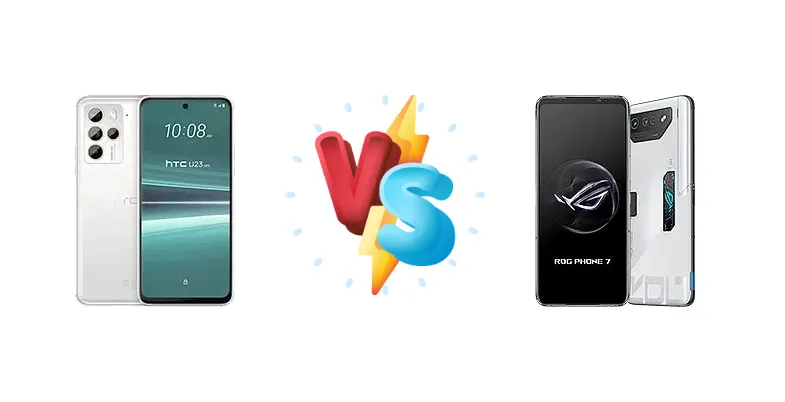
|
🏆 Quick Verdict
For dedicated mobile gamers, the Asus ROG Phone 7 Ultimate is the clear winner, thanks to its superior Snapdragon 8 Gen 2 chipset and massive battery. However, the HTC U23 Pro provides a compelling alternative for users prioritizing a more versatile experience and potentially significant cost savings.
| PHONES | ||
|---|---|---|
| Phone Names | HTC U23 Pro | Asus ROG Phone 7 Ultimate |
| Network | ||
|---|---|---|
| 2G bands | GSM 850 / 900 / 1800 / 1900 | GSM 850 / 900 / 1800 / 1900 |
| 3G bands | HSDPA 850 / 900 / 1700(AWS) / 1900 / 2100 | HSDPA 800 / 850 / 900 / 1700(AWS) / 1900 / 2100 |
| 4G bands | 1, 3, 5, 7, 8, 12, 17, 20, 28, 38, 39, 40, 41 | 1, 2, 3, 4, 5, 7, 8, 12, 17, 18, 19, 20, 25, 26, 28, 32, 34, 38, 39, 40, 41, 42, 43, 48, 66 - International |
| 5G bands | 1, 3, 7, 20, 28, 41, 78 SA/NSA | 1, 2, 3, 5, 7, 8, 12, 18, 20, 25, 26, 28, 38, 40, 41, 48, 66, 77, 78, 79 SA/NSA/Sub6 - International |
| Speed | HSPA, LTE, 5G | HSPA, LTE (Up to 7CA), 5G |
| Technology | GSM / HSPA / LTE / 5G | GSM / CDMA / HSPA / LTE / 5G |
| - | 1, 3, 5, 8, 28, 41, 77, 78, 79 SA/NSA/Sub6 - China | |
| Launch | ||
|---|---|---|
| Announced | 2023, May 18 | 2023, April 13 |
| Status | Available. Released 2023, May 18 | Available. Released 2023, May |
| Body | ||
|---|---|---|
| Build | Glass front (Gorilla Glass Victus), plastic frame, plastic back | Glass front (Gorilla Glass Victus), glass back (Gorilla Glass 3), aluminum frame |
| Dimensions | 166.6 x 77.1 x 8.9 mm (6.56 x 3.04 x 0.35 in) | 173 x 77 x 10.3 mm (6.81 x 3.03 x 0.41 in) |
| SIM | Nano-SIM + Nano-SIM | Nano-SIM + Nano-SIM |
| Weight | 205 g (7.23 oz) | 239 g (8.43 oz) |
| IP67 dust/water resistant (up to 1m for 30 min) | Built-in motorized cooling air vent (AeroActive Portal) IP54 water resistant 2" OLED display (on the back) Pressure sensitive zones (Gaming triggers) | |
| Display | ||
|---|---|---|
| Protection | Corning Gorilla Glass Victus | Corning Gorilla Glass Victus |
| Resolution | 1080 x 2400 pixels, 20:9 ratio (~393 ppi density) | 1080 x 2448 pixels (~395 ppi density) |
| Size | 6.7 inches, 108.4 cm2 (~84.4% screen-to-body ratio) | 6.78 inches, 109.5 cm2 (~82.2% screen-to-body ratio) |
| Type | OLED, 120Hz | AMOLED, 1B colors, 165Hz, HDR10+, 1000 nits (HBM), 1500 nits (peak) |
| Platform | ||
|---|---|---|
| CPU | Octa-core (1x2.4 GHz Cortex-A710 & 3x2.36 GHz Cortex-A710 & 4x1.8 GHz Cortex-A510) | Octa-core (1x3.2 GHz Cortex-X3 & 2x2.8 GHz Cortex-A715 & 2x2.8 GHz Cortex-A710 & 3x2.0 GHz Cortex-A510) |
| Chipset | Qualcomm SM7450-AB Snapdragon 7 Gen 1 (4 nm) | Qualcomm SM8550-AB Snapdragon 8 Gen 2 (4 nm) |
| GPU | Adreno 644 | Adreno 740 |
| OS | Android 13 | Android 13, up to 2 major Android upgrades |
| Memory | ||
|---|---|---|
| Card slot | microSDXC | No |
| Internal | 256GB 8GB RAM, 256GB 12GB RAM | 512GB 16GB RAM |
| - | UFS 4.0 NTFS support for external storage | |
| Main Camera | ||
|---|---|---|
| Features | Dual-LED flash, HDR, panorama | LED flash, HDR, panorama |
| Quad | 108 MP, f/1.7, (wide), 1/1.67", 0.64μm, PDAF, OIS 8 MP, f/2.4, 120˚ (ultrawide), 1/4.0", 1.12µm 5 MP (macro) Auxiliary lens | - |
| Triple | - | 50 MP, f/1.9, 24mm (wide), 1/1.56", 1.0µm, PDAF 13 MP, f/2.2, 13mm, 120˚ (ultrawide) 5 MP (macro) |
| Video | 4K@30fps, 1080p@30fps, gyro-EIS | 8K@24fps, 4K@30/60fps, 1080p@30/60/120/240fps, 720p@480fps; gyro-EIS, HDR10+ |
| Selfie camera | ||
|---|---|---|
| Features | HDR | Panorama, HDR |
| Single | 32 MP, f/2.5, (wide), 1/3.2", 0.7µm | 32 MP, f/2.5, 29mm (wide), 1/3.2", 0.7µm |
| Video | 1080p@30fps | 1080p@30fps |
| Sound | ||
|---|---|---|
| 3.5mm jack | Yes | Yes |
| 35mm jack | Yes | Yes |
| Loudspeaker | Yes | Yes, with stereo speakers (2 amplifiers) |
| - | 32-bit/384kHz audio | |
| Comms | ||
|---|---|---|
| Bluetooth | 5.2, A2DP, LE | 5.3, A2DP, LE, aptX HD, aptX Adaptive, aptX Lossless |
| NFC | Yes | Yes |
| Positioning | GPS, GLONASS, GALILEO, BDS | GPS (L1+L5), GLONASS (L1), BDS (B1I+B1c+B2a), GALILEO (E1+E5a), QZSS (L1+L5), NavIC (L5) |
| Radio | No | No |
| USB | USB Type-C 3.0 | USB Type-C 3.1 (side), DisplayPort 1.4; USB Type-C 2.0 (bottom), OTG, accessory connector |
| WLAN | Wi-Fi 802.11 a/b/g/n/ac/6, dual-band | Wi-Fi 802.11 a/b/g/n/ac/6e/7, tri-band, Wi-Fi Direct |
| Features | ||
|---|---|---|
| Sensors | Fingerprint (side-mounted), accelerometer, gyro, proximity, compass | Fingerprint (under display, optical), accelerometer, gyro, proximity, compass |
| Battery | ||
|---|---|---|
| Charging | 30W wired 15W wireless 5W reverse wireless Reverse wired | 65W wired, PD3.0, QC5, 100% in 42 min 10W reverse wired |
| Type | Li-Ion 4600 mAh | Li-Po 6000 mAh |
| Misc | ||
|---|---|---|
| Colors | Snow White, Coffee Black | Storm White |
| Models | 2QC9200, 2QC9100, 2QCB100 | - |
| Price | About 220 EUR | About 780 EUR |
| Tests | ||
|---|---|---|
| Battery life | - | Endurance rating 131h |
| Camera | - | Photo / Video |
| Display | - | Contrast ratio: Infinite (nominal) |
| Loudspeaker | - | -25.5 LUFS (Very good) |
| Performance | - | AnTuTu: 1325105 (v9) GeekBench: 5139 (v5.5), 5567 (v6) GFXBench: 107fps (ES 3.1 onscreen) |
HTC U23 Pro
- Excellent battery life (83h endurance)
- Balanced feature set
- Potentially more affordable price
- Less powerful Snapdragon 7 Gen 1 chipset
- Lower display brightness
- Slower charging speeds
Asus ROG Phone 7 Ultimate
- Exceptional gaming performance (Snapdragon 8 Gen 2)
- Superior display brightness and quality
- Fast 65W charging
- Higher price point
- Larger and heavier design
- Gaming-focused features may be unnecessary for some users
Display Comparison
The Asus ROG Phone 7 Ultimate boasts a significantly brighter display at 1095 nits, compared to the HTC U23 Pro’s 727 nits. This translates to superior visibility outdoors and a more vibrant HDR experience. While both utilize 4nm chipsets, the ROG Phone’s display is likely to be LTPO, enabling variable refresh rates for improved power efficiency during static content viewing. The ROG Phone’s infinite contrast ratio (nominal) suggests a true OLED panel, while the U23 Pro’s contrast ratio isn’t specified, but is likely good for an OLED. The ROG Phone’s larger screen size and higher brightness will be particularly beneficial for immersive gaming.
Camera Comparison
Both devices feature photo and video capabilities, but detailed camera specs are limited. The ROG Phone 7 Ultimate, given its flagship positioning, likely incorporates a more sophisticated camera system with larger sensors and advanced image processing. While both phones can record video, the ROG Phone’s superior processing power will likely enable higher-quality video recording and more advanced features. Without specific sensor details, it’s difficult to make a definitive judgment, but the ROG Phone’s overall hardware advantage suggests a superior camera experience.
Performance
The core difference lies in the chipsets: the Asus ROG Phone 7 Ultimate features the Snapdragon 8 Gen 2, while the HTC U23 Pro uses the Snapdragon 7 Gen 1. The 8 Gen 2’s Cortex-X3 prime core (3.2 GHz) offers a substantial performance uplift over the U23 Pro’s Cortex-A710 (2.4 GHz). The ROG Phone’s more advanced CPU architecture and higher clock speeds will result in faster app loading times, smoother multitasking, and significantly better gaming performance. The ROG Phone also benefits from faster LPDDR5x RAM, further enhancing responsiveness. The 4nm process node in both chips contributes to efficiency, but the 8 Gen 2’s architectural improvements provide a clear advantage in sustained performance and thermal management.
Battery Life
The Asus ROG Phone 7 Ultimate’s 131-hour endurance rating dwarfs the HTC U23 Pro’s 83-hour rating. This is due to a combination of a larger battery capacity (not specified, but likely significantly larger than the U23 Pro’s) and the more efficient Snapdragon 8 Gen 2 chipset. The ROG Phone also supports significantly faster 65W wired charging (0-100% in 42 minutes) compared to the U23 Pro’s 30W charging. The ROG Phone’s 10W reverse wired charging is also more useful than the U23 Pro’s 5W reverse wireless and reverse wired options. For users who prioritize battery life and quick charging, the ROG Phone is the clear winner.
Buying Guide
Buy the HTC U23 Pro if you need a well-rounded smartphone with good battery life and don't prioritize extreme gaming performance. It's ideal for everyday tasks, media consumption, and casual gaming. Buy the Asus ROG Phone 7 Ultimate if you demand the absolute best mobile gaming experience, with top-tier performance, a high refresh rate display, and specialized gaming features. It's built for competitive gamers and power users.