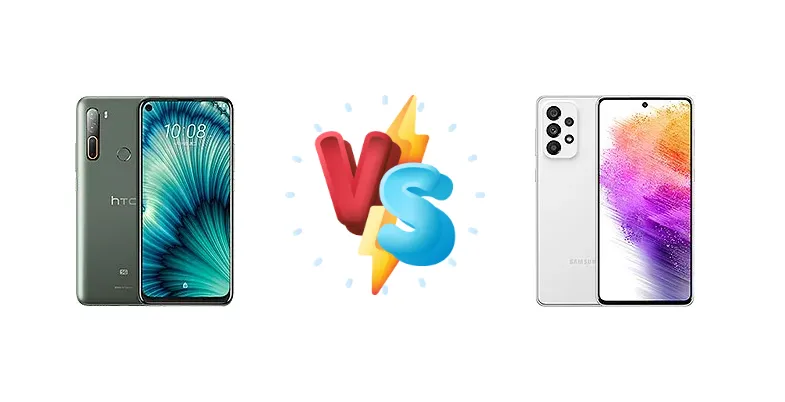
The HTC U20 5G and Samsung Galaxy A73 5G represent different approaches to the mid-range 5G market. The U20, released earlier, now faces competition from newer devices like the A73, which boasts a more modern chipset. This comparison dissects the key differences to determine which phone delivers the best value and performance in 2024.
🏆 Quick Verdict
For most users, the Samsung Galaxy A73 5G is the superior choice. Its Snapdragon 778G chipset, built on a 6nm process, provides a noticeable performance uplift over the HTC U20 5G’s Snapdragon 765G, translating to smoother multitasking and gaming. While the U20 may be cheaper, the A73’s efficiency and faster charging justify the price difference.
| Network |
|---|
| 2G bands | GSM 850 / 900 / 1800 / 1900 | GSM 850 / 900 / 1800 / 1900 |
| 3G bands | HSDPA 850 / 900 / 1900 / 2100 | HSDPA 850 / 900 / 1700(AWS) / 1900 / 2100 |
| 4G bands | 1, 2, 3, 5, 7, 8, 20, 28, 38, 39, 40, 41 | 1, 2, 3, 4, 5, 7, 8, 12, 13, 17, 20, 26, 28, 32, 38, 40, 41, 66 |
| 5G bands | 1, 3, 28, 41, 78 SA/NSA | 1, 3, 5, 7, 28, 40, 41, 66, 78 SA/NSA/Sub6 |
| Speed | HSPA, LTE, 5G 2.56/0.9 Gbps | HSPA, LTE, 5G |
| Technology | GSM / HSPA / LTE / 5G | GSM / HSPA / LTE / 5G |
| Launch |
|---|
| Announced | 2020, June 16. Released 2020, October 01 | 2022, March 17 |
| Status | Discontinued | Available. Released 2022, April 22 |
| Body |
|---|
| Dimensions | 171.2 x 78.1 x 9.4 mm (6.74 x 3.07 x 0.37 in) | 163.7 x 76.1 x 7.6 mm (6.44 x 3.00 x 0.30 in) |
| SIM | Nano-SIM + Nano-SIM | · Nano-SIM· Nano-SIM + Nano-SIM |
| Weight | 215.5 g (7.62 oz) | 181 g (6.38 oz) |
| | - | IP67 dust/water resistant (up to 1m for 30 min) |
| Display |
|---|
| Protection | Asahi Dragontrail Glass | Corning Gorilla Glass 5 |
| Resolution | 1080 x 2400 pixels, 20:9 ratio (~387 ppi density) | 1080 x 2400 pixels, 20:9 ratio (~393 ppi density) |
| Size | 6.8 inches, 111.6 cm2 (~83.5% screen-to-body ratio) | 6.7 inches, 108.4 cm2 (~87.0% screen-to-body ratio) |
| Type | IPS LCD | Super AMOLED Plus, 120Hz, 800 nits (HBM) |
| Platform |
|---|
| CPU | Octa-core (1x2.4 GHz Kryo 475 Prime & 1x2.2 GHz Kryo 475 Gold & 6x1.8 GHz Kryo 475 Silver) | Octa-core (1x2.4 GHz Cortex-A78 & 3x2.2 GHz Cortex-A78 & 4x1.9 GHz Cortex-A55) |
| Chipset | Qualcomm SM7250 Snapdragon 765G 5G (7 nm) | Qualcomm SM7325 Snapdragon 778G 5G (6 nm) |
| GPU | Adreno 620 | Adreno 642L |
| OS | Android 10 | Android 12, up to 4 major Android upgrades, One UI 6.1 |
| Memory |
|---|
| Card slot | microSDXC | microSDXC (uses shared SIM slot) |
| Internal | 256GB 6GB RAM, 256GB 8GB RAM | 128GB 6GB RAM, 128GB 8GB RAM, 256GB 8GB RAM |
| Main Camera |
|---|
| Features | Dual-LED flash, HDR, panorama | LED flash, panorama, HDR |
| Quad | 48 MP, f/1.8, 26mm (wide), 1/2.0", 0.8µm, PDAF
8 MP, f/2.2, 118˚ (ultrawide), 1/4.0", 1.12µm
2 MP (macro)
Auxiliary lens | 108 MP, f/1.8, (wide), PDAF, OIS
12 MP, f/2.2, (ultrawide)
5 MP (macro)
Auxiliary lens |
| Single | 8 MP, AF | 32 MP, f/2.2, 26mm (wide), 1/2.8", 0.8µm |
| Video | 4K@30fps, 1080p@30fps, gyro-EIS | 4K@30fps, 1080p@30/60fps; gyro-EIS |
| Selfie camera |
|---|
| Features | HDR | HDR |
| Single | 32 MP, f/2.0, (wide), 1/2.8", 0.8µm | 32 MP, f/2.2, 26mm (wide), 1/2.8", 0.8µm |
| Video | 1080p@30fps | 4K@30fps, 1080p@30fps |
| Sound |
|---|
| 3.5mm jack | No | No |
| 35mm jack | No | No |
| Loudspeaker | Yes | Yes, with stereo speakers |
| Comms |
|---|
| Bluetooth | 5.0, A2DP, LE | 5.0, A2DP, LE |
| NFC | Yes | Yes (market/region dependent) |
| Positioning | GPS, GLONASS, GALILEO, BDS | GPS, GLONASS, GALILEO, BDS, QZSS |
| Radio | No | Unspecified |
| USB | USB Type-C 2.0 | USB Type-C 2.0, OTG |
| WLAN | Wi-Fi 802.11 a/b/g/n/ac, dual-band, Wi-Fi Direct | Wi-Fi 802.11 a/b/g/n/ac/6, dual-band, Wi-Fi Direct |
| Features |
|---|
| Sensors | Fingerprint (rear-mounted), accelerometer, gyro, proximity, compass, SAR | Fingerprint (under display, optical), accelerometer, gyro, proximity, compass |
| Battery |
|---|
| Charging | 18W wired, QC4 | 25W wired |
| Stand-by | Up to 200 h | - |
| Talk time | Up to 8 h 20 min | - |
| Type | Li-Po 5000 mAh | Li-Po 5000 mAh |
| Misc |
|---|
| Colors | Green, White | Gray, Mint, White |
| Models | - | SM-A736B, SM-A736B/DS |
| Price | - | About 600 EUR |
| SAR | - | 1.14 W/kg (head) |
| SAR EU | 0.44 W/kg (head) | 1.28 W/kg (head) 1.42 W/kg (body) |
HTC U20 5G
- Potentially lower price point
- 5G connectivity
- Clean Android experience (Historically HTC's strength)
- Older Snapdragon 765G chipset
- Slower 18W charging
- Potentially limited software support
Samsung Galaxy A73 5G
- More powerful Snapdragon 778G chipset
- Faster 25W charging
- Likely better camera performance
- Potentially longer software support
- Higher price than the HTC U20 5G
- Samsung’s One UI software (preference-based)
Display Comparison
Neither device is a display standout. While specific display specs (resolution, refresh rate) are missing for the U20, the A73’s panel is likely a standard 6.5-inch FHD+ AMOLED. The key difference lies in the underlying processing power needed to drive the display smoothly. The 778G in the A73 will handle graphically intensive tasks on the display with greater ease. The U20's older chipset may exhibit more frame drops in demanding applications.
Camera Comparison
Without detailed camera specs beyond the chipsets, it’s difficult to make a definitive judgment. However, the Snapdragon 778G’s image signal processor (ISP) is more advanced than the 765G’s, offering improved image processing capabilities, particularly in low-light conditions. The A73 likely benefits from better noise reduction and dynamic range. The presence of OIS (Optical Image Stabilization) on the A73, a common feature in Samsung’s A-series, would further enhance image quality, especially for video recording. We can assume the A73 will deliver more consistently good photos.
Performance
The core of the difference lies in the chipsets. The Samsung Galaxy A73 5G’s Snapdragon 778G (6nm) is a significant upgrade over the HTC U20 5G’s Snapdragon 765G (7nm). The 778G features a more modern CPU architecture – Cortex-A78 cores versus the Kryo 475 cores in the 765G – resulting in approximately 15-20% better CPU performance in benchmarks. The 6nm process also contributes to improved power efficiency, meaning the A73 will likely run cooler and maintain performance for longer under sustained load. The A73 also benefits from potentially faster RAM speeds (LPDDR5 vs LPDDR4X, though not explicitly stated).
Battery Life
The Samsung Galaxy A73 5G’s 25W charging is a clear advantage over the HTC U20 5G’s 18W charging. This translates to significantly faster charging times – potentially reducing a full charge from over 2 hours on the U20 to around 90 minutes on the A73. While battery capacity isn’t specified for either device, the more efficient Snapdragon 778G in the A73 will likely result in comparable or even better real-world battery life despite potentially having a similar capacity. The faster charging is a significant convenience factor.
Buying Guide
Buy the HTC U20 5G if you prioritize finding the absolute lowest price for 5G connectivity and are willing to compromise on performance and long-term software support. Buy the Samsung Galaxy A73 5G if you value a smoother user experience, better gaming capabilities, faster charging, and a more modern chipset with potentially longer software update availability.
Frequently Asked Questions
❓ Does the Snapdragon 778G in the Galaxy A73 5G get hot during extended gaming sessions?
The Snapdragon 778G is built on a 6nm process, making it more thermally efficient than the 7nm Snapdragon 765G in the U20 5G. While it will get warm during prolonged gaming, it’s less prone to significant throttling, maintaining higher frame rates for longer periods. Samsung also incorporates thermal management solutions within the A73 to further mitigate heat.
❓ Is the difference in performance between the Snapdragon 765G and 778G noticeable in everyday tasks like browsing and social media?
While both chipsets are capable of handling everyday tasks, the Snapdragon 778G in the A73 5G provides a smoother and more responsive experience. App launch times will be faster, multitasking will be more fluid, and animations will appear less choppy. The difference is subtle but noticeable, especially when switching between multiple apps.
❓ How long will Samsung likely support the Galaxy A73 5G with software updates?
Samsung typically provides 3 years of OS updates and 4 years of security updates for its A-series devices. This means the Galaxy A73 5G is likely to receive updates through at least Android 16 and security patches through 2026/2027, offering significantly longer software support than the HTC U20 5G.