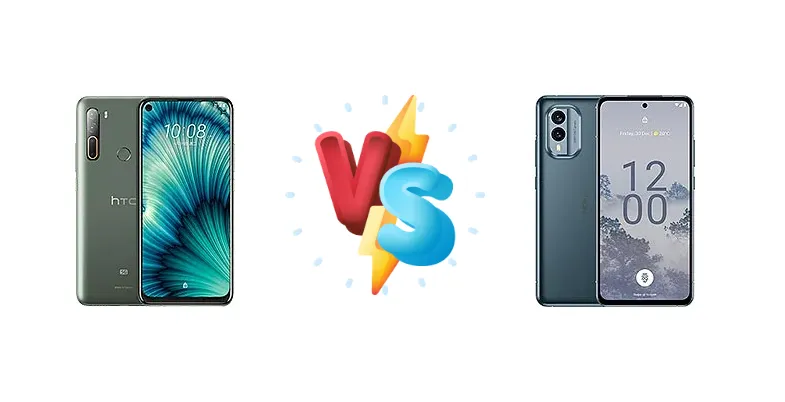
The HTC U20 5G and Nokia X30 represent distinct approaches to the mid-range 5G smartphone market. The U20 5G, while older, boasts a more powerful chipset, while the X30 focuses on longevity, a brighter display, and faster charging. This comparison dives deep into the specifications to determine which device delivers the best overall experience.
🏆 Quick Verdict
For users prioritizing raw performance and occasional gaming, the HTC U20 5G offers a noticeable edge thanks to its Snapdragon 765G. However, the Nokia X30’s brighter display, faster 33W charging, and comparable battery endurance make it the better choice for everyday users who value convenience and a more modern feature set.
| Network |
|---|
| 2G bands | GSM 850 / 900 / 1800 / 1900 | GSM 850 / 900 / 1800 / 1900 |
| 3G bands | HSDPA 850 / 900 / 1900 / 2100 | HSDPA 850 / 900 / 1700(AWS) / 1900 / 2100 |
| 4G bands | 1, 2, 3, 5, 7, 8, 20, 28, 38, 39, 40, 41 | 1, 2, 3, 4, 5, 7, 8, 12, 17, 20, 28, 32, 38, 39, 40, 41 |
| 5G bands | 1, 3, 28, 41, 78 SA/NSA | 1, 3, 5, 7, 8, 28, 38, 40, 41, 77, 78 SA/NSA/Sub6 |
| Speed | HSPA, LTE, 5G 2.56/0.9 Gbps | HSPA, LTE, 5G |
| Technology | GSM / HSPA / LTE / 5G | GSM / HSPA / LTE / 5G |
| Launch |
|---|
| Announced | 2020, June 16. Released 2020, October 01 | 2022, September 01 |
| Status | Discontinued | Available. Released 2022, September 21 |
| Body |
|---|
| Build | - | Glass front (Gorilla Glass Victus), aluminum frame, plastic back |
| Dimensions | 171.2 x 78.1 x 9.4 mm (6.74 x 3.07 x 0.37 in) | 158.9 x 73.9 x 8 mm (6.26 x 2.91 x 0.31 in) |
| SIM | Nano-SIM + Nano-SIM | · Nano-SIM + eSIM· Nano-SIM + Nano-SIM |
| Weight | 215.5 g (7.62 oz) | 185 g (6.53 oz) |
| | - | IP67 dust/water resistant (up to 1m for 30 min) |
| Display |
|---|
| Protection | Asahi Dragontrail Glass | Corning Gorilla Glass Victus |
| Resolution | 1080 x 2400 pixels, 20:9 ratio (~387 ppi density) | 1080 x 2400 pixels, 20:9 ratio (~409 ppi density) |
| Size | 6.8 inches, 111.6 cm2 (~83.5% screen-to-body ratio) | 6.43 inches, 99.8 cm2 (~85.0% screen-to-body ratio) |
| Type | IPS LCD | AMOLED, 90Hz, 450 nits (typ), 700 nits (peak) |
| Platform |
|---|
| CPU | Octa-core (1x2.4 GHz Kryo 475 Prime & 1x2.2 GHz Kryo 475 Gold & 6x1.8 GHz Kryo 475 Silver) | Octa-core (2x2.2 GHz Kryo 660 Gold & 6x1.7 GHz Kryo 660 Silver) |
| Chipset | Qualcomm SM7250 Snapdragon 765G 5G (7 nm) | Qualcomm SM6375 Snapdragon 695 5G (6 nm) |
| GPU | Adreno 620 | Adreno 619 |
| OS | Android 10 | Android 12, upgradable to Android 13 |
| Memory |
|---|
| Card slot | microSDXC | No |
| Internal | 256GB 6GB RAM, 256GB 8GB RAM | 128GB 6GB RAM, 128GB 8GB RAM, 256GB 8GB RAM |
| | - | UFS 2.2 - 128GB
UFS 3.0 - 256GB |
| Main Camera |
|---|
| Dual | - | 50 MP, f/1.9, (wide), 1/1.56", 1.0µm, PDAF, OIS
13 MP, f/2.4, 123˚ (ultrawide), 1/3.06" |
| Features | Dual-LED flash, HDR, panorama | LED flash, HDR, panorama |
| Quad | 48 MP, f/1.8, 26mm (wide), 1/2.0", 0.8µm, PDAF
8 MP, f/2.2, 118˚ (ultrawide), 1/4.0", 1.12µm
2 MP (macro)
Auxiliary lens | - |
| Single | 8 MP, AF | 16 MP, f/2.4, (wide), 1/3.06", 1.0µm |
| Video | 4K@30fps, 1080p@30fps, gyro-EIS | 1080p@30/60fps |
| Selfie camera |
|---|
| Features | HDR | - |
| Single | 32 MP, f/2.0, (wide), 1/2.8", 0.8µm | 16 MP, f/2.4, (wide), 1/3.06", 1.0µm |
| Video | 1080p@30fps | 1080p@30fps |
| Sound |
|---|
| 3.5mm jack | No | No |
| 35mm jack | No | No |
| Loudspeaker | Yes | Yes |
| Comms |
|---|
| Bluetooth | 5.0, A2DP, LE | 5.1, A2DP, LE, aptX HD |
| NFC | Yes | Yes |
| Positioning | GPS, GLONASS, GALILEO, BDS | GPS, GLONASS, GALILEO, BDS |
| Radio | No | FM radio, RDS |
| USB | USB Type-C 2.0 | USB Type-C 2.0, OTG |
| WLAN | Wi-Fi 802.11 a/b/g/n/ac, dual-band, Wi-Fi Direct | Wi-Fi 802.11 a/b/g/n/ac/6, dual-band, Wi-Fi Direct |
| Features |
|---|
| Sensors | Fingerprint (rear-mounted), accelerometer, gyro, proximity, compass, SAR | Fingerprint (under display, optical), accelerometer, gyro, proximity, compass |
| Battery |
|---|
| Charging | 18W wired, QC4 | 33W wired, PD3.0 |
| Stand-by | Up to 200 h | - |
| Talk time | Up to 8 h 20 min | - |
| Type | Li-Po 5000 mAh | Li-Po 4200 mAh |
| Misc |
|---|
| Colors | Green, White | Cloudy Blue, Ice White |
| Models | - | TA-1450, TA-1443 |
| Price | - | $ 399.00 |
| SAR EU | 0.44 W/kg (head) | 0.79 W/kg (head) 1.37 W/kg (body) |
| Tests |
|---|
| Battery life | - |
Endurance rating 94h
|
| Camera | - |
Photo / Video |
| Display | - |
Contrast ratio: Infinite (nominal) |
| Loudspeaker | - |
-27.5 LUFS (Good)
|
| Performance | - |
AnTuTu: 403732 (v9)
GeekBench: 1920 (v5.1)
GFXBench: 17fps (ES 3.1 onscreen) |
HTC U20 5G
- More powerful Snapdragon 765G chipset
- Potentially better gaming performance
- Established 5G connectivity
- Slower 18W charging
- Display brightness data unavailable, likely lower than X30
- Older device, potentially fewer software updates
Nokia X30
- Brighter 746 nit display for outdoor visibility
- Faster 33W charging with PD3.0
- Comparable 94-hour battery endurance
- Less powerful Snapdragon 695 chipset
- Potentially lower CPU performance in demanding tasks
- May not be ideal for intensive gaming
Display Comparison
The Nokia X30 immediately stands out with its measured peak brightness of 746 nits, significantly improving outdoor visibility compared to the HTC U20 5G (brightness data unavailable). While the U20 5G’s panel characteristics are unknown, the X30’s ‘Infinite’ contrast ratio (nominal) suggests a typical OLED experience. Both devices lack high refresh rate displays, focusing instead on power efficiency. The X30’s brighter panel is a clear advantage for users who frequently use their phones outdoors.
Camera Comparison
Both phones feature photo and video capabilities, but detailed camera specifications are limited. Without sensor size or aperture information, a direct comparison is difficult. The Nokia X30’s focus on image processing and software enhancements likely provides a more refined camera experience. The absence of detailed camera specs suggests neither phone is positioned as a photography powerhouse, focusing instead on providing adequate image capture for social media and everyday use.
Performance
The core difference lies in the chipsets. The HTC U20 5G utilizes the Qualcomm Snapdragon 765G (7nm), featuring a Kryo 475 prime core clocked at 2.4GHz, while the Nokia X30 employs the Snapdragon 695 5G (6nm). The 6nm process of the 695 offers improved power efficiency, but the 765G’s more powerful CPU architecture – with a higher clocked prime core – translates to better overall performance, particularly in CPU-intensive tasks. The 765G’s Adreno 620 GPU also provides a more capable gaming experience. However, the X30’s 6nm node may result in better sustained performance under load due to improved thermal characteristics.
Battery Life
Both the HTC U20 5G and Nokia X30 achieve an endurance rating of 94 hours, indicating similar real-world battery life. However, the charging speeds differ significantly. The Nokia X30 supports 33W wired charging with PD3.0, allowing for a much faster 0-100% charge compared to the HTC U20 5G’s 18W QC4 charging. This faster charging is a significant convenience factor for users who frequently need to top up their battery quickly.
Buying Guide
Buy the HTC U20 5G if you need a phone capable of handling more demanding applications and light gaming, and are comfortable with a slightly older device. Buy the Nokia X30 if you prioritize a brighter, more visible display in sunlight, faster charging speeds, and a phone built with a focus on software updates and sustainability.
Frequently Asked Questions
❓ Does the Snapdragon 695 in the Nokia X30 struggle with graphically intensive games like Genshin Impact?
The Snapdragon 695 is a capable chipset, but it's not designed for high-end gaming. Genshin Impact will likely require significant graphics settings reductions to achieve playable frame rates on the Nokia X30. The HTC U20 5G’s Snapdragon 765G will offer a smoother experience, but still won’t deliver flagship-level performance.
❓ How long does it realistically take to fully charge the Nokia X30 from 0% with the 33W charger?
While Nokia doesn't provide exact figures, with 33W PD3.0 charging, the Nokia X30 should fully charge from 0% in approximately 70-80 minutes. This is significantly faster than the HTC U20 5G’s 18W charging, which could take over 2 hours for a full charge.
❓ Is the software support better on the Nokia X30 compared to the older HTC U20 5G?
Nokia is known for providing consistent software updates and security patches, particularly on their X-series devices. The HTC U20 5G, being an older model, is likely to receive fewer updates, potentially leaving it vulnerable to security risks over time. This is a key advantage for the Nokia X30.