
HTC U20 5G vs Motorola Moto G62 5G: A Detailed Comparison of Mid-Range 5G Contenders
| Phones Images | |||||
|---|---|---|---|---|---|
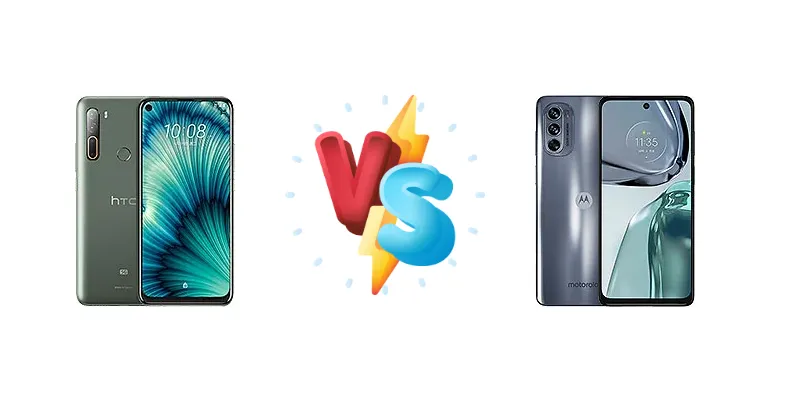
|
🏆 Quick Verdict
For users prioritizing performance and responsiveness, the HTC U20 5G is the better choice thanks to its Snapdragon 765G. However, the Motorola Moto G62 5G offers comparable battery life and a respectable display at a potentially lower price point, making it ideal for everyday users.
| PHONES | ||
|---|---|---|
| Phone Names | HTC U20 5G | Motorola Moto G62 5G |
| Network | ||
|---|---|---|
| 2G bands | GSM 850 / 900 / 1800 / 1900 | GSM 850 / 900 / 1800 / 1900 |
| 3G bands | HSDPA 850 / 900 / 1900 / 2100 | HSDPA 850 / 900 / 1700(AWS) / 1900 / 2100 |
| 4G bands | 1, 2, 3, 5, 7, 8, 20, 28, 38, 39, 40, 41 | 1, 2, 3, 4, 5, 7, 8, 12, 13, 17, 18, 19, 20, 26, 28, 32, 38, 39, 40, 41, 42, 43 - Europe |
| 5G bands | 1, 3, 28, 41, 78 SA/NSA | 1, 3, 5, 7, 8, 20, 28, 38, 40, 41, 77, 78 SA/NSA - Europe |
| Speed | HSPA, LTE, 5G 2.56/0.9 Gbps | HSPA, LTE, 5G |
| Technology | GSM / HSPA / LTE / 5G | GSM / HSPA / LTE / 5G |
| - | 1, 5, 7, 28, 40, 41, 66, 78 SA/NSA - LATAM, Brazil | |
| Launch | ||
|---|---|---|
| Announced | 2020, June 16. Released 2020, October 01 | 2022, June 09 |
| Status | Discontinued | Available. Released 2022, June 28 |
| Body | ||
|---|---|---|
| Build | - | Glass front, plastic frame, plastic back |
| Dimensions | 171.2 x 78.1 x 9.4 mm (6.74 x 3.07 x 0.37 in) | 161.8 x 74 x 8.6 mm (6.37 x 2.91 x 0.34 in) |
| SIM | Nano-SIM + Nano-SIM | Nano-SIM + Nano-SIM |
| Weight | 215.5 g (7.62 oz) | 184 g (6.49 oz) |
| - | Water-repellent design | |
| Display | ||
|---|---|---|
| Protection | Asahi Dragontrail Glass | - |
| Resolution | 1080 x 2400 pixels, 20:9 ratio (~387 ppi density) | 1080 x 2400 pixels, 20:9 ratio (~405 ppi density) |
| Size | 6.8 inches, 111.6 cm2 (~83.5% screen-to-body ratio) | 6.5 inches, 102.0 cm2 (~85.2% screen-to-body ratio) |
| Type | IPS LCD | IPS LCD, 120Hz |
| Platform | ||
|---|---|---|
| CPU | Octa-core (1x2.4 GHz Kryo 475 Prime & 1x2.2 GHz Kryo 475 Gold & 6x1.8 GHz Kryo 475 Silver) | Octa-core (2x2.2 GHz Kryo 460 & 6x1.8 GHz Kryo 460) |
| Chipset | Qualcomm SM7250 Snapdragon 765G 5G (7 nm) | Qualcomm SM4350-AC Snapdragon 480+ 5G (8 nm) |
| GPU | Adreno 620 | Adreno 619 |
| OS | Android 10 | Android 12, upgradable to Android 13 |
| Memory | ||
|---|---|---|
| Card slot | microSDXC | microSDXC (uses shared SIM slot) |
| Internal | 256GB 6GB RAM, 256GB 8GB RAM | 64GB 4GB RAM, 128GB 4GB RAM, 128GB 6GB RAM, 128GB 8GB RAM |
| Main Camera | ||
|---|---|---|
| Features | Dual-LED flash, HDR, panorama | LED flash, HDR, panorama |
| Quad | 48 MP, f/1.8, 26mm (wide), 1/2.0", 0.8µm, PDAF 8 MP, f/2.2, 118˚ (ultrawide), 1/4.0", 1.12µm 2 MP (macro) Auxiliary lens | - |
| Single | 8 MP, AF | - |
| Triple | - | 50 MP, f/1.8 (wide), 1/2.76", 0.64µm, PDAF 8 MP, f/2.2, 118˚ (ultrawide), 1/4.0", 1.12µm 2 MP (macro) |
| Video | 4K@30fps, 1080p@30fps, gyro-EIS | 1080p@30/60fps |
| Selfie camera | ||
|---|---|---|
| Features | HDR | - |
| Single | 32 MP, f/2.0, (wide), 1/2.8", 0.8µm | 16 MP, f/2.2, (wide), 1/3.0", 1.0µm |
| Video | 1080p@30fps | 1080p@30fps |
| Sound | ||
|---|---|---|
| 3.5mm jack | No | Yes |
| 35mm jack | No | Yes |
| Loudspeaker | Yes | Yes, with stereo speakers |
| Comms | ||
|---|---|---|
| Bluetooth | 5.0, A2DP, LE | 5.1, A2DP, LE |
| NFC | Yes | Yes |
| Positioning | GPS, GLONASS, GALILEO, BDS | GPS, GLONASS, GALILEO, BDS |
| Radio | No | Unspecified |
| USB | USB Type-C 2.0 | USB Type-C 2.0 |
| WLAN | Wi-Fi 802.11 a/b/g/n/ac, dual-band, Wi-Fi Direct | Wi-Fi 802.11 a/b/g/n/ac, dual-band, Wi-Fi Direct |
| Features | ||
|---|---|---|
| Sensors | Fingerprint (rear-mounted), accelerometer, gyro, proximity, compass, SAR | Fingerprint (side-mounted), accelerometer, gyro, proximity, compass |
| Battery | ||
|---|---|---|
| Charging | 18W wired, QC4 | 15W wired |
| Stand-by | Up to 200 h | - |
| Talk time | Up to 8 h 20 min | - |
| Type | Li-Po 5000 mAh | Li-Po 5000 mAh |
| Misc | ||
|---|---|---|
| Colors | Green, White | Midnight Gray, Frosted Blue |
| Price | - | About 110 EUR |
| SAR EU | 0.44 W/kg (head) | - |
| Tests | ||
|---|---|---|
| Battery life | - | Endurance rating 122h |
| Camera | - | Photo / Video |
| Display | - | Contrast ratio: 1571:1 |
| Loudspeaker | - | -25.9 LUFS (Very good) |
| Performance | - | AnTuTu: 303072 (v9) GeekBench: 1697 (v5.1) GFXBench: 14fps (ES 3.1 onscreen) |
HTC U20 5G
- More powerful Snapdragon 765G processor
- Faster 18W Quick Charge 4 charging
- Potentially better image processing capabilities
- May be harder to find at retail
- Potentially higher price point
Motorola Moto G62 5G
- Bright and clear 552 nit display
- Excellent battery endurance (122h)
- Potentially more affordable price
- Less powerful Snapdragon 480+ processor
- Slower 15W charging
Display Comparison
The Motorola Moto G62 5G boasts a display capable of reaching 552 nits of peak brightness, and a 1571:1 contrast ratio, providing a visually clear experience in most lighting conditions. While the HTC U20 5G’s display specifications aren’t provided, its market positioning suggests a similar, if not slightly less vibrant, experience. The G62’s measured brightness is a significant advantage for outdoor visibility. Neither manufacturer details refresh rate, suggesting both likely operate at the standard 60Hz.
Camera Comparison
Both devices feature photo and video capabilities, but detailed camera specifications are limited. Without sensor size or aperture information, a direct comparison is difficult. However, the U20 5G’s higher overall processing power suggests it may have an edge in image processing speed and potentially more advanced features. The inclusion of a dedicated image signal processor (ISP) within the Snapdragon 765G is more robust than that found in the 480+, potentially leading to better dynamic range and low-light performance. The presence of a 2MP macro lens on the G62 is unlikely to significantly impact overall camera quality.
Performance
The core difference lies in the chipsets. The HTC U20 5G utilizes the Qualcomm SM7250 Snapdragon 765G (7nm), featuring a Kryo 475 octa-core CPU with a prime core clocked at 2.4GHz. This is a significant step up from the Motorola Moto G62 5G’s Snapdragon 480+ (8nm), which has a dual-core configuration peaking at 2.2GHz. The 7nm process node of the 765G generally translates to better power efficiency and thermal performance compared to the 8nm 480+. This means the U20 5G is likely to sustain higher performance for longer periods, particularly in graphically intensive applications. The U20’s CPU architecture, with its Kryo 475 cores, also offers a more refined experience than the Kryo 460 cores in the G62.
Battery Life
Both the HTC U20 5G and Motorola Moto G62 5G share an endurance rating of 122 hours, indicating similar battery life under typical usage. However, the U20 5G’s 18W Quick Charge 4 (QC4) support offers faster charging speeds compared to the G62’s 15W wired charging. While the G62’s efficiency might offset the smaller charging wattage, the U20 5G will likely reach a full charge quicker, providing a convenience advantage.
Buying Guide
Buy the HTC U20 5G if you need a phone capable of handling more demanding tasks like gaming or video editing, and appreciate the extra processing power of the Snapdragon 765G. Buy the Motorola Moto G62 5G if you prioritize all-day battery life, a bright and clear display for media consumption, and a more budget-friendly price tag, accepting a slight performance trade-off.