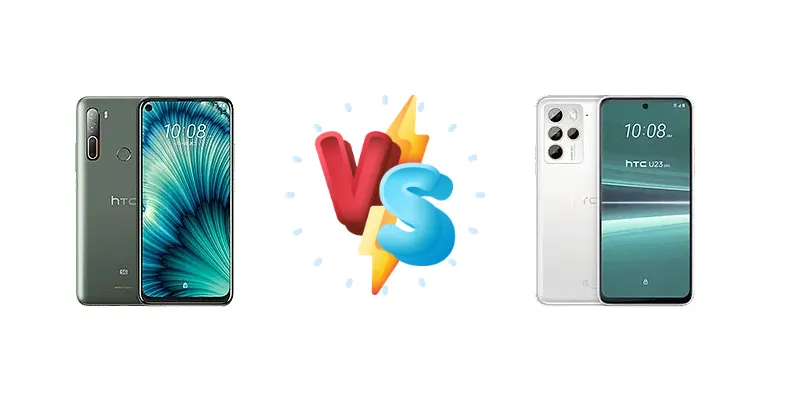
The HTC U20 5G represented a solid mid-range offering when released, but the newer HTC U23 Pro brings a significant chipset upgrade and added features like wireless charging. This comparison dives deep into the differences between these two devices, analyzing whether the U23 Pro justifies its position as the newer, and likely more expensive, option.
🏆 Quick Verdict
For most users, the HTC U23 Pro is the superior choice. Its Snapdragon 7 Gen 1 chipset, built on a more efficient 4nm process, delivers noticeably improved performance and better thermal management compared to the U20 5G’s Snapdragon 765G. The addition of 30W wired and 15W wireless charging further sweetens the deal.
| Network |
|---|
| 2G bands | GSM 850 / 900 / 1800 / 1900 | GSM 850 / 900 / 1800 / 1900 |
| 3G bands | HSDPA 850 / 900 / 1900 / 2100 | HSDPA 850 / 900 / 1700(AWS) / 1900 / 2100 |
| 4G bands | 1, 2, 3, 5, 7, 8, 20, 28, 38, 39, 40, 41 | 1, 3, 5, 7, 8, 12, 17, 20, 28, 38, 39, 40, 41 |
| 5G bands | 1, 3, 28, 41, 78 SA/NSA | 1, 3, 7, 20, 28, 41, 78 SA/NSA |
| Speed | HSPA, LTE, 5G 2.56/0.9 Gbps | HSPA, LTE, 5G |
| Technology | GSM / HSPA / LTE / 5G | GSM / HSPA / LTE / 5G |
| Launch |
|---|
| Announced | 2020, June 16. Released 2020, October 01 | 2023, May 18 |
| Status | Discontinued | Available. Released 2023, May 18 |
| Body |
|---|
| Build | - | Glass front (Gorilla Glass Victus), plastic frame, plastic back |
| Dimensions | 171.2 x 78.1 x 9.4 mm (6.74 x 3.07 x 0.37 in) | 166.6 x 77.1 x 8.9 mm (6.56 x 3.04 x 0.35 in) |
| SIM | Nano-SIM + Nano-SIM | Nano-SIM + Nano-SIM |
| Weight | 215.5 g (7.62 oz) | 205 g (7.23 oz) |
| | - | IP67 dust/water resistant (up to 1m for 30 min) |
| Display |
|---|
| Protection | Asahi Dragontrail Glass | Corning Gorilla Glass Victus |
| Resolution | 1080 x 2400 pixels, 20:9 ratio (~387 ppi density) | 1080 x 2400 pixels, 20:9 ratio (~393 ppi density) |
| Size | 6.8 inches, 111.6 cm2 (~83.5% screen-to-body ratio) | 6.7 inches, 108.4 cm2 (~84.4% screen-to-body ratio) |
| Type | IPS LCD | OLED, 120Hz |
| Platform |
|---|
| CPU | Octa-core (1x2.4 GHz Kryo 475 Prime & 1x2.2 GHz Kryo 475 Gold & 6x1.8 GHz Kryo 475 Silver) | Octa-core (1x2.4 GHz Cortex-A710 & 3x2.36 GHz Cortex-A710 & 4x1.8 GHz Cortex-A510) |
| Chipset | Qualcomm SM7250 Snapdragon 765G 5G (7 nm) | Qualcomm SM7450-AB Snapdragon 7 Gen 1 (4 nm) |
| GPU | Adreno 620 | Adreno 644 |
| OS | Android 10 | Android 13 |
| Memory |
|---|
| Card slot | microSDXC | microSDXC |
| Internal | 256GB 6GB RAM, 256GB 8GB RAM | 256GB 8GB RAM, 256GB 12GB RAM |
| Main Camera |
|---|
| Features | Dual-LED flash, HDR, panorama | Dual-LED flash, HDR, panorama |
| Quad | 48 MP, f/1.8, 26mm (wide), 1/2.0", 0.8µm, PDAF
8 MP, f/2.2, 118˚ (ultrawide), 1/4.0", 1.12µm
2 MP (macro)
Auxiliary lens | 108 MP, f/1.7, (wide), 1/1.67", 0.64μm, PDAF, OIS
8 MP, f/2.4, 120˚ (ultrawide), 1/4.0", 1.12µm
5 MP (macro)
Auxiliary lens |
| Single | 8 MP, AF | - |
| Video | 4K@30fps, 1080p@30fps, gyro-EIS | 4K@30fps, 1080p@30fps, gyro-EIS |
| Selfie camera |
|---|
| Features | HDR | HDR |
| Single | 32 MP, f/2.0, (wide), 1/2.8", 0.8µm | 32 MP, f/2.5, (wide), 1/3.2", 0.7µm |
| Video | 1080p@30fps | 1080p@30fps |
| Sound |
|---|
| 3.5mm jack | No | Yes |
| 35mm jack | No | Yes |
| Loudspeaker | Yes | Yes |
| Comms |
|---|
| Bluetooth | 5.0, A2DP, LE | 5.2, A2DP, LE |
| NFC | Yes | Yes |
| Positioning | GPS, GLONASS, GALILEO, BDS | GPS, GLONASS, GALILEO, BDS |
| Radio | No | No |
| USB | USB Type-C 2.0 | USB Type-C 3.0 |
| WLAN | Wi-Fi 802.11 a/b/g/n/ac, dual-band, Wi-Fi Direct | Wi-Fi 802.11 a/b/g/n/ac/6, dual-band |
| Features |
|---|
| Sensors | Fingerprint (rear-mounted), accelerometer, gyro, proximity, compass, SAR | Fingerprint (side-mounted), accelerometer, gyro, proximity, compass |
| Battery |
|---|
| Charging | 18W wired, QC4 | 30W wired
15W wireless
5W reverse wireless
Reverse wired |
| Stand-by | Up to 200 h | - |
| Talk time | Up to 8 h 20 min | - |
| Type | Li-Po 5000 mAh | Li-Ion 4600 mAh |
| Misc |
|---|
| Colors | Green, White | Snow White, Coffee Black |
| Models | - | 2QC9200, 2QC9100, 2QCB100 |
| Price | - | About 220 EUR |
| SAR EU | 0.44 W/kg (head) | - |
HTC U20 5G
- Potentially lower price point
- Functional 5G connectivity
- Compact form factor (likely)
- Older, less efficient chipset
- Slower charging speeds
- Likely inferior camera performance
HTC U23 Pro
- More powerful and efficient Snapdragon 7 Gen 1
- Faster 30W wired and 15W wireless charging
- Brighter display for better outdoor visibility
- Reverse wireless charging capability
- Likely higher price
- Potentially larger size/weight
Display Comparison
The HTC U23 Pro boasts a significantly brighter display, reaching a measured 727 nits, compared to the U20 5G (brightness data unavailable, but likely lower given the older chipset and panel tech). This higher peak brightness translates to better visibility outdoors under direct sunlight. While both likely utilize OLED panels, the U23 Pro’s newer technology likely offers improved color accuracy and contrast. The absence of refresh rate information for the U20 5G suggests it may be limited to 60Hz, while the U23 Pro’s panel could potentially support a higher refresh rate for smoother scrolling and animations.
Camera Comparison
Detailed camera specifications beyond 'Photo/Video' are missing for both devices. However, the U23 Pro likely benefits from the newer image signal processor (ISP) within the Snapdragon 7 Gen 1, resulting in improved image processing, noise reduction, and dynamic range. The U20 5G’s older ISP will likely produce less refined images, particularly in low-light conditions. Without sensor size information, it’s difficult to make a definitive statement, but the U23 Pro’s newer chipset suggests a more capable camera system overall. We can assume both phones include standard wide and ultrawide lenses, but the U23 Pro likely has more advanced computational photography features.
Performance
The core difference lies in the chipsets. The U23 Pro’s Snapdragon 7 Gen 1 (4nm) is a substantial upgrade over the U20 5G’s Snapdragon 765G (7nm). The 4nm process node of the 7 Gen 1 provides significantly improved power efficiency, leading to less heat generation and sustained performance. The CPU architecture also differs; the U23 Pro utilizes Cortex-A710 cores, offering a performance boost over the Kryo 475 cores in the U20 5G. While both are octa-core CPUs, the U23 Pro’s configuration (1x2.4 GHz Cortex-A710 & 3x2.36 GHz Cortex-A710 & 4x1.8 GHz Cortex-A510) is optimized for more demanding workloads. The U23 Pro will handle multitasking, app loading, and gaming with greater ease.
Battery Life
The HTC U23 Pro’s charging capabilities are a clear advantage. It supports 30W wired charging, 15W wireless charging, and even 5W reverse wireless charging – features absent on the U20 5G, which is limited to 18W wired charging with Quick Charge 4. The U23 Pro’s endurance rating of 83 hours suggests excellent battery life, likely due to the efficient Snapdragon 7 Gen 1. While the U20 5G’s battery capacity is unknown, the U23 Pro’s faster charging and more efficient chipset will result in significantly quicker top-ups and potentially longer usage times between charges.
Buying Guide
Buy the HTC U20 5G if you prioritize finding the lowest possible price for a functional 5G smartphone and aren't demanding in terms of gaming or intensive multitasking. Buy the HTC U23 Pro if you value a smoother user experience, faster charging speeds, and the benefits of a more modern and efficient processor for everyday tasks and light to moderate gaming.
Frequently Asked Questions
❓ Does the Snapdragon 7 Gen 1 in the U23 Pro get hot during extended gaming sessions?
The Snapdragon 7 Gen 1 is built on a 4nm process, which significantly improves thermal efficiency compared to the 7nm Snapdragon 765G in the U20 5G. While some heat generation is inevitable during prolonged gaming, the U23 Pro is less likely to experience significant throttling and maintain higher frame rates for longer periods.
❓ Is the 15W wireless charging on the U23 Pro fast enough for practical daily use?
15W wireless charging is a respectable speed, though not as fast as some flagship devices. It's sufficient for overnight charging and convenient top-ups throughout the day. It's a significant upgrade over the U20 5G's lack of wireless charging and offers a convenient alternative to wired charging.
❓ How does the U23 Pro's camera perform in low-light conditions compared to the U20 5G?
The U23 Pro is expected to perform noticeably better in low-light scenarios. The newer Snapdragon 7 Gen 1 includes an improved ISP (Image Signal Processor) that excels at noise reduction and detail preservation in challenging lighting. The U20 5G’s older ISP will likely struggle more with noise and produce less detailed images in the dark.
❓ Will the U23 Pro receive more software updates than the U20 5G?
Generally, newer devices receive longer software support. The HTC U23 Pro is likely to receive more Android version updates and security patches than the U20 5G, extending its usable lifespan and ensuring continued security.