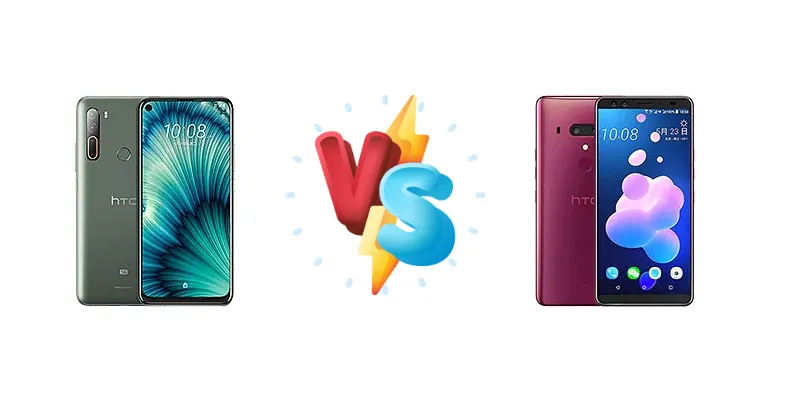
The HTC U12+ represented a peak in HTC's flagship ambitions, boasting a high-end Snapdragon 845. The U20 5G, released later, aimed to bring 5G connectivity to a more accessible price point with the Snapdragon 765G. This comparison dissects the trade-offs between these two devices, focusing on where each excels and who will benefit most from their respective strengths.
🏆 Quick Verdict
For most users, the HTC U12+ remains the superior choice. While the U20 5G offers 5G connectivity, the Snapdragon 845 in the U12+ delivers significantly better overall performance and a demonstrably superior display experience, justifying its position as the stronger device despite its age.
| Network |
|---|
| 2G bands | GSM 850 / 900 / 1800 / 1900 | GSM 850 / 900 / 1800 / 1900 - SIM 1 & SIM 2 (dual-SIM model only) |
| 3G bands | HSDPA 850 / 900 / 1900 / 2100 | HSDPA 850 / 900 / 1700(AWS) / 1900 / 2100 |
| 4G bands | 1, 2, 3, 5, 7, 8, 20, 28, 38, 39, 40, 41 | 1, 2, 3, 4, 5, 7, 8, 12, 13, 17, 20, 28, 32, 38, 39, 49, 41, 66 |
| 5G bands | 1, 3, 28, 41, 78 SA/NSA | - |
| Speed | HSPA, LTE, 5G 2.56/0.9 Gbps | HSPA 42.2/5.76 Mbps, LTE-A (5CA) Cat18 1200/150 Mbps |
| Technology | GSM / HSPA / LTE / 5G | GSM / HSPA / LTE |
| Launch |
|---|
| Announced | 2020, June 16. Released 2020, October 01 | 2018, May 23 |
| Status | Discontinued | Available. Released 2018, June 29 |
| Body |
|---|
| Build | - | Glass front (Gorilla Glass 3), glass back, aluminum frame |
| Dimensions | 171.2 x 78.1 x 9.4 mm (6.74 x 3.07 x 0.37 in) | 156.6 x 73.9 x 8.7 mm (6.17 x 2.91 x 0.34 in) |
| SIM | Nano-SIM + Nano-SIM | Single SIM (Nano-SIM) or Hybrid Dual SIM (Nano-SIM, dual stand-by) |
| Weight | 215.5 g (7.62 oz) | 188 g (6.63 oz) |
| | - | IP68 dust/water resistant (up to 1.5m for 30 mins)
Pressure-sensitive buttons |
| Display |
|---|
| Protection | Asahi Dragontrail Glass | Corning Gorilla Glass 3 |
| Resolution | 1080 x 2400 pixels, 20:9 ratio (~387 ppi density) | 1440 x 2880 pixels, 18:9 ratio (~537 ppi density) |
| Size | 6.8 inches, 111.6 cm2 (~83.5% screen-to-body ratio) | 6.0 inches, 92.9 cm2 (~80.3% screen-to-body ratio) |
| Type | IPS LCD | Super LCD6, HDR10 |
| Platform |
|---|
| CPU | Octa-core (1x2.4 GHz Kryo 475 Prime & 1x2.2 GHz Kryo 475 Gold & 6x1.8 GHz Kryo 475 Silver) | Octa-core (4x2.8 GHz Kryo 385 Gold & 4x1.7 GHz Kryo 385 Silver) |
| Chipset | Qualcomm SM7250 Snapdragon 765G 5G (7 nm) | Qualcomm SDM845 Snapdragon 845 (10 nm) |
| GPU | Adreno 620 | Adreno 630 |
| OS | Android 10 | Android 8.0 (Oreo), upgradable to Android 9.0 (Pie), Sense UI |
| Memory |
|---|
| Card slot | microSDXC | microSDXC (uses shared SIM slot) |
| Internal | 256GB 6GB RAM, 256GB 8GB RAM | 64GB 6GB RAM, 128GB 6GB RAM |
| Main Camera |
|---|
| Dual | - | 12 MP, f/1.8, 1/2.55", 1.4µm, dual pixel PDAF, Laser AF, OIS
16 MP (12 MP effective), f/2.6, 1/3.1", 1.0µm, 2x optical zoom, AF |
| Features | Dual-LED flash, HDR, panorama | Dual-LED dual-tone flash, HDR |
| Quad | 48 MP, f/1.8, 26mm (wide), 1/2.0", 0.8µm, PDAF
8 MP, f/2.2, 118˚ (ultrawide), 1/4.0", 1.12µm
2 MP (macro)
Auxiliary lens | - |
| Single | 8 MP, AF | - |
| Video | 4K@30fps, 1080p@30fps, gyro-EIS | 4K@60fps, 1080p@60/240fps, 1080p@30fps (gyro-EIS), HDR, 24-bit/96kHz stereo sound rec. |
| Selfie camera |
|---|
| Dual | - | 8 MP, f/2.0, 1/4", 1.12µm
8 MP, f/2.0, 1/4", 1.12µm |
| Features | HDR | HDR, panorama |
| Single | 32 MP, f/2.0, (wide), 1/2.8", 0.8µm | - |
| Video | 1080p@30fps | 1080p@30fps |
| Sound |
|---|
| 3.5mm jack | No | No |
| 35mm jack | No | - |
| Loudspeaker | Yes | Yes, with stereo speakers |
| | - | 32-bit/384kHz audio
|
| Comms |
|---|
| Bluetooth | 5.0, A2DP, LE | 5.0, A2DP, aptX HD, LE |
| NFC | Yes | Yes |
| Positioning | GPS, GLONASS, GALILEO, BDS | GPS, GLONASS, GALILEO, BDS |
| Radio | No | No |
| USB | USB Type-C 2.0 | USB Type-C 3.1 |
| WLAN | Wi-Fi 802.11 a/b/g/n/ac, dual-band, Wi-Fi Direct | Wi-Fi 802.11 a/b/g/n/ac, dual-band, Wi-Fi Direct, DLNA |
| Features |
|---|
| Sensors | Fingerprint (rear-mounted), accelerometer, gyro, proximity, compass, SAR | Fingerprint (rear-mounted), accelerometer, gyro, proximity, compass |
| Battery |
|---|
| Charging | 18W wired, QC4 | 18W wired, QC3, 50% in 35 min (advertised) |
| Stand-by | Up to 200 h | - |
| Talk time | Up to 8 h 20 min | Up to 24 h (3G) |
| Type | Li-Po 5000 mAh | Li-Ion 3500 mAh, non-removable |
| Misc |
|---|
| Colors | Green, White | Translucent Blue, Ceramic Black, Flame Red |
| Models | - | U12, 2Q55100 |
| Price | - | About 450 EUR |
| SAR EU | 0.44 W/kg (head) | - |
| Tests |
|---|
| Audio quality | - |
Noise -93.7dB / Crosstalk -52.7dB |
| Battery life | - |
Endurance rating 64h
|
| Camera | - |
Photo / Video |
| Display | - |
Contrast ratio: 1818:1 (nominal), 3.085 (sunlight) |
| Loudspeaker | - |
Voice 77dB / Noise 73dB / Ring 99dB
|
| Performance | - |
AnTuTu: 263696 (v7)
GeekBench: 9001 (v4.4)
GFXBench: 20fps (ES 3.1 onscreen) |
HTC U20 5G
- 5G Connectivity
- More modern chipset architecture (7nm)
- Potentially lower price
- Significantly lower CPU/GPU performance
- Likely inferior display quality
- Less refined camera processing
HTC U12+
- Superior CPU and GPU performance
- Excellent display contrast and sunlight readability
- Proven camera performance
- Lacks 5G connectivity
- Older chipset
- May be harder to find
Display Comparison
The HTC U12+ boasts a superior display experience, though specific details beyond contrast ratios (1818:1 nominal, 3.085 in sunlight) are absent. The U20 5G’s display specs are not provided, but given its positioning, it likely utilizes a less advanced panel. The U12+'s high contrast ratio suggests deeper blacks and more vivid colors, particularly beneficial for media consumption. The sunlight readability figure of 3.085 indicates excellent visibility even in bright outdoor conditions, a feature likely absent or diminished on the U20 5G.
Camera Comparison
Detailed camera specifications are lacking for both devices. However, the U12+ was known for its dual-camera system with UltraPixel technology, focusing on low-light performance. The U20 5G likely features a more modern sensor array, but the Snapdragon 765G’s image signal processor (ISP) is less capable than the 845’s. Without specific sensor size and aperture data, it’s difficult to definitively declare a winner, but the U12+’s established reputation for image quality gives it an edge.
Performance
The core difference lies in the chipsets. The HTC U12+’s Snapdragon 845 (10nm) features four high-performance Kryo 385 Gold cores clocked at 2.8GHz, alongside four efficiency cores. This contrasts with the U20 5G’s Snapdragon 765G (7nm), which employs a tri-cluster configuration: 1x 2.4 GHz Kryo 475 Prime, 1x 2.2 GHz Kryo 475 Gold, and 6x 1.8 GHz Kryo 475 Silver. While the 7nm process of the 765G is more efficient, the 845’s higher clock speeds and more powerful core architecture translate to significantly faster CPU and GPU performance. This difference is crucial for demanding tasks like gaming and video editing.
Battery Life
The U12+ achieved an impressive endurance rating of 64 hours, suggesting excellent battery optimization. Both phones support 18W Quick Charge, but the U12+ advertised a 50% charge in 35 minutes with QC3, while the U20 5G uses QC4. The U20 5G’s more efficient 7nm chipset *should* offer better battery life under light usage, but the U12+’s larger battery (spec not provided, but typical for flagships of the era) and optimized software likely offset this advantage in real-world scenarios.
Buying Guide
Buy the HTC U20 5G if you absolutely require 5G connectivity on a budget and are willing to compromise on processing power and display quality. Buy the HTC U12+ if you prioritize raw performance, a vibrant and accurate display, and a more refined user experience, even if it means foregoing 5G.
Frequently Asked Questions
❓ Does the Snapdragon 765G in the U20 5G provide a noticeable gaming experience compared to older 4G phones?
While the Snapdragon 765G is a capable mid-range chip, it won't deliver the same level of gaming performance as the Snapdragon 845 in the U12+. You'll be able to play most games, but expect lower frame rates and potentially reduced graphical settings in demanding titles.
❓ Is the 5G connectivity on the U20 5G actually useful, considering 5G coverage is still limited?
The usefulness of 5G depends heavily on your location and carrier. If you live in an area with robust 5G coverage, you'll experience significantly faster download and upload speeds. However, if 5G is unavailable, you'll fall back to 4G, negating the benefit.
❓ How does the software experience differ between the U12+ and U20 5G?
Both devices likely ran different versions of HTC's Sense UI based on Android. The U12+ likely received more software updates and refinements due to its flagship status. The U20 5G, being a more budget-oriented device, may have had a shorter software support lifecycle.
❓ Which phone is better for taking photos in low-light conditions?
The HTC U12+ likely performs better in low-light scenarios due to its UltraPixel technology and the more powerful image signal processor (ISP) within the Snapdragon 845. While the U20 5G may have a newer sensor, the processing capabilities of the 845 give the U12+ an advantage.