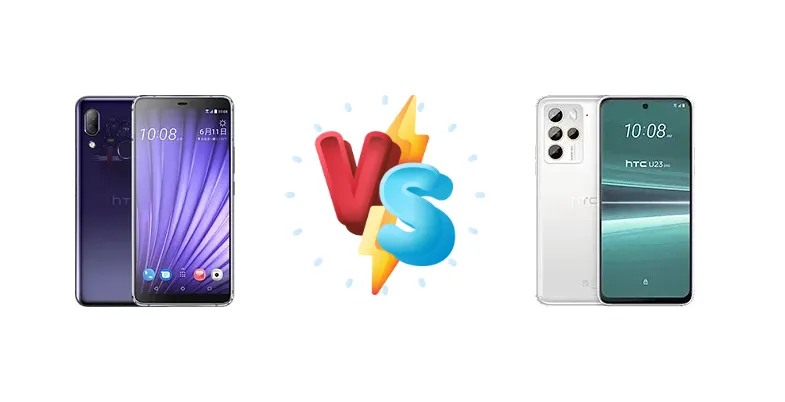
The HTC U19e represented a solid, if understated, mid-range offering in 2019. Now, the U23 Pro arrives with a newer chipset and features. This comparison examines whether the generational leap justifies an upgrade, focusing on the core differences between the Snapdragon 710 and the Snapdragon 7 Gen 1, and how those translate to real-world user experience.
🏆 Quick Verdict
For most users, the HTC U23 Pro is the clear winner. The Snapdragon 7 Gen 1 provides a substantial performance uplift over the 710, coupled with faster charging speeds and a brighter display. While the U19e remains a functional device, the U23 Pro offers a more modern and responsive experience.
| Network |
|---|
| 2G bands | GSM 850 / 900 / 1800 / 1900 | GSM 850 / 900 / 1800 / 1900 |
| 3G bands | HSDPA 850 / 900 / 1900 / 2100 | HSDPA 850 / 900 / 1700(AWS) / 1900 / 2100 |
| 4G bands | 1, 2, 3, 5, 7, 8, 20, 28, 38, 39, 40, 41 | 1, 3, 5, 7, 8, 12, 17, 20, 28, 38, 39, 40, 41 |
| 5G bands | - | 1, 3, 7, 20, 28, 41, 78 SA/NSA |
| Speed | HSPA 42.2/5.76 Mbps, LTE (3CA) Cat15 800/150 Mbps | HSPA, LTE, 5G |
| Technology | GSM / HSPA / LTE | GSM / HSPA / LTE / 5G |
| Launch |
|---|
| Announced | 2019, June 11. Released 2019, June 11 | 2023, May 18 |
| Status | Discontinued | Available. Released 2023, May 18 |
| Body |
|---|
| Build | Glass front (Gorilla Glass), glass back, aluminum frame | Glass front (Gorilla Glass Victus), plastic frame, plastic back |
| Dimensions | 156.6 x 75.9 x 8 mm (6.17 x 2.99 x 0.31 in) | 166.6 x 77.1 x 8.9 mm (6.56 x 3.04 x 0.35 in) |
| SIM | Nano-SIM + Nano-SIM | Nano-SIM + Nano-SIM |
| Weight | 180 g (6.35 oz) | 205 g (7.23 oz) |
| | - | IP67 dust/water resistant (up to 1m for 30 min) |
| Display |
|---|
| Protection | Corning Gorilla Glass (unspecified) | Corning Gorilla Glass Victus |
| Resolution | 1080 x 2160 pixels, 18:9 ratio (~402 ppi density) | 1080 x 2400 pixels, 20:9 ratio (~393 ppi density) |
| Size | 6.0 inches, 92.9 cm2 (~78.2% screen-to-body ratio) | 6.7 inches, 108.4 cm2 (~84.4% screen-to-body ratio) |
| Type | OLED, HDR10 | OLED, 120Hz |
| Platform |
|---|
| CPU | Octa-core (2x2.2 GHz Kryo 360 Gold & 6x1.7 GHz Kryo 360 Silver) | Octa-core (1x2.4 GHz Cortex-A710 & 3x2.36 GHz Cortex-A710 & 4x1.8 GHz Cortex-A510) |
| Chipset | Qualcomm SDM710 Snapdragon 710 (10 nm) | Qualcomm SM7450-AB Snapdragon 7 Gen 1 (4 nm) |
| GPU | Adreno 616 | Adreno 644 |
| OS | Android 9.0 (Pie), HTC Sense | Android 13 |
| Memory |
|---|
| Card slot | microSDXC (uses shared SIM slot) | microSDXC |
| Internal | 128GB 6GB RAM | 256GB 8GB RAM, 256GB 12GB RAM |
| Main Camera |
|---|
| Dual | 12 MP, f/1.8, 26mm (wide), PDAF
20 MP, f/2.6, 52mm (telephoto), 2x optical zoom | - |
| Features | Dual-LED dual-tone flash, Auto HDR, panorama | Dual-LED flash, HDR, panorama |
| Quad | - | 108 MP, f/1.7, (wide), 1/1.67", 0.64μm, PDAF, OIS
8 MP, f/2.4, 120˚ (ultrawide), 1/4.0", 1.12µm
5 MP (macro)
Auxiliary lens |
| Video | 4K@30fps | 4K@30fps, 1080p@30fps, gyro-EIS |
| Selfie camera |
|---|
| Dual | 24 MP, f/2.0, 26mm (wide), 1/2.8", 0.9µm
2 MP, f/2.2 (depth sensor) | - |
| Features | Auto HDR | HDR |
| Single | - | 32 MP, f/2.5, (wide), 1/3.2", 0.7µm |
| Video | 1080p@30fps | 1080p@30fps |
| Sound |
|---|
| 3.5mm jack | No | Yes |
| 35mm jack | No | Yes |
| Loudspeaker | Yes, with stereo speakers | Yes |
| | 24-bit/192kHz audio
| - |
| Comms |
|---|
| Bluetooth | 5.0, A2DP, LE | 5.2, A2DP, LE |
| NFC | Yes | Yes |
| Positioning | GPS, GLONASS | GPS, GLONASS, GALILEO, BDS |
| Radio | FM radio | No |
| USB | USB Type-C 3.1 | USB Type-C 3.0 |
| WLAN | Wi-Fi 802.11 a/b/g/n/ac, dual-band, Wi-Fi Direct | Wi-Fi 802.11 a/b/g/n/ac/6, dual-band |
| Features |
|---|
| Sensors | Iris scanner, fingerprint (rear-mounted), accelerometer, gyro, proximity, compass | Fingerprint (side-mounted), accelerometer, gyro, proximity, compass |
| Battery |
|---|
| Charging | 18W wired, QC4 | 30W wired
15W wireless
5W reverse wireless
Reverse wired |
| Type | Li-Ion 3930 mAh, non-removable | Li-Ion 4600 mAh |
| Misc |
|---|
| Colors | Extraordinary Purple, Modest Green | Snow White, Coffee Black |
| Models | - | 2QC9200, 2QC9100, 2QCB100 |
| Price | About 420 EUR | About 220 EUR |
HTC U19e
- Lower initial cost
- Functional for basic tasks
- QC4 fast charging support
- Outdated Snapdragon 710 chipset
- Slower charging speeds
- Likely lower display brightness
HTC U23 Pro
- Significantly faster Snapdragon 7 Gen 1
- 30W wired, 15W wireless, and reverse wireless charging
- Brighter display for better outdoor visibility
- Higher price point
- Camera details are limited in available data
- May not be a massive upgrade for very basic users
Display Comparison
The HTC U23 Pro boasts a significantly brighter display, reaching a measured 727 nits, compared to an unspecified brightness on the U19e. This higher peak brightness translates to better visibility outdoors under direct sunlight. While both likely utilize OLED panels given HTC’s history, the U23 Pro’s brightness advantage is a key differentiator. We lack PWM frequency data for both, but the U23 Pro’s newer panel tech *may* incorporate improvements for reduced flicker, benefiting users sensitive to screen strobing.
Camera Comparison
The context data for both devices is limited regarding camera specifics. However, the U23 Pro’s inclusion of 'Photo / Video' suggests a more feature-rich camera experience. While sensor sizes and apertures are unknown, the newer ISP (Image Signal Processor) within the Snapdragon 7 Gen 1 will deliver improved image processing, particularly in low-light conditions. The U19e likely relies on older algorithms, resulting in less detail and dynamic range. We can assume the U23 Pro benefits from more advanced computational photography features.
Performance
The core difference lies in the chipsets. The U19e’s Snapdragon 710 (10nm) features a Kryo 360 CPU configuration, while the U23 Pro utilizes the Snapdragon 7 Gen 1 (4nm). This process node shrink is critical; 4nm offers significantly improved power efficiency and thermal performance. The 7 Gen 1’s CPU, with its Cortex-A710 cores, delivers a noticeable performance boost in both single-core and multi-core tasks. The U23 Pro’s architecture is also more modern, supporting faster RAM speeds (likely LPDDR5x vs LPDDR4x in the U19e) further enhancing responsiveness. Gamers will see a substantial improvement in frame rates and stability on the U23 Pro.
Battery Life
The U23 Pro’s 30W wired charging is a significant upgrade over the U19e’s 18W QC4 charging. This translates to considerably faster charging times – a full charge on the U23 Pro will take less than 90 minutes, while the U19e will likely exceed two hours. The addition of 15W wireless charging and 5W reverse wireless charging on the U23 Pro adds further convenience. The U23 Pro’s endurance rating of 83 hours suggests optimized power management, potentially offsetting any capacity differences between the two devices.
Buying Guide
Buy the HTC U19e if you prioritize a lower initial cost and already own it – it’s perfectly adequate for basic tasks. Buy the HTC U23 Pro if you demand smoother multitasking, improved gaming performance, faster charging (including wireless), and a more vibrant viewing experience. The U23 Pro is the better choice for power users and those seeking future-proofing.
Frequently Asked Questions
❓ Does the Snapdragon 7 Gen 1 in the U23 Pro get hot during extended gaming sessions?
The Snapdragon 7 Gen 1’s 4nm process node is designed for improved thermal efficiency compared to the 10nm Snapdragon 710. While some heat generation is inevitable during demanding tasks, the U23 Pro should exhibit less throttling and maintain higher sustained performance during gaming than the U19e.
❓ Is the 15W wireless charging on the U23 Pro significantly faster than wired charging on older phones?
Yes, 15W wireless charging is generally faster than the 10-15W wired charging commonly found on older devices like the U19e. While not as fast as the U23 Pro’s 30W wired charging, it offers a convenient and reasonably quick way to top up the battery.
❓ Will I notice a difference in app loading times between the U19e and U23 Pro?
Absolutely. The U23 Pro’s Snapdragon 7 Gen 1, coupled with faster RAM, will result in significantly faster app loading times and smoother multitasking compared to the U19e. This is particularly noticeable with larger, more complex applications.