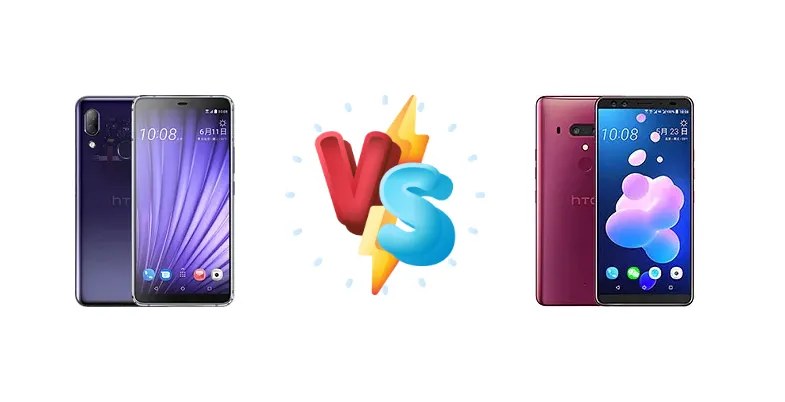
The HTC U12+ represented a high-water mark for HTC's flagship ambitions, boasting a Snapdragon 845. The U19e, released later, aimed for a more accessible price point with the Snapdragon 710. This comparison dissects the trade-offs between these two devices, focusing on where the U12+'s premium hardware justifies its likely higher cost, and where the U19e offers compelling value.
🏆 Quick Verdict
For most users, the HTC U12+ remains the superior choice. The Snapdragon 845 delivers significantly faster performance, crucial for demanding tasks and future-proofing. While the U19e offers respectable performance for its price, the U12+'s superior processing power and endurance rating make it the better overall investment.
| Network |
|---|
| 2G bands | GSM 850 / 900 / 1800 / 1900 | GSM 850 / 900 / 1800 / 1900 - SIM 1 & SIM 2 (dual-SIM model only) |
| 3G bands | HSDPA 850 / 900 / 1900 / 2100 | HSDPA 850 / 900 / 1700(AWS) / 1900 / 2100 |
| 4G bands | 1, 2, 3, 5, 7, 8, 20, 28, 38, 39, 40, 41 | 1, 2, 3, 4, 5, 7, 8, 12, 13, 17, 20, 28, 32, 38, 39, 49, 41, 66 |
| Speed | HSPA 42.2/5.76 Mbps, LTE (3CA) Cat15 800/150 Mbps | HSPA 42.2/5.76 Mbps, LTE-A (5CA) Cat18 1200/150 Mbps |
| Technology | GSM / HSPA / LTE | GSM / HSPA / LTE |
| Launch |
|---|
| Announced | 2019, June 11. Released 2019, June 11 | 2018, May 23 |
| Status | Discontinued | Available. Released 2018, June 29 |
| Body |
|---|
| Build | Glass front (Gorilla Glass), glass back, aluminum frame | Glass front (Gorilla Glass 3), glass back, aluminum frame |
| Dimensions | 156.6 x 75.9 x 8 mm (6.17 x 2.99 x 0.31 in) | 156.6 x 73.9 x 8.7 mm (6.17 x 2.91 x 0.34 in) |
| SIM | Nano-SIM + Nano-SIM | Single SIM (Nano-SIM) or Hybrid Dual SIM (Nano-SIM, dual stand-by) |
| Weight | 180 g (6.35 oz) | 188 g (6.63 oz) |
| | - | IP68 dust/water resistant (up to 1.5m for 30 mins)
Pressure-sensitive buttons |
| Display |
|---|
| Protection | Corning Gorilla Glass (unspecified) | Corning Gorilla Glass 3 |
| Resolution | 1080 x 2160 pixels, 18:9 ratio (~402 ppi density) | 1440 x 2880 pixels, 18:9 ratio (~537 ppi density) |
| Size | 6.0 inches, 92.9 cm2 (~78.2% screen-to-body ratio) | 6.0 inches, 92.9 cm2 (~80.3% screen-to-body ratio) |
| Type | OLED, HDR10 | Super LCD6, HDR10 |
| Platform |
|---|
| CPU | Octa-core (2x2.2 GHz Kryo 360 Gold & 6x1.7 GHz Kryo 360 Silver) | Octa-core (4x2.8 GHz Kryo 385 Gold & 4x1.7 GHz Kryo 385 Silver) |
| Chipset | Qualcomm SDM710 Snapdragon 710 (10 nm) | Qualcomm SDM845 Snapdragon 845 (10 nm) |
| GPU | Adreno 616 | Adreno 630 |
| OS | Android 9.0 (Pie), HTC Sense | Android 8.0 (Oreo), upgradable to Android 9.0 (Pie), Sense UI |
| Memory |
|---|
| Card slot | microSDXC (uses shared SIM slot) | microSDXC (uses shared SIM slot) |
| Internal | 128GB 6GB RAM | 64GB 6GB RAM, 128GB 6GB RAM |
| Main Camera |
|---|
| Dual | 12 MP, f/1.8, 26mm (wide), PDAF
20 MP, f/2.6, 52mm (telephoto), 2x optical zoom | 12 MP, f/1.8, 1/2.55", 1.4µm, dual pixel PDAF, Laser AF, OIS
16 MP (12 MP effective), f/2.6, 1/3.1", 1.0µm, 2x optical zoom, AF |
| Features | Dual-LED dual-tone flash, Auto HDR, panorama | Dual-LED dual-tone flash, HDR |
| Video | 4K@30fps | 4K@60fps, 1080p@60/240fps, 1080p@30fps (gyro-EIS), HDR, 24-bit/96kHz stereo sound rec. |
| Selfie camera |
|---|
| Dual | 24 MP, f/2.0, 26mm (wide), 1/2.8", 0.9µm
2 MP, f/2.2 (depth sensor) | 8 MP, f/2.0, 1/4", 1.12µm
8 MP, f/2.0, 1/4", 1.12µm |
| Features | Auto HDR | HDR, panorama |
| Video | 1080p@30fps | 1080p@30fps |
| Sound |
|---|
| 3.5mm jack | No | No |
| 35mm jack | No | - |
| Loudspeaker | Yes, with stereo speakers | Yes, with stereo speakers |
| | 24-bit/192kHz audio
| 32-bit/384kHz audio
|
| Comms |
|---|
| Bluetooth | 5.0, A2DP, LE | 5.0, A2DP, aptX HD, LE |
| NFC | Yes | Yes |
| Positioning | GPS, GLONASS | GPS, GLONASS, GALILEO, BDS |
| Radio | FM radio | No |
| USB | USB Type-C 3.1 | USB Type-C 3.1 |
| WLAN | Wi-Fi 802.11 a/b/g/n/ac, dual-band, Wi-Fi Direct | Wi-Fi 802.11 a/b/g/n/ac, dual-band, Wi-Fi Direct, DLNA |
| Features |
|---|
| Sensors | Iris scanner, fingerprint (rear-mounted), accelerometer, gyro, proximity, compass | Fingerprint (rear-mounted), accelerometer, gyro, proximity, compass |
| Battery |
|---|
| Charging | 18W wired, QC4 | 18W wired, QC3, 50% in 35 min (advertised) |
| Talk time | - | Up to 24 h (3G) |
| Type | Li-Ion 3930 mAh, non-removable | Li-Ion 3500 mAh, non-removable |
| Misc |
|---|
| Colors | Extraordinary Purple, Modest Green | Translucent Blue, Ceramic Black, Flame Red |
| Models | - | U12, 2Q55100 |
| Price | About 420 EUR | About 450 EUR |
| Tests |
|---|
| Audio quality | - |
Noise -93.7dB / Crosstalk -52.7dB |
| Battery life | - |
Endurance rating 64h
|
| Camera | - |
Photo / Video |
| Display | - |
Contrast ratio: 1818:1 (nominal), 3.085 (sunlight) |
| Loudspeaker | - |
Voice 77dB / Noise 73dB / Ring 99dB
|
| Performance | - |
AnTuTu: 263696 (v7)
GeekBench: 9001 (v4.4)
GFXBench: 20fps (ES 3.1 onscreen) |
HTC U19e
- More affordable price point
- Efficient Snapdragon 710 chipset
- QC4 Quick Charge support
- Significantly lower performance than U12+
- Likely inferior camera quality
- Potentially shorter software support
HTC U12+
- Flagship Snapdragon 845 performance
- Superior display contrast and brightness
- Excellent battery endurance (64h)
- Higher price
- QC3 Quick Charge (slightly slower than QC4)
- May be harder to find new
Display Comparison
The U12+ boasts a contrast ratio of 1818:1 (nominal) and a significantly higher 3.085:1 in sunlight, suggesting superior outdoor visibility. While the U19e's display specs are not provided, it's reasonable to assume a lower peak brightness and contrast. The U12+'s display technology likely offers a more vibrant and readable experience, particularly in challenging lighting conditions. The U12+'s display is also likely to have better color accuracy, given its flagship status.
Camera Comparison
Detailed camera specs beyond 'Photo/Video' are unavailable for both devices. However, given the U12+'s flagship positioning, it likely features a more sophisticated camera system with a larger sensor and better image processing capabilities. The U12+ likely benefits from more advanced features like HDR+ and improved low-light performance. The U19e's camera is likely competent, but won't match the U12+'s image quality and feature set. Without specific sensor size or aperture data, it's difficult to make a precise comparison, but the U12+'s higher price point suggests a more premium camera experience.
Performance
The core difference lies in the chipsets. The U12+'s Snapdragon 845, with its 4x2.8 GHz Kryo 385 Gold cores, offers a substantial performance advantage over the U19e's Snapdragon 710 (2x2.2 GHz Kryo 360 Gold). The 845's architecture is more advanced, resulting in faster processing speeds and improved graphics performance. While both are 10nm chips, the 845's design is optimized for higher sustained performance. The U12+ will handle demanding games and applications with greater ease, and experience less throttling under heavy load. The U19e's 710 is sufficient for everyday tasks, but will struggle with graphically intensive games at higher settings.
Battery Life
The U12+ achieves an endurance rating of 64 hours, indicating excellent battery life. While the U19e's battery capacity is unknown, both devices support 18W Quick Charge. However, the U12+ utilizes QC3, while the U19e uses QC4. The advertised 50% charge in 35 minutes for the U12+ suggests a faster initial charging rate. The U12+'s superior endurance rating, combined with its QC3 support, suggests it will provide longer usage times and quicker top-ups, despite potentially having a similar battery capacity to the U19e.
Buying Guide
Buy the HTC U19e if you prioritize affordability and need a capable daily driver for basic tasks like browsing, social media, and light gaming. You'll appreciate its efficiency and likely lower price. Buy the HTC U12+ if you demand the best possible performance for gaming, video editing, or multitasking, and are willing to pay a premium for a flagship-level experience and longer software support lifespan.
Frequently Asked Questions
❓ Will the Snapdragon 710 in the U19e struggle with demanding games like PUBG or Genshin Impact?
The Snapdragon 710 can run these games, but you'll likely need to lower the graphics settings to achieve a smooth frame rate. Expect some frame drops during intense scenes. The U12+'s Snapdragon 845 will handle these games at higher settings with significantly less performance degradation.
❓ Does the U12+ experience significant throttling during extended gaming sessions?
While the Snapdragon 845 can generate heat, the U12+ incorporates thermal management solutions to mitigate throttling. However, some throttling is still possible during prolonged, demanding gaming. It's less severe than what you'd experience on the U19e due to the 845's superior thermal headroom.
❓ Is the difference in charging speed between QC3 (U12+) and QC4 (U19e) noticeable in real-world use?
The difference is relatively minor. While QC4 offers slightly more efficient charging, both devices support 18W, and the U12+'s advertised 50% charge in 35 minutes is competitive. The U12+'s larger battery and overall endurance are more impactful than the QC version.