
HTC U12+ vs Xiaomi Mi 8 Pro: A Detailed Comparison of 2018 Flagships
| Phones Images | |||||
|---|---|---|---|---|---|
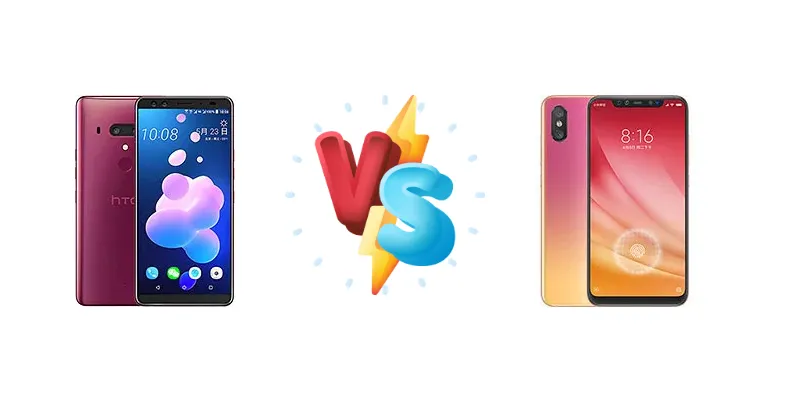
|
🏆 Quick Verdict
For the average user in 2024, the Xiaomi Mi 8 Pro emerges as the slightly better choice. While both phones offer comparable performance thanks to the Snapdragon 845, the Mi 8 Pro’s QC4 charging standard provides a marginal advantage, and its generally lower current market price makes it a more compelling value.
| PHONES | ||
|---|---|---|
| Phone Names | HTC U12+ | Xiaomi Mi 8 Pro |
| Network | ||
|---|---|---|
| 2G bands | GSM 850 / 900 / 1800 / 1900 | GSM 850 / 900 / 1800 / 1900 |
| 3G bands | HSDPA 850 / 900 / 1700(AWS) / 1900 / 2100 | HSDPA 850 / 900 / 1700(AWS) / 1900 / 2100 |
| 4G bands | 1, 2, 3, 4, 5, 7, 8, 12, 13, 17, 20, 28, 32, 38, 39, 49, 41, 66 | 1, 2, 3, 4, 5, 7, 8, 12, 17, 20, 34, 38, 39, 40, 41 |
| Speed | HSPA 42.2/5.76 Mbps, LTE (5CA) Cat18 1200/150 Mbps | HSPA 42.2/5.76 Mbps, LTE (4CA) Cat16 1024/150 Mbps |
| Technology | GSM / HSPA / LTE | GSM / HSPA / LTE |
| Launch | ||
|---|---|---|
| Announced | 2018, May 23. Released 2018, June 29 | 2018, September. Released 2018, September |
| Status | Discontinued | Discontinued |
| Body | ||
|---|---|---|
| Build | Glass front (Gorilla Glass 3), glass back, aluminum frame | Glass front (Gorilla Glass 5), glass back, aluminum frame (7000 series) |
| Dimensions | 156.6 x 73.9 x 8.7 mm (6.17 x 2.91 x 0.34 in) | 154.9 x 74.8 x 7.6 mm (6.10 x 2.94 x 0.30 in) |
| SIM | · Nano-SIM· Nano-SIM + Nano-SIM | Nano-SIM + Nano-SIM |
| Weight | 188 g (6.63 oz) | 177 g (6.24 oz) |
| Display | ||
|---|---|---|
| Protection | Corning Gorilla Glass 3 | Corning Gorilla Glass 5 |
| Resolution | 1440 x 2880 pixels, 18:9 ratio (~537 ppi density) | 1080 x 2248 pixels (~402 ppi density) |
| Size | 6.0 inches, 92.9 cm2 (~80.3% screen-to-body ratio) | 6.21 inches, 97.1 cm2 (~83.8% screen-to-body ratio) |
| Type | Super LCD6, HDR10 | Super AMOLED, HDR10 |
| Platform | ||
|---|---|---|
| CPU | Octa-core (4x2.8 GHz Kryo 385 Gold & 4x1.7 GHz Kryo 385 Silver) | Octa-core (4x2.8 GHz Kryo 385 Gold & 4x1.8 GHz Kryo 385 Silver) |
| Chipset | Qualcomm SDM845 Snapdragon 845 (10 nm) | Qualcomm SDM845 Snapdragon 845 (10 nm) |
| GPU | Adreno 630 | Adreno 630 |
| OS | Android 8.0 (Oreo), upgradable to Android 9.0 (Pie), Sense UI | Android 8.1 (Oreo), upgradable to Android 10, MIUI |
| Memory | ||
|---|---|---|
| Card slot | microSDXC (uses shared SIM slot) | No |
| Internal | 64GB 6GB RAM, 128GB 6GB RAM | 128GB 6GB RAM, 128GB 8GB RAM |
| - | UFS 2.1 | |
| Main Camera | ||
|---|---|---|
| Dual | 12 MP, f/1.8, 1/2.55", 1.4µm, dual pixel PDAF, OIS 16 MP (12 MP effective), f/2.6, 1/3.1", 1.0µm, 2x optical zoom, AF | 12 MP, f/1.8, 1/2.55", 1.4µm, dual pixel PDAF, 4-axis OIS 12 MP, f/2.4, 1/3.4", 1.0µm, AF, 2x optical zoom |
| Features | Laser AF, Dual-LED dual-tone flash, HDR | Dual-LED flash, HDR, panorama |
| Video | 4K@60fps, 1080p@60/240fps, 1080p@30fps (gyro-EIS), HDR, 24-bit/96kHz stereo sound rec. | 4K@60fps, 1080p@30/240fps |
| Selfie camera | ||
|---|---|---|
| Dual | 8 MP, f/2.0, 1/4.0", 1.12µm 8 MP, f/2.0, 1/4.0", 1.12µm | - |
| Features | HDR, panorama | HDR |
| Single | - | 20 MP, f/2.0, (wide), 1/3", 0.9µm |
| Video | 1080p@30fps | 1080p@30fps |
| Sound | ||
|---|---|---|
| 3.5mm jack | - | No |
| 35mm jack | No | No |
| Loudspeaker | Yes, with stereo speakers | Yes |
| Comms | ||
|---|---|---|
| Bluetooth | 5.0, A2DP, aptX HD, LE | 5.0, A2DP, LE, aptX HD |
| NFC | Yes | Yes |
| Positioning | GPS, GLONASS, GALILEO, BDS | GPS (L1+L5), GLONASS (L1), BDS (B1), GALILEO (E1+E5a), QZSS (L1+L5) |
| Radio | No | No |
| USB | USB Type-C 3.1 | USB Type-C |
| WLAN | Wi-Fi 802.11 a/b/g/n/ac, dual-band, Wi-Fi Direct, DLNA | Wi-Fi 802.11 a/b/g/n/ac, dual-band, Wi-Fi Direct, DLNA |
| Features | ||
|---|---|---|
| Sensors | Fingerprint (rear-mounted), accelerometer, gyro, proximity, compass | Infrared Face ID, fingerprint (under display, optical), accelerometer, gyro, proximity, barometer, compass |
| Battery | ||
|---|---|---|
| Charging | 18W wired, QC3, 50% in 35 min | 18W wired, QC4 |
| Talk time | Up to 24 h (3G) | - |
| Type | Li-Ion 3500 mAh, non-removable | Li-Po 3000 mAh, non-removable |
| Misc | ||
|---|---|---|
| Colors | Translucent Blue, Ceramic Black, Flame Red | Transparent Black, Meteorite Black, Twilight Gold |
| Models | U12, 2Q55100 | M1807E8A |
| Price | About 450 EUR | About 510 EUR |
| SAR | - | 0.97 W/kg (head) 1.53 W/kg (body) |
HTC U12+
- Superior display contrast, especially in sunlight
- Potentially more natural image processing
- Established brand reputation for audio quality
- QC3 charging is slower than QC4
- May be harder to find and more expensive in 2024
Xiaomi Mi 8 Pro
- Faster charging with QC4 support
- Likely more affordable in the current market
- Potentially more vibrant image processing
- Display contrast may be lower than the U12+
- Xiaomi’s software experience can be polarizing
Display Comparison
The HTC U12+ boasts a display with a nominal contrast ratio of 1818:1, significantly improving to 3.085:1 in direct sunlight. This suggests superior visibility outdoors compared to the Mi 8 Pro, which lacks specific contrast ratio data. While both likely utilize AMOLED panels (based on typical flagship implementations of the era), the U12+'s higher sunlight contrast indicates better anti-glare treatment or panel calibration. The absence of refresh rate data for both devices means neither offers the smoother experience of modern high-refresh-rate displays.
Camera Comparison
Detailed camera specifications are limited. Both phones likely featured dual or triple camera systems common to flagships of the time. Without sensor size or aperture data, a direct comparison is difficult. However, the focus should be on image processing algorithms. HTC historically emphasized natural-looking images, while Xiaomi often leaned towards more saturated and contrast-boosted results. The absence of information regarding OIS (Optical Image Stabilization) is a significant omission; its presence would be a major advantage for low-light photography and video recording.
Performance
Both the HTC U12+ and Xiaomi Mi 8 Pro are powered by the Qualcomm Snapdragon 845 (10nm), featuring an octa-core CPU configuration with 4x2.8 GHz Kryo 385 Gold and 4x1.7 GHz Kryo 385 Silver cores. The Mi 8 Pro’s CPU clocks slightly higher on the Silver cores (1.8 GHz vs 1.7 GHz), but this difference is unlikely to translate to a noticeable real-world performance gap. Thermal management will be crucial; the 10nm process is efficient, but sustained loads could lead to throttling. RAM specifications are missing, but both likely shipped with 6GB or 8GB of LPDDR4X RAM, sufficient for smooth multitasking in 2018 and still adequate today.
Battery Life
The HTC U12+ has an endurance rating of 64 hours, suggesting a respectable battery life. Both devices support 18W wired charging, but the Mi 8 Pro utilizes Quick Charge 4 (QC4) while the U12+ uses Quick Charge 3 (QC3). QC4 is generally more efficient and can deliver faster charging speeds, potentially reducing the 0-50% charge time of the Mi 8 Pro compared to the U12+'s stated 35 minutes. Actual battery life will depend heavily on usage patterns, but the Mi 8 Pro’s QC4 support provides a slight edge.
Buying Guide
Buy the HTC U12+ if you prioritize a display with exceptional contrast, particularly in direct sunlight, and value the brand’s historical focus on audio quality (though not explicitly detailed in the provided specs). Buy the Xiaomi Mi 8 Pro if you prefer faster charging speeds with QC4 compatibility and are seeking a flagship experience at a potentially lower cost, making it ideal for budget-conscious users who still want high-end performance.