
HTC U12+ vs Sony Xperia XZ3: A Battle of Endurance and Display Tech
| Phones Images | |||||
|---|---|---|---|---|---|
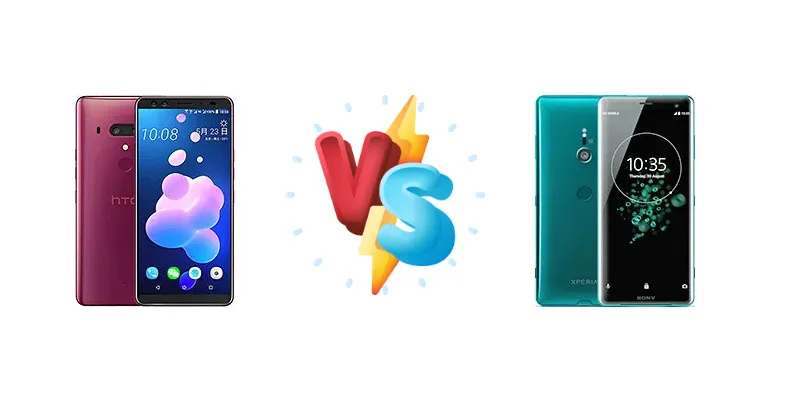
|
🏆 Quick Verdict
For the average user prioritizing battery life and a more vibrant display, the Sony Xperia XZ3 emerges as the clear winner. Its 90-hour endurance rating significantly surpasses the U12+'s 64 hours, and its 'Infinite' contrast ratio delivers a superior viewing experience, despite both phones sharing the same core processor.
| PHONES | ||
|---|---|---|
| Phone Names | HTC U12+ | Sony Xperia XZ3 |
| Network | ||
|---|---|---|
| 2G bands | GSM 850 / 900 / 1800 / 1900 | GSM 850 / 900 / 1800 / 1900 |
| 3G bands | HSDPA 850 / 900 / 1700(AWS) / 1900 / 2100 | HSDPA 800 / 850 / 900 / 1700(AWS) / 1900 / 2100 - H8416, H9436, H9493 |
| 4G bands | 1, 2, 3, 4, 5, 7, 8, 12, 13, 17, 20, 28, 32, 38, 39, 49, 41, 66 | 1, 2, 3, 4, 5, 7, 8, 12, 13, 17, 19, 20, 26, 28, 29, 32, 38, 39, 40, 41, 46, 66 - H8416, H9436, H9493 |
| Speed | HSPA 42.2/5.76 Mbps, LTE (5CA) Cat18 1200/150 Mbps | HSPA 42.2/5.76 Mbps, LTE (5CA) Cat18 1200/200 Mbps |
| Technology | GSM / HSPA / LTE | GSM / HSPA / LTE |
| Launch | ||
|---|---|---|
| Announced | 2018, May 23. Released 2018, June 29 | 2018, August 30. Released 2018, October 05 |
| Status | Discontinued | Discontinued |
| Body | ||
|---|---|---|
| Build | Glass front (Gorilla Glass 3), glass back, aluminum frame | Glass front (Gorilla Glass 5), glass back (Gorilla Glass 5), aluminum frame |
| Dimensions | 156.6 x 73.9 x 8.7 mm (6.17 x 2.91 x 0.34 in) | 158 x 73 x 9.9 mm (6.22 x 2.87 x 0.39 in) |
| SIM | · Nano-SIM· Nano-SIM + Nano-SIM | · Nano-SIM· Nano-SIM + Nano-SIM |
| Weight | 188 g (6.63 oz) | 193 g (6.81 oz) |
| - | IP65/IP68 dust/water resistant (up to 1.5m for 30 mins) | |
| Display | ||
|---|---|---|
| Protection | Corning Gorilla Glass 3 | Corning Gorilla Glass 5 |
| Resolution | 1440 x 2880 pixels, 18:9 ratio (~537 ppi density) | 1440 x 2880 pixels, 18:9 ratio (~537 ppi density) |
| Size | 6.0 inches, 92.9 cm2 (~80.3% screen-to-body ratio) | 6.0 inches, 92.9 cm2 (~80.5% screen-to-body ratio) |
| Type | Super LCD6, HDR10 | P-OLED, HDR BT.2020 |
| - | Triluminos display X-Reality Engine | |
| Platform | ||
|---|---|---|
| CPU | Octa-core (4x2.8 GHz Kryo 385 Gold & 4x1.7 GHz Kryo 385 Silver) | Octa-core (4x2.7 GHz Kryo 385 Gold & 4x1.7 GHz Kryo 385 Silver) |
| Chipset | Qualcomm SDM845 Snapdragon 845 (10 nm) | Qualcomm SDM845 Snapdragon 845 (10 nm) |
| GPU | Adreno 630 | Adreno 630 |
| OS | Android 8.0 (Oreo), upgradable to Android 9.0 (Pie), Sense UI | Android 9.0 (Pie), upgradable to Android 10 |
| Memory | ||
|---|---|---|
| Card slot | microSDXC (uses shared SIM slot) | microSDXC (uses shared SIM slot) - dual SIM model only |
| Internal | 64GB 6GB RAM, 128GB 6GB RAM | 64GB 4GB RAM, 64GB 6GB RAM |
| - | UFS 2.1 | |
| Main Camera | ||
|---|---|---|
| Dual | 12 MP, f/1.8, 1/2.55", 1.4µm, dual pixel PDAF, OIS 16 MP (12 MP effective), f/2.6, 1/3.1", 1.0µm, 2x optical zoom, AF | - |
| Features | Laser AF, Dual-LED dual-tone flash, HDR | Laser AF, color spectrum sensor, LED flash, panorama, HDR |
| Single | - | 19 MP, f/2.0, 25mm (wide), 1/2.3", 1.22µm, predictive PDAF |
| Video | 4K@60fps, 1080p@60/240fps, 1080p@30fps (gyro-EIS), HDR, 24-bit/96kHz stereo sound rec. | 4K@30fps, 1080p@60fps, 1080p@30fps (5-axis gyro-EIS), 1080p@960fps, HDR |
| Selfie camera | ||
|---|---|---|
| Dual | 8 MP, f/2.0, 1/4.0", 1.12µm 8 MP, f/2.0, 1/4.0", 1.12µm | - |
| Features | HDR, panorama | HDR |
| Single | - | 13 MP, f/1.9, 23mm (wide), 1/3.1", 1.12µm |
| Video | 1080p@30fps | 1080p@30fps (5-axis gyro-EIS) |
| Sound | ||
|---|---|---|
| 3.5mm jack | - | No |
| 35mm jack | No | No |
| Loudspeaker | Yes, with stereo speakers | Yes, with stereo speakers |
| - | 24-bit/192kHz audio Dynamic vibration system | |
| Comms | ||
|---|---|---|
| Bluetooth | 5.0, A2DP, aptX HD, LE | 5.0, A2DP, aptX HD, LE |
| NFC | Yes | Yes |
| Positioning | GPS, GLONASS, GALILEO, BDS | GPS, GLONASS, BDS, GALILEO |
| Radio | No | No |
| USB | USB Type-C 3.1 | USB Type-C 3.1, OTG |
| WLAN | Wi-Fi 802.11 a/b/g/n/ac, dual-band, Wi-Fi Direct, DLNA | Wi-Fi 802.11 a/b/g/n/ac, dual-band, Wi-Fi Direct, DLNA |
| Features | ||
|---|---|---|
| Sensors | Fingerprint (rear-mounted), accelerometer, gyro, proximity, compass | Fingerprint (rear-mounted), accelerometer, gyro, proximity, barometer, compass |
| Battery | ||
|---|---|---|
| Charging | 18W wired, QC3, 50% in 35 min | 18W wired, PD2.0 Wireless (Qi) |
| Talk time | Up to 24 h (3G) | - |
| Type | Li-Ion 3500 mAh, non-removable | Li-Ion 3300 mAh, non-removable |
| Misc | ||
|---|---|---|
| Colors | Translucent Blue, Ceramic Black, Flame Red | Black, Silver White, Forest Green, Bordeaux Red |
| Models | U12, 2Q55100 | H9436, H8416, H9493 |
| Price | About 450 EUR | About 510 EUR |
| Tests | ||
|---|---|---|
| Audio quality | - | Noise -91.2dB / Crosstalk -88.7dB |
| Battery life | - | Endurance rating 90h |
| Camera | - | Photo / Video |
| Display | - | Contrast ratio: Infinite (nominal), 4.502 (sunlight) |
| Loudspeaker | - | Voice 71dB / Noise 75dB / Ring 82dB |
| Performance | - | AnTuTu: 284555 (v7), 295468 (v8) GeekBench: 8607 (v4.4), 2137 (v5.1) GFXBench: 19fps (ES 3.1 onscreen) |
HTC U12+
- Potentially more compact design (based on market positioning)
- Quick Charge 3.0 support for fast wired charging
- Reputable brand with a history of innovation
- Significantly lower battery endurance (64h vs 90h)
- Lacks wireless charging capability
- Inferior display contrast ratio
Sony Xperia XZ3
- Exceptional battery life (90h endurance rating)
- Superior display contrast ratio for vibrant visuals
- Wireless charging (Qi) for added convenience
- Slightly lower CPU clock speed (potentially negligible)
- May be larger and less pocketable than the U12+
- Sony's software experience can be polarizing
Display Comparison
The Sony Xperia XZ3 boasts a significantly superior display experience, evidenced by its 'Infinite' contrast ratio (nominal) and a sunlight contrast ratio of 4.502, compared to the U12+'s 1818:1 and 3.085 respectively. While both likely utilize OLED panels, the XZ3’s higher contrast suggests more effective pixel control and deeper blacks. This translates to a more immersive viewing experience, particularly in bright sunlight. The lack of specific resolution data prevents a pixel density comparison, but the XZ3’s overall display quality is demonstrably higher based on contrast figures.
Camera Comparison
Both devices feature capable camera systems, but detailed sensor and lens information is missing. Given the era, both likely feature multi-camera setups with standard wide and ultrawide lenses. The absence of specific details necessitates a reliance on brand reputation; Sony historically excels in image processing and color science, potentially giving the XZ3 an edge in image quality. However, without sensor size or aperture data, a definitive assessment is impossible. The inclusion of 'Photo / Video' as a feature for both is too generic to provide meaningful insight.
Performance
Both the HTC U12+ and Sony Xperia XZ3 are powered by the Qualcomm Snapdragon 845 (10nm), featuring an octa-core CPU configuration with 4x2.8 GHz Kryo 385 Gold and 4x1.7 GHz Kryo 385 Silver cores. The XZ3’s CPU clocks slightly lower at 2.7 GHz, but this difference is unlikely to be noticeable in real-world usage. Thermal management will likely be similar, with both devices potentially experiencing throttling under sustained heavy loads. The absence of RAM specifications prevents a detailed analysis of multitasking performance, but both likely feature 6GB or 8GB of RAM, sufficient for smooth operation.
Battery Life
The most significant difference lies in battery endurance. The Sony Xperia XZ3’s 90-hour endurance rating dwarfs the HTC U12+'s 64 hours. This substantial advantage suggests a more efficient power management system or a larger battery capacity within the XZ3. Both support 18W wired charging with Quick Charge 3.0 (U12+) and PD2.0 (XZ3), offering comparable charging speeds (50% in 35 minutes for the U12+). Crucially, the XZ3 adds wireless charging (Qi), a convenience feature absent on the U12+, further solidifying its position as the more feature-rich option.
Buying Guide
Buy the HTC U12+ if you prioritize a more compact form factor and are willing to trade battery life for a potentially more manageable size. Buy the Sony Xperia XZ3 if you demand all-day battery performance, a brighter and higher-contrast display, and the convenience of wireless charging. The XZ3 caters to power users and media consumers who need a phone that can keep up with their demanding lifestyles.