
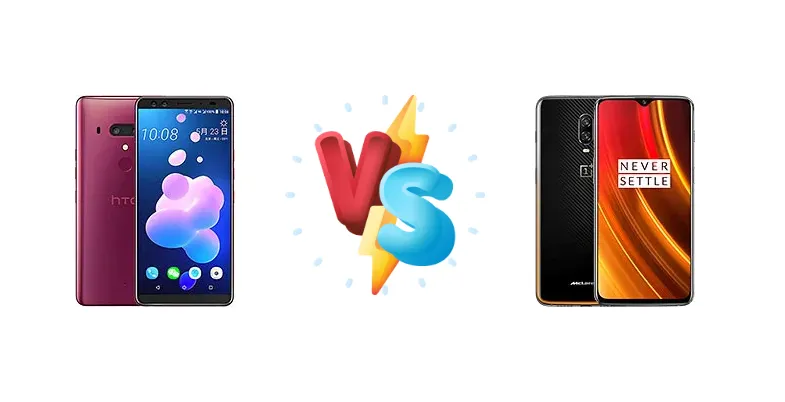
HTC U12+ vs OnePlus 6T McLaren: A Detailed Comparison of 2018 Flagships
| Phones Images | |||||
|---|---|---|---|---|---|
|
🏆 Quick Verdict
For the average user prioritizing speed and convenience, the OnePlus 6T McLaren emerges as the winner. Its significantly faster 30W charging – achieving 50% charge in just 20 minutes – is a substantial advantage over the U12+'s 35-minute timeframe. While both share the same Snapdragon 845, the charging speed makes the 6T McLaren more practical for power users.
| PHONES | ||
|---|---|---|
| Phone Names | HTC U12+ | OnePlus 6T McLaren |
| Network | ||
|---|---|---|
| 2G bands | GSM 850 / 900 / 1800 / 1900 | GSM 850 / 900 / 1800 / 1900 |
| 3G bands | HSDPA 850 / 900 / 1700(AWS) / 1900 / 2100 | HSDPA 800 / 850 / 900 / 1700(AWS) / 1800 / 1900 / 2100 |
| 4G bands | 1, 2, 3, 4, 5, 7, 8, 12, 13, 17, 20, 28, 32, 38, 39, 49, 41, 66 | 1, 2, 3, 4, 5, 7, 12, 13, 17, 18, 19, 20, 25, 26, 28, 29, 30, 32, 34, 38, 39, 40, 41, 46, 66, 71 |
| Speed | HSPA 42.2/5.76 Mbps, LTE (5CA) Cat18 1200/150 Mbps | HSPA 42.2/5.76 Mbps, LTE (5CA) Cat16 1024/150 Mbps |
| Technology | GSM / HSPA / LTE | GSM / HSPA / LTE |
| Launch | ||
|---|---|---|
| Announced | 2018, May 23. Released 2018, June 29 | 2018, December 11. Released 2018, December 13 |
| Status | Discontinued | Discontinued |
| Body | ||
|---|---|---|
| Build | Glass front (Gorilla Glass 3), glass back, aluminum frame | Glass front (Gorilla Glass 6), glass back, aluminum frame |
| Dimensions | 156.6 x 73.9 x 8.7 mm (6.17 x 2.91 x 0.34 in) | 157.5 x 74.8 x 8.2 mm (6.20 x 2.94 x 0.32 in) |
| SIM | · Nano-SIM· Nano-SIM + Nano-SIM | Nano-SIM + Nano-SIM |
| Weight | 188 g (6.63 oz) | 185 g (6.53 oz) |
| Display | ||
|---|---|---|
| Protection | Corning Gorilla Glass 3 | Corning Gorilla Glass 6 |
| Resolution | 1440 x 2880 pixels, 18:9 ratio (~537 ppi density) | 1080 x 2340 pixels, 19.5:9 ratio (~402 ppi density) |
| Size | 6.0 inches, 92.9 cm2 (~80.3% screen-to-body ratio) | 6.41 inches, 100.9 cm2 (~85.6% screen-to-body ratio) |
| Type | Super LCD6, HDR10 | Optic AMOLED |
| Platform | ||
|---|---|---|
| CPU | Octa-core (4x2.8 GHz Kryo 385 Gold & 4x1.7 GHz Kryo 385 Silver) | Octa-core (4x2.8 GHz Kryo 385 Gold & 4x1.7 GHz Kryo 385 Silver) |
| Chipset | Qualcomm SDM845 Snapdragon 845 (10 nm) | Qualcomm SDM845 Snapdragon 845 (10 nm) |
| GPU | Adreno 630 | Adreno 630 |
| OS | Android 8.0 (Oreo), upgradable to Android 9.0 (Pie), Sense UI | Android 9.0 (Pie), upgradable to Android 10, OxygenOS 10 |
| Memory | ||
|---|---|---|
| Card slot | microSDXC (uses shared SIM slot) | No |
| Internal | 64GB 6GB RAM, 128GB 6GB RAM | 256GB 10GB RAM |
| - | UFS 2.1 | |
| Main Camera | ||
|---|---|---|
| Dual | 12 MP, f/1.8, 1/2.55", 1.4µm, dual pixel PDAF, OIS 16 MP (12 MP effective), f/2.6, 1/3.1", 1.0µm, 2x optical zoom, AF | 16 MP, f/1.7, 25mm (wide), 1/2.6", 1.22µm, PDAF, OIS 20 MP (16 MP effective), f/1.7, 25mm (wide), 1/2.8", 1.0µm, PDAF |
| Features | Laser AF, Dual-LED dual-tone flash, HDR | Dual-LED flash, HDR, panorama |
| Video | 4K@60fps, 1080p@60/240fps, 1080p@30fps (gyro-EIS), HDR, 24-bit/96kHz stereo sound rec. | 4K@30/60fps, 1080p@30/60/240fps, 720p@480fps, Auto HDR, gyro-EIS |
| Selfie camera | ||
|---|---|---|
| Dual | 8 MP, f/2.0, 1/4.0", 1.12µm 8 MP, f/2.0, 1/4.0", 1.12µm | - |
| Features | HDR, panorama | HDR |
| Single | - | 16 MP, f/2.0, 25mm (wide), 1/3.06", 1.0µm |
| Video | 1080p@30fps | 1080p@30fps, gyro-EIS |
| Sound | ||
|---|---|---|
| 3.5mm jack | - | No |
| 35mm jack | No | No |
| Loudspeaker | Yes, with stereo speakers | Yes |
| - | Dirac HD sound | |
| Comms | ||
|---|---|---|
| Bluetooth | 5.0, A2DP, aptX HD, LE | 5.0, A2DP, aptX HD, LE |
| NFC | Yes | Yes |
| Positioning | GPS, GLONASS, GALILEO, BDS | GPS, GLONASS, BDS, GALILEO |
| Radio | No | No |
| USB | USB Type-C 3.1 | USB Type-C 2.0, OTG |
| WLAN | Wi-Fi 802.11 a/b/g/n/ac, dual-band, Wi-Fi Direct, DLNA | Wi-Fi 802.11 a/b/g/n/ac, dual-band, Wi-Fi Direct, DLNA |
| Features | ||
|---|---|---|
| Sensors | Fingerprint (rear-mounted), accelerometer, gyro, proximity, compass | Fingerprint (under display, optical), accelerometer, gyro, proximity, compass |
| Battery | ||
|---|---|---|
| Charging | 18W wired, QC3, 50% in 35 min | 30W wired, 50% in 20 min |
| Talk time | Up to 24 h (3G) | - |
| Type | Li-Ion 3500 mAh, non-removable | Li-Po 3700 mAh, non-removable |
| Misc | ||
|---|---|---|
| Colors | Translucent Blue, Ceramic Black, Flame Red | Speed Orange |
| Models | U12, 2Q55100 | - |
| Price | About 450 EUR | About 700 EUR |
| Tests | ||
|---|---|---|
| Performance | - | AnTuTu: 292716 (v7) GeekBench: 9005 (v4.4) |
HTC U12+
- Higher display contrast ratio for vibrant visuals
- Potentially better outdoor visibility due to sunlight contrast
- Respectable battery endurance (64h rating)
- Slower charging speed (35 minutes to 50%)
- Limited camera information for detailed analysis
- Older device, potentially fewer software updates
OnePlus 6T McLaren
- Significantly faster 30W charging (20 minutes to 50%)
- OnePlus’s software optimizations for smoother performance
- Likely more streamlined software experience
- Display specs are unknown, making a direct comparison difficult
- Camera details are limited
- Potential for more aggressive thermal throttling
Display Comparison
The HTC U12+ boasts a notable contrast ratio of 1818:1 (nominal) and an impressive 3.085:1 in sunlight, suggesting superior visibility in bright conditions. While the OnePlus 6T McLaren’s display specs aren’t provided, OnePlus historically focused on color accuracy and AMOLED vibrancy. The U12+'s higher contrast ratio implies deeper blacks and a more dynamic image, potentially benefiting media consumption. However, without knowing the 6T McLaren’s peak brightness, a definitive judgment is difficult; the U12+’s sunlight contrast suggests a strong advantage in outdoor use.
Camera Comparison
Detailed camera specs beyond 'Photo / Video' are absent for the HTC U12+. Given the era, it likely featured a dual or triple camera setup. The OnePlus 6T McLaren’s camera details are also missing. Without sensor size, aperture, or OIS information, a direct comparison is impossible. However, both phones likely relied heavily on software processing to enhance image quality. The absence of specific details suggests neither phone was a standout camera performer compared to later flagships, and image quality will likely depend heavily on lighting conditions and software algorithms.
Performance
Both the HTC U12+ and OnePlus 6T McLaren are powered by the Qualcomm Snapdragon 845 (10nm), paired with an identical Octa-core CPU configuration (4x2.8 GHz Kryo 385 Gold & 4x1.7 GHz Kryo 385 Silver). This means raw processing power is virtually identical. However, OnePlus is known for its software optimizations, potentially leading to slightly smoother performance in real-world usage. Thermal management is a key consideration; while both will throttle under sustained load, the 6T McLaren’s focus on speed might prioritize performance over sustained thermal control, while HTC may have opted for a more conservative approach.
Battery Life
The HTC U12+ has an endurance rating of 64 hours, indicating respectable battery life for its time. The OnePlus 6T McLaren, however, compensates for potentially similar battery capacity with its significantly faster 30W charging, achieving 50% charge in just 20 minutes. The U12+ takes 35 minutes for the same milestone. This difference is crucial for users who frequently need to recharge. While the U12+'s endurance rating suggests longer overall runtime, the 6T McLaren’s charging speed minimizes downtime, making it more convenient for power users.
Buying Guide
Buy the HTC U12+ if you prioritize display contrast and a more comprehensive feature set, potentially benefiting from its older, but still capable, camera system. Buy the OnePlus 6T McLaren if you value rapid charging, a streamlined software experience, and a phone designed for demanding users who need to quickly top up their battery throughout the day.