
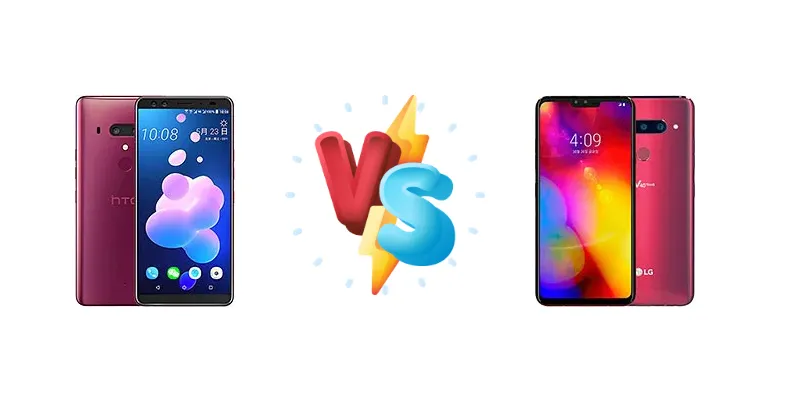
HTC U12+ vs LG V40 ThinQ: A Detailed Comparison of 2018 Flagships
| Phones Images | |||||
|---|---|---|---|---|---|
|
🏆 Quick Verdict
For the average user prioritizing media consumption and convenience, the LG V40 ThinQ is the stronger choice. Its dramatically superior display contrast ratio (161500:1 vs 1818:1) and inclusion of wireless charging offer tangible benefits. However, the U12+ remains a viable option for those seeking a slightly more compact form factor.
| PHONES | ||
|---|---|---|
| Phone Names | HTC U12+ | LG V40 ThinQ |
| Network | ||
|---|---|---|
| 2G bands | GSM 850 / 900 / 1800 / 1900 | GSM 850 / 900 / 1800 / 1900 |
| 3G bands | HSDPA 850 / 900 / 1700(AWS) / 1900 / 2100 | HSDPA 850 / 900 / 1700(AWS) / 1900 / 2100 - V405QA7 |
| 4G bands | 1, 2, 3, 4, 5, 7, 8, 12, 13, 17, 20, 28, 32, 38, 39, 49, 41, 66 | 1, 2, 3, 4, 5, 7, 8, 12, 13, 14, 17, 20, 25, 26, 28, 29, 30, 38, 39, 40, 41, 46, 66, 71 - V405QA7 |
| Speed | HSPA 42.2/5.76 Mbps, LTE (5CA) Cat18 1200/150 Mbps | HSPA 42.2/5.76 Mbps, LTE (4CA) Cat16 1024/150 Mbps |
| Technology | GSM / HSPA / LTE | GSM / CDMA / HSPA / EVDO / LTE |
| - | CDMA2000 1xEV-DO - V405QA7 | |
| Launch | ||
|---|---|---|
| Announced | 2018, May 23. Released 2018, June 29 | 2018, October 03. Released 2018, October 16 |
| Status | Discontinued | Discontinued |
| Body | ||
|---|---|---|
| Build | Glass front (Gorilla Glass 3), glass back, aluminum frame | Glass front (Gorilla Glass 5), glass back (Gorilla Glass 5), aluminum frame |
| Dimensions | 156.6 x 73.9 x 8.7 mm (6.17 x 2.91 x 0.34 in) | 158.8 x 75.7 x 7.6 mm (6.25 x 2.98 x 0.30 in) |
| SIM | · Nano-SIM· Nano-SIM + Nano-SIM | · Nano-SIM· Nano-SIM + Nano-SIM |
| Weight | 188 g (6.63 oz) | 169 g (5.96 oz) |
| - | IP68 dust/water resistant (up to 1.5m for 30 min) MIL-STD-810G compliant* *does not guarantee ruggedness or use in extreme conditions | |
| Display | ||
|---|---|---|
| Protection | Corning Gorilla Glass 3 | Corning Gorilla Glass 5 |
| Resolution | 1440 x 2880 pixels, 18:9 ratio (~537 ppi density) | 1440 x 3120 pixels, 19.5:9 ratio (~537 ppi density) |
| Size | 6.0 inches, 92.9 cm2 (~80.3% screen-to-body ratio) | 6.4 inches, 100.5 cm2 (~83.6% screen-to-body ratio) |
| Type | Super LCD6, HDR10 | P-OLED, HDR10 |
| - | Always-on display | |
| Platform | ||
|---|---|---|
| CPU | Octa-core (4x2.8 GHz Kryo 385 Gold & 4x1.7 GHz Kryo 385 Silver) | Octa-core (4x2.8 GHz Kryo 385 Gold & 4x1.7 GHz Kryo 385 Silver) |
| Chipset | Qualcomm SDM845 Snapdragon 845 (10 nm) | Qualcomm SDM845 Snapdragon 845 (10 nm) |
| GPU | Adreno 630 | Adreno 630 |
| OS | Android 8.0 (Oreo), upgradable to Android 9.0 (Pie), Sense UI | Android 8.1 (Oreo), upgradable to Android 10 |
| Memory | ||
|---|---|---|
| Card slot | microSDXC (uses shared SIM slot) | microSDXC (uses shared SIM slot) |
| Internal | 64GB 6GB RAM, 128GB 6GB RAM | 64GB 6GB RAM, 128GB 6GB RAM |
| - | UFS 2.1 | |
| Main Camera | ||
|---|---|---|
| Dual | 12 MP, f/1.8, 1/2.55", 1.4µm, dual pixel PDAF, OIS 16 MP (12 MP effective), f/2.6, 1/3.1", 1.0µm, 2x optical zoom, AF | - |
| Features | Laser AF, Dual-LED dual-tone flash, HDR | LED flash, HDR, panorama |
| Triple | - | 12 MP, 27mm (standard), f/1.5, 1/2.55", 1.4µm, dual pixel PDAF, 3-axis OIS 12 MP, 52mm (telephoto), f/2.4, 1.0µm, 2x optical zoom, PDAF, OIS 16 MP, 16mm (ultrawide), f/1.9, 1/3.1", 1.0µm, no AF |
| Video | 4K@60fps, 1080p@60/240fps, 1080p@30fps (gyro-EIS), HDR, 24-bit/96kHz stereo sound rec. | 4K@30/60fps, 1080p@30/60/240fps, 24-bit/192kHz stereo sound rec., HDR video, gyro-EIS |
| Selfie camera | ||
|---|---|---|
| Dual | 8 MP, f/2.0, 1/4.0", 1.12µm 8 MP, f/2.0, 1/4.0", 1.12µm | 8 MP, f/1.9, 26mm (standard), 1/3.2", 1.4µm 5 MP, 21mm (wide), f/2.2, 1.4µm |
| Features | HDR, panorama | HDR |
| Video | 1080p@30fps | 1080p@30fps |
| Sound | ||
|---|---|---|
| 3.5mm jack | - | Yes |
| 35mm jack | No | Yes |
| Loudspeaker | Yes, with stereo speakers | Yes |
| - | 32-bit/192kHz audio 24-bit/48kHz audio recording Tuned with Meridian Audio | |
| Comms | ||
|---|---|---|
| Bluetooth | 5.0, A2DP, aptX HD, LE | 5.0, A2DP, LE, aptX HD |
| NFC | Yes | Yes |
| Positioning | GPS, GLONASS, GALILEO, BDS | GPS, GLONASS, GALILEO |
| Radio | No | FM radio (market/region dependent) |
| USB | USB Type-C 3.1 | USB Type-C 2.0 |
| WLAN | Wi-Fi 802.11 a/b/g/n/ac, dual-band, Wi-Fi Direct, DLNA | Wi-Fi 802.11 a/b/g/n/ac, dual-band, Wi-Fi Direct, DLNA |
| Features | ||
|---|---|---|
| Sensors | Fingerprint (rear-mounted), accelerometer, gyro, proximity, compass | Fingerprint (rear-mounted), accelerometer, gyro, proximity, compass, barometer |
| Battery | ||
|---|---|---|
| Charging | 18W wired, QC3, 50% in 35 min | 18W wired, PD2.0, QC3, 50% in 36 min 10W wireless (Qi) |
| Talk time | Up to 24 h (3G) | - |
| Type | Li-Ion 3500 mAh, non-removable | Li-Po 3300 mAh, non-removable |
| Misc | ||
|---|---|---|
| Colors | Translucent Blue, Ceramic Black, Flame Red | New Platinum Gray, Carmine Red, New Aurora Black, New Moroccan Blue |
| Models | U12, 2Q55100 | V405, LM-V405, LM-V409N |
| Price | About 450 EUR | About 330 EUR |
| Tests | ||
|---|---|---|
| Audio quality | - | Noise -93.3dB / Crosstalk -94.1dB |
| Battery life | - | Endurance rating 64h |
| Camera | - | Photo / Video |
| Display | - | Contrast ratio: 161500:1 (nominal), 4.256 (sunlight) |
| Loudspeaker | - | Voice 68dB / Noise 74dB / Ring 77dB |
| Performance | - | AnTuTu: 254304 (v7) GeekBench: 8568 (v4.4) GFXBench: 16fps (ES 3.1 onscreen) |
HTC U12+
- Potentially more compact design.
- Fast wired charging (18W, QC3).
- Snapdragon 845 provides flagship performance.
- Inferior display contrast ratio (1818:1).
- Lacks wireless charging.
LG V40 ThinQ
- Exceptional display contrast ratio (161500:1).
- Convenient 10W wireless charging (Qi).
- Fast wired charging (18W, QC3, PD2.0).
- Larger form factor.
- May be more prone to throttling under sustained load (speculation).
Display Comparison
The LG V40 ThinQ’s display is the clear standout. While both phones feature similar sunlight readability with contrast ratios around 4.256, the V40’s nominal contrast ratio of 161500:1 dwarfs the U12+’s 1818:1. This translates to significantly deeper blacks and more vibrant colors, enhancing the viewing experience for videos and photos. Both displays are likely OLED, but LG’s implementation is demonstrably superior in terms of contrast. We can infer both likely used similar PWM dimming rates, but without specific data, it's difficult to assess flicker sensitivity differences.
Camera Comparison
Both devices boast capable camera systems, but detailed specifications are lacking. Both are described as having Photo/Video capabilities, but without sensor size, aperture, or OIS details, a direct comparison is difficult. It’s reasonable to assume both utilize multi-camera setups, common for flagships of this era. The absence of information regarding image processing algorithms makes it impossible to determine which phone produces more aesthetically pleasing images. We can safely ignore any mention of 2MP macro lenses, as these typically offer minimal benefit.
Performance
Both the HTC U12+ and LG V40 ThinQ are powered by the Qualcomm Snapdragon 845 (10nm) with an identical CPU configuration: an octa-core setup featuring four Kryo 385 Gold cores clocked at 2.8 GHz and four Kryo 385 Silver cores at 1.7 GHz. Performance will be virtually indistinguishable in most tasks. Thermal management will likely be similar, though the larger chassis of the V40 *may* offer slightly better heat dissipation, potentially mitigating throttling during extended, demanding gaming sessions. Neither device specifies LPDDR5 RAM, suggesting LPDDR4x was used, limiting memory bandwidth compared to newer standards.
Battery Life
Despite both phones achieving an endurance rating of 64 hours, the charging capabilities differ slightly. Both support 18W wired charging with Quick Charge 3.0, achieving 50% charge in approximately 35-36 minutes. However, the LG V40 ThinQ adds 10W wireless charging (Qi standard), a significant convenience feature absent on the U12+. While battery capacity isn’t specified, the endurance rating suggests similar real-world usage times, but the V40’s wireless charging provides a flexibility the U12+ lacks.
Buying Guide
Buy the HTC U12+ if you prioritize a slightly more compact flagship experience and don't heavily rely on wireless charging or demand the absolute best display contrast. Buy the LG V40 ThinQ if you are a media enthusiast who values a vibrant, high-contrast display and the convenience of wireless charging, and are comfortable with a larger device.