
HTC U12+ vs. Huawei P20 Pro: A Detailed Comparison for Power Users
| Phones Images | |||||
|---|---|---|---|---|---|
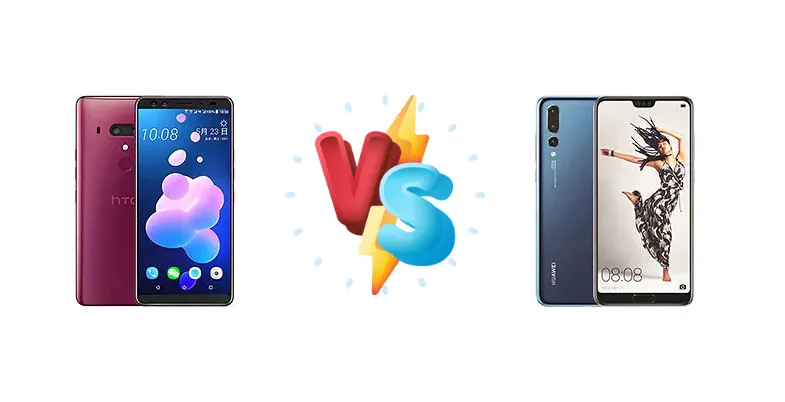
|
🏆 Quick Verdict
For most users, the Huawei P20 Pro emerges as the stronger choice. Its significantly superior 89-hour endurance rating, coupled with faster 22.5W charging, outweighs the U12+'s slightly higher display contrast. While the Snapdragon 845 in the U12+ is a capable chip, the P20 Pro’s overall package offers a more refined experience.
| PHONES | ||
|---|---|---|
| Phone Names | HTC U12+ | Huawei P20 Pro |
| Network | ||
|---|---|---|
| 2G bands | GSM 850 / 900 / 1800 / 1900 | GSM 850 / 900 / 1800 / 1900 |
| 3G bands | HSDPA 850 / 900 / 1700(AWS) / 1900 / 2100 | HSDPA 850 / 900 / 1900 / 2100 |
| 4G bands | 1, 2, 3, 4, 5, 7, 8, 12, 13, 17, 20, 28, 32, 38, 39, 49, 41, 66 | 1, 2, 3, 4, 5, 6, 7, 8, 9, 12, 17, 18, 19, 20, 26, 28, 32, 34, 38, 39, 40 |
| Speed | HSPA 42.2/5.76 Mbps, LTE (5CA) Cat18 1200/150 Mbps | HSPA 42.2/5.76 Mbps, LTE (3CA) Cat16 1024/150 Mbps |
| Technology | GSM / HSPA / LTE | GSM / HSPA / LTE |
| Launch | ||
|---|---|---|
| Announced | 2018, May 23. Released 2018, June 29 | 2018, March 27. Released 2018, April 06 |
| Status | Discontinued | Discontinued |
| Body | ||
|---|---|---|
| Build | Glass front (Gorilla Glass 3), glass back, aluminum frame | Glass front (Gorilla Glass 5), glass back, aluminum frame |
| Dimensions | 156.6 x 73.9 x 8.7 mm (6.17 x 2.91 x 0.34 in) | 155 x 73.9 x 7.8 mm (6.10 x 2.91 x 0.31 in) |
| SIM | · Nano-SIM· Nano-SIM + Nano-SIM | · Nano-SIM· Nano-SIM + Nano-SIM |
| Weight | 188 g (6.63 oz) | 180 g (6.35 oz) |
| - | IP67 dust/water resistant (up to 1m for 30 mins) | |
| Display | ||
|---|---|---|
| Protection | Corning Gorilla Glass 3 | Corning Gorilla Glass 5 |
| Resolution | 1440 x 2880 pixels, 18:9 ratio (~537 ppi density) | 1080 x 2240 pixels, 18.7:9 ratio (~408 ppi density) |
| Size | 6.0 inches, 92.9 cm2 (~80.3% screen-to-body ratio) | 6.1 inches, 93.9 cm2 (~82.0% screen-to-body ratio) |
| Type | Super LCD6, HDR10 | OLED |
| Platform | ||
|---|---|---|
| CPU | Octa-core (4x2.8 GHz Kryo 385 Gold & 4x1.7 GHz Kryo 385 Silver) | Octa-core (4x2.4 GHz Cortex-A73 & 4x1.8 GHz Cortex-A53) |
| Chipset | Qualcomm SDM845 Snapdragon 845 (10 nm) | Kirin 970 (10 nm) |
| GPU | Adreno 630 | Mali-G72 MP12 |
| OS | Android 8.0 (Oreo), upgradable to Android 9.0 (Pie), Sense UI | Android 8.1 (Oreo), upgradable to Android 10, EMUI 12 |
| Memory | ||
|---|---|---|
| Card slot | microSDXC (uses shared SIM slot) | No |
| Internal | 64GB 6GB RAM, 128GB 6GB RAM | 64GB 6GB RAM, 128GB 6GB RAM, 128GB 8GB RAM, 256GB 6GB RAM, 256GB 8GB RAM |
| - | UFS 2.1 | |
| Main Camera | ||
|---|---|---|
| Dual | 12 MP, f/1.8, 1/2.55", 1.4µm, dual pixel PDAF, OIS 16 MP (12 MP effective), f/2.6, 1/3.1", 1.0µm, 2x optical zoom, AF | - |
| Features | Laser AF, Dual-LED dual-tone flash, HDR | Laser AF, color spectrum sensor, Leica optics, LED flash, HDR, panorama |
| Triple | - | 40 MP, f/1.8, 27mm (wide), 1/1.7", PDAF, OIS 8 MP, f/2.4, 80mm (telephoto), 1/4.0", PDAF, OIS, 3x optical zoom 20 MP B/W, f/1.6, 27mm (wide), 1/2.7" |
| Video | 4K@60fps, 1080p@60/240fps, 1080p@30fps (gyro-EIS), HDR, 24-bit/96kHz stereo sound rec. | 4K@30fps, 1080p@60fps, 1080p@30fps (gyro-EIS), 720p@960fps |
| Selfie camera | ||
|---|---|---|
| Dual | 8 MP, f/2.0, 1/4.0", 1.12µm 8 MP, f/2.0, 1/4.0", 1.12µm | - |
| Features | HDR, panorama | Leica optics |
| Single | - | 24 MP, f/2.0, 26mm (wide), 1/2.8", 0.9µm |
| Video | 1080p@30fps | 1080p@30fps |
| Sound | ||
|---|---|---|
| 3.5mm jack | - | No |
| 35mm jack | No | No |
| Loudspeaker | Yes, with stereo speakers | Yes, with stereo speakers |
| - | 32-bit/384kHz audio | |
| Comms | ||
|---|---|---|
| Bluetooth | 5.0, A2DP, aptX HD, LE | 4.2, A2DP, LE, EDR, aptX HD |
| Infrared port | - | Yes |
| NFC | Yes | Yes |
| Positioning | GPS, GLONASS, GALILEO, BDS | GPS, GLONASS, GALILEO |
| Radio | No | No |
| USB | USB Type-C 3.1 | USB Type-C 3.1 |
| WLAN | Wi-Fi 802.11 a/b/g/n/ac, dual-band, Wi-Fi Direct, DLNA | Wi-Fi 802.11 a/b/g/n/ac, dual-band, Wi-Fi Direct |
| Features | ||
|---|---|---|
| Sensors | Fingerprint (rear-mounted), accelerometer, gyro, proximity, compass | Fingerprint (front-mounted), accelerometer, gyro, proximity, compass |
| Battery | ||
|---|---|---|
| Charging | 18W wired, QC3, 50% in 35 min | 22.5W wired, 58% in 30 min |
| Talk time | Up to 24 h (3G) | - |
| Type | Li-Ion 3500 mAh, non-removable | Li-Po 4000 mAh, non-removable |
| Misc | ||
|---|---|---|
| Colors | Translucent Blue, Ceramic Black, Flame Red | Black, Gold |
| Models | U12, 2Q55100 | CLT-L29C, CLT-L29, CLT-L09C, CLT-L09, CLT-AL00, CLT-AL01, CLT-TL01, CLT-AL00L, CLT-L04, HW-01K, CLT-L0J |
| Price | About 450 EUR | About 410 EUR |
| Tests | ||
|---|---|---|
| Audio quality | - | Noise -92.1dB / Crosstalk -92.1dB |
| Battery life | - | Endurance rating 89h |
| Camera | - | Photo / Video |
| Display | - | Contrast ratio: Infinite (nominal), 4.087 (sunlight) |
| Loudspeaker | - | Voice 71dB / Noise 69dB / Ring 91dB |
| Performance | - | AnTuTu: 209884 (v7) GeekBench: 6679 (v4.4) GFXBench: 21fps (ES 3.1 onscreen) |
HTC U12+
- Powerful Snapdragon 845 processor
- Slightly higher nominal display contrast
- Potentially better sustained gaming performance
- Significantly shorter battery life
- Slower charging speeds
- Less advanced camera system (likely)
Huawei P20 Pro
- Exceptional battery life (89-hour endurance)
- Faster 22.5W charging
- Likely superior camera system with triple lenses
- Kirin 970 processor may not match Snapdragon 845 in sustained gaming
- Nominal display contrast is lower
- Software support may be limited
Display Comparison
The Huawei P20 Pro boasts an 'Infinite' contrast ratio (4.087 in sunlight), suggesting deeper blacks and superior visibility outdoors compared to the HTC U12+'s 1818:1 nominal and 3.085 sunlight contrast. While 'Infinite' is a marketing term, the P20 Pro’s display demonstrably performs better in bright conditions. Both phones likely utilize OLED panels, but the P20 Pro’s calibration and peak brightness give it an edge for media consumption and outdoor use. The U12+’s slightly lower contrast may be noticeable to discerning viewers.
Camera Comparison
Both devices are marketed for their camera capabilities, but specifics beyond 'Photo / Video' are lacking. However, given Huawei’s historical focus on camera innovation, the P20 Pro likely features a more advanced image processing pipeline and potentially larger sensor sizes. The P20 Pro’s triple-lens setup (a feature not mentioned for the U12+) suggests greater versatility in zoom and low-light performance. Without detailed sensor specs, it’s reasonable to assume the P20 Pro offers a more refined and feature-rich camera experience.
Performance
The HTC U12+ is powered by the Qualcomm Snapdragon 845, built on a 10nm process, featuring an octa-core CPU with Kryo 385 cores clocked up to 2.8 GHz. This provides strong single-core and multi-core performance. However, the Huawei P20 Pro’s Kirin 970, also 10nm, while clocked lower at 2.4 GHz, benefits from Huawei’s neural processing unit (NPU) for AI-accelerated tasks. In real-world usage, the difference is subtle; the Snapdragon 845 will likely excel in sustained gaming loads, but the Kirin 970 offers efficient performance for everyday tasks and camera processing. Both devices likely feature similar RAM configurations, minimizing performance bottlenecks.
Battery Life
The most significant difference lies in battery endurance. The Huawei P20 Pro’s 89-hour rating dwarfs the HTC U12+'s 64-hour rating. This translates to a full day or more of extra usage for the P20 Pro. Furthermore, the P20 Pro supports 22.5W wired charging, achieving 58% charge in 30 minutes, while the U12+’s 18W charging with QC3 takes 35 minutes to reach 50%. This faster charging speed minimizes downtime and makes the P20 Pro more convenient for users who frequently need to top up their battery.
Buying Guide
Buy the HTC U12+ if you prioritize raw processing power for demanding applications and appreciate a display with a marginally higher nominal contrast ratio. Buy the Huawei P20 Pro if battery life is paramount, you frequently capture photos and videos, and you value faster charging speeds for minimal downtime. The P20 Pro is the better all-rounder for the average user.