
HTC U12+ vs Google Pixel 3 XL: A Detailed Comparison of 2018 Flagships
| Phones Images | |||||
|---|---|---|---|---|---|
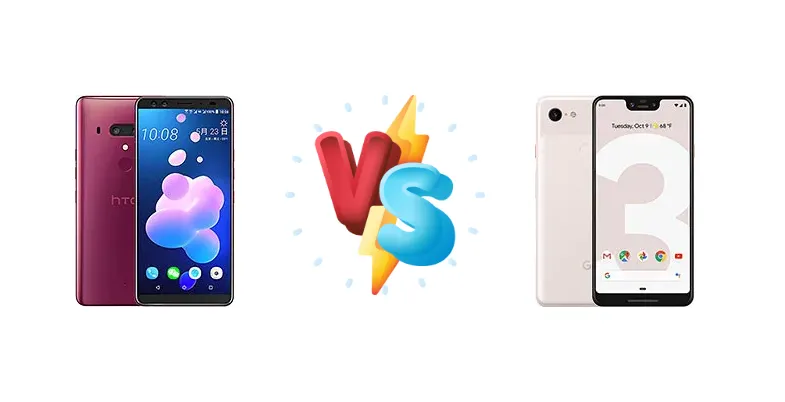
|
🏆 Quick Verdict
For the average user prioritizing camera quality and software support, the Google Pixel 3 XL is the better choice. Its superior image processing and guaranteed updates outweigh the HTC U12+'s slightly higher display contrast. However, the U12+ offers faster charging and a potentially more robust build.
| PHONES | ||
|---|---|---|
| Phone Names | HTC U12+ | Google Pixel 3 XL |
| Network | ||
|---|---|---|
| 2G bands | GSM 850 / 900 / 1800 / 1900 | GSM 850 / 900 / 1800 / 1900 |
| 3G bands | HSDPA 850 / 900 / 1700(AWS) / 1900 / 2100 | HSDPA 850 / 900 / 1700(AWS) / 1900 / 2100 |
| 4G bands | 1, 2, 3, 4, 5, 7, 8, 12, 13, 17, 20, 28, 32, 38, 39, 49, 41, 66 | 1, 2, 3, 4, 5, 7, 8, 12, 13, 17, 18, 19, 20, 25, 26, 28, 29, 32, 38, 39, 40, 41, 42, 46, 66, 71 |
| Speed | HSPA 42.2/5.76 Mbps, LTE (5CA) Cat18 1200/150 Mbps | HSPA 42.2/5.76 Mbps, LTE (5CA) Cat16 1024/75 Mbps |
| Technology | GSM / HSPA / LTE | GSM / CDMA / HSPA / EVDO / LTE |
| - | CDMA2000 1xEV-DO | |
| Launch | ||
|---|---|---|
| Announced | 2018, May 23. Released 2018, June 29 | 2018, October 09. Released 2018, October 18 |
| Status | Discontinued | Discontinued |
| Body | ||
|---|---|---|
| Build | Glass front (Gorilla Glass 3), glass back, aluminum frame | Glass front (Gorilla Glass 5), glass back (Gorilla Glass 5), aluminum frame |
| Dimensions | 156.6 x 73.9 x 8.7 mm (6.17 x 2.91 x 0.34 in) | 158 x 76.7 x 7.9 mm (6.22 x 3.02 x 0.31 in) |
| SIM | · Nano-SIM· Nano-SIM + Nano-SIM | Nano-SIM + eSIM |
| Weight | 188 g (6.63 oz) | 184 g (6.49 oz) |
| - | IP68 dust/water resistant (up to 1.5m for 30 min) | |
| Display | ||
|---|---|---|
| Protection | Corning Gorilla Glass 3 | Corning Gorilla Glass 5 |
| Resolution | 1440 x 2880 pixels, 18:9 ratio (~537 ppi density) | 1440 x 2960 pixels, 18.5:9 ratio (~523 ppi density) |
| Size | 6.0 inches, 92.9 cm2 (~80.3% screen-to-body ratio) | 6.3 inches, 100.3 cm2 (~82.8% screen-to-body ratio) |
| Type | Super LCD6, HDR10 | P-OLED, HDR |
| - | Always-on display | |
| Platform | ||
|---|---|---|
| CPU | Octa-core (4x2.8 GHz Kryo 385 Gold & 4x1.7 GHz Kryo 385 Silver) | Octa-core (4x2.5 GHz Kryo 385 Gold & 4x1.6 GHz Kryo 385 Silver) |
| Chipset | Qualcomm SDM845 Snapdragon 845 (10 nm) | Qualcomm SDM845 Snapdragon 845 (10 nm) |
| GPU | Adreno 630 | Adreno 630 |
| OS | Android 8.0 (Oreo), upgradable to Android 9.0 (Pie), Sense UI | Android 9.0 (Pie), upgradable to Android 12 |
| Memory | ||
|---|---|---|
| Card slot | microSDXC (uses shared SIM slot) | No |
| Internal | 64GB 6GB RAM, 128GB 6GB RAM | 64GB 4GB RAM, 128GB 4GB RAM |
| - | UFS 2.1 | |
| Main Camera | ||
|---|---|---|
| Dual | 12 MP, f/1.8, 1/2.55", 1.4µm, dual pixel PDAF, OIS 16 MP (12 MP effective), f/2.6, 1/3.1", 1.0µm, 2x optical zoom, AF | - |
| Features | Laser AF, Dual-LED dual-tone flash, HDR | Dual-LED flash, Pixel Shift, Auto-HDR, panorama |
| Single | - | 12.2 MP, f/1.8, 28mm (wide), 1/2.55", 1.4µm, dual pixel PDAF, OIS |
| Video | 4K@60fps, 1080p@60/240fps, 1080p@30fps (gyro-EIS), HDR, 24-bit/96kHz stereo sound rec. | 4K@30fps, 1080p@30/60/120fps, 1080p@30fps (gyro-EIS) |
| Selfie camera | ||
|---|---|---|
| Dual | 8 MP, f/2.0, 1/4.0", 1.12µm 8 MP, f/2.0, 1/4.0", 1.12µm | 8 MP, f/1.8, 28mm (wide), PDAF 8 MP, f/2.2, 19mm (ultrawide), no AF |
| Features | HDR, panorama | HDR |
| Video | 1080p@30fps | 1080p@30fps |
| Sound | ||
|---|---|---|
| 3.5mm jack | - | No |
| 35mm jack | No | No |
| Loudspeaker | Yes, with stereo speakers | Yes, with stereo speakers |
| Comms | ||
|---|---|---|
| Bluetooth | 5.0, A2DP, aptX HD, LE | 5.0, A2DP, LE, aptX HD |
| NFC | Yes | Yes |
| Positioning | GPS, GLONASS, GALILEO, BDS | GPS, GLONASS, BDS, GALILEO |
| Radio | No | No |
| USB | USB Type-C 3.1 | USB Type-C 3.1 |
| WLAN | Wi-Fi 802.11 a/b/g/n/ac, dual-band, Wi-Fi Direct, DLNA | Wi-Fi 802.11 a/b/g/n/ac, dual-band, Wi-Fi Direct, DLNA |
| Features | ||
|---|---|---|
| Sensors | Fingerprint (rear-mounted), accelerometer, gyro, proximity, compass | Fingerprint (rear-mounted), accelerometer, gyro, proximity, compass, barometer |
| Battery | ||
|---|---|---|
| Charging | 18W wired, QC3, 50% in 35 min | 18W wired, PD2.0 Wireless |
| Talk time | Up to 24 h (3G) | - |
| Type | Li-Ion 3500 mAh, non-removable | Li-Po 3430 mAh, non-removable |
| Misc | ||
|---|---|---|
| Colors | Translucent Blue, Ceramic Black, Flame Red | Clearly White, Just Black, Not Pink |
| Models | U12, 2Q55100 | G013C |
| Price | About 450 EUR | About 260 EUR |
| Tests | ||
|---|---|---|
| Performance | - | AnTuTu: 258244 (v7), 341814 (v8) GeekBench: 8088 (v4.4), 2092 (v5.1) GFXBench: 12fps (ES 3.1 onscreen) |
HTC U12+
- Faster 18W charging with QC3 support
- Higher nominal and sunlight contrast ratio on the display
- Potentially more customizable Android experience
- Likely lacks the Pixel 3 XL’s software update commitment
- Camera performance likely trails the Pixel 3 XL
Google Pixel 3 XL
- Superior camera performance, especially in low light
- Guaranteed software updates and a clean Android experience
- Wireless charging support
- Slightly slower CPU clock speed
- Charging may be slower than U12+ without QC3
Display Comparison
Both the HTC U12+ and Pixel 3 XL feature displays designed for immersive viewing, but differ in key characteristics. The U12+ boasts a higher nominal contrast ratio of 1818:1, compared to the Pixel 3 XL’s unspecified ratio, suggesting deeper blacks and more vibrant colors under ideal conditions. However, the Pixel 3 XL likely benefits from Google’s image processing to enhance perceived contrast. Crucially, the U12+ achieves a significantly higher contrast ratio in direct sunlight (3.085), indicating better outdoor visibility. While both likely utilize OLED panels, the U12+'s superior sunlight readability is a tangible advantage for outdoor users.
Camera Comparison
The Pixel 3 XL’s camera is its defining feature. While specific sensor details are unavailable for either device in the provided data, Google’s computational photography prowess – features like Night Sight and HDR+ – significantly elevates image quality, particularly in challenging lighting conditions. The U12+ likely relies more on hardware capabilities, but without detailed sensor information, it’s difficult to assess its low-light performance. The Pixel 3 XL’s image processing prioritizes dynamic range and detail, while the U12+ may lean towards more saturated colors. The absence of information on OIS and lens apertures makes a definitive hardware comparison impossible, but the Pixel 3 XL’s software advantage is substantial.
Performance
Both devices are powered by the Qualcomm Snapdragon 845 (10nm), but with slightly different CPU clock speeds. The U12+ features a 2.8 GHz Kryo 385 Gold core, marginally faster than the Pixel 3 XL’s 2.5 GHz Kryo 385 Gold. In real-world usage, this difference is unlikely to be noticeable for most tasks. Both phones share the same 4x1.7 GHz Kryo 385 Silver efficiency cores. The Pixel 3 XL’s advantage lies in Google’s software optimization, potentially leading to smoother performance in specific applications. Thermal management will be similar, with both devices susceptible to throttling under sustained heavy loads, typical of the Snapdragon 845.
Battery Life
The HTC U12+ has an endurance rating of 64 hours, suggesting a larger battery capacity than the Pixel 3 XL, though the exact mAh is not specified. Both devices support 18W wired charging, but the U12+ benefits from Quick Charge 3 (QC3) compatibility, while the Pixel 3 XL utilizes Power Delivery 2.0 (PD2.0). The U12+ claims a 50% charge in 35 minutes, indicating a faster charging cycle. The Pixel 3 XL also supports wireless charging, a feature absent on the U12+, offering added convenience.
Buying Guide
Buy the HTC U12+ if you need faster charging speeds (18W with QC3) and value a higher nominal display contrast ratio (1818:1). It’s a good option for users who prefer a more customizable Android experience and don't rely heavily on Google's exclusive software features. Buy the Google Pixel 3 XL if you prioritize exceptional camera performance, especially in low light, and want a phone with guaranteed software updates and a clean, streamlined Android experience.