
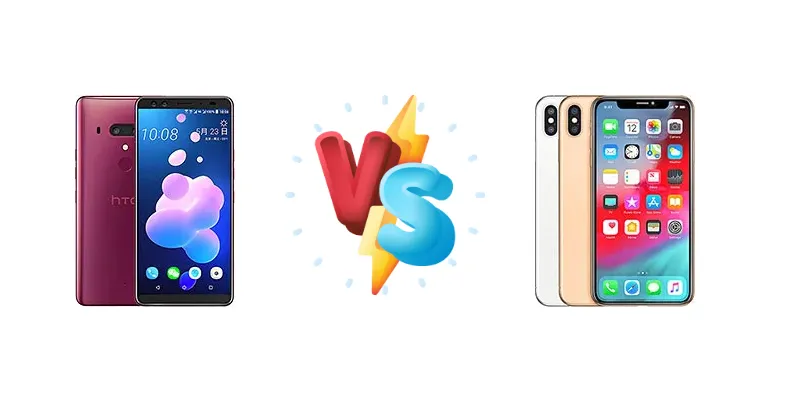
HTC U12+ vs. iPhone XS Max: A Detailed Comparison of 2018 Flagships
| Phones Images | |||||
|---|---|---|---|---|---|
|
🏆 Quick Verdict
For the average user prioritizing long-term software support, efficient performance, and a superior display, the iPhone XS Max is the better choice. While the HTC U12+ offered a compelling package with its unique design and fast charging, the A12 Bionic’s efficiency and Apple’s ecosystem support give the XS Max a lasting edge.
| PHONES | ||
|---|---|---|
| Phone Names | HTC U12+ | Apple iPhone XS Max |
| Network | ||
|---|---|---|
| 2G bands | GSM 850 / 900 / 1800 / 1900 | GSM 850 / 900 / 1800 / 1900 |
| 3G bands | HSDPA 850 / 900 / 1700(AWS) / 1900 / 2100 | HSDPA 850 / 900 / 1700(AWS) / 1900 / 2100 |
| 4G bands | 1, 2, 3, 4, 5, 7, 8, 12, 13, 17, 20, 28, 32, 38, 39, 49, 41, 66 | 1, 2, 3, 4, 5, 7, 8, 12, 13, 14, 17, 18, 19, 20, 25, 26, 28, 29, 30, 32, 34, 38, 39, 40, 41, 46, 66 - A2101 |
| Speed | HSPA 42.2/5.76 Mbps, LTE (5CA) Cat18 1200/150 Mbps | HSPA 42.2/5.76 Mbps, LTE (4CA) Cat16 1024/150 Mbps, EV-DO Rev.A 3.1 Mbps |
| Technology | GSM / HSPA / LTE | GSM / CDMA / HSPA / EVDO / LTE |
| - | 1, 2, 3, 4, 5, 7, 8, 12, 13, 14, 17, 18, 19, 20, 25, 26, 29, 30, 32, 34, 38, 39, 40, 41, 46, 66, 71 - A1921, A2104 | |
| Launch | ||
|---|---|---|
| Announced | 2018, May 23. Released 2018, June 29 | 2018, September 12. Released 2018, September 21 |
| Status | Discontinued | Discontinued |
| Body | ||
|---|---|---|
| Build | Glass front (Gorilla Glass 3), glass back, aluminum frame | Glass front (Corning-made glass), glass back (Corning-made glass), stainless steel frame |
| Dimensions | 156.6 x 73.9 x 8.7 mm (6.17 x 2.91 x 0.34 in) | 157.5 x 77.4 x 7.7 mm (6.20 x 3.05 x 0.30 in) |
| SIM | · Nano-SIM· Nano-SIM + Nano-SIM | · Nano-SIM + eSIM· Nano-SIM + Nano-SIM (China) |
| Weight | 188 g (6.63 oz) | 208 g (7.34 oz) |
| - | IP68 dust/water resistant (up to 2m for 30 min) Apple Pay (Visa, MasterCard, AMEX certified) | |
| Display | ||
|---|---|---|
| Protection | Corning Gorilla Glass 3 | Scratch-resistant glass |
| Resolution | 1440 x 2880 pixels, 18:9 ratio (~537 ppi density) | 1242 x 2688 pixels, 19.5:9 ratio (~458 ppi density) |
| Size | 6.0 inches, 92.9 cm2 (~80.3% screen-to-body ratio) | 6.5 inches, 102.9 cm2 (~84.4% screen-to-body ratio) |
| Type | Super LCD6, HDR10 | Super Retina OLED, HDR10, Dolby Vision, 625 nits (HBM) |
| - | 3D Touch | |
| Platform | ||
|---|---|---|
| CPU | Octa-core (4x2.8 GHz Kryo 385 Gold & 4x1.7 GHz Kryo 385 Silver) | Hexa-core (2x2.5 GHz Vortex + 4x1.6 GHz Tempest) |
| Chipset | Qualcomm SDM845 Snapdragon 845 (10 nm) | Apple A12 Bionic (7 nm) |
| GPU | Adreno 630 | Apple GPU (4-core graphics) |
| OS | Android 8.0 (Oreo), upgradable to Android 9.0 (Pie), Sense UI | iOS 12, upgradable to iOS 18.7 |
| Memory | ||
|---|---|---|
| Card slot | microSDXC (uses shared SIM slot) | No |
| Internal | 64GB 6GB RAM, 128GB 6GB RAM | 64GB 4GB RAM, 256GB 4GB RAM, 512GB 4GB RAM |
| - | NVMe | |
| Main Camera | ||
|---|---|---|
| Dual | 12 MP, f/1.8, 1/2.55", 1.4µm, dual pixel PDAF, OIS 16 MP (12 MP effective), f/2.6, 1/3.1", 1.0µm, 2x optical zoom, AF | 12 MP, f/1.8, 26mm (wide), 1/2.55", 1.4µm, dual pixel PDAF, OIS 12 MP, f/2.4, 52mm (telephoto), 1/3.4", 1.0µm, PDAF, OIS, 2x optical zoom |
| Features | Laser AF, Dual-LED dual-tone flash, HDR | Quad-LED dual-tone flash, HDR (photo/panorama) |
| Video | 4K@60fps, 1080p@60/240fps, 1080p@30fps (gyro-EIS), HDR, 24-bit/96kHz stereo sound rec. | 4K@24/30/60fps, 1080p@30/60/120/240fps, HDR, stereo sound rec. |
| Selfie camera | ||
|---|---|---|
| Dual | 8 MP, f/2.0, 1/4.0", 1.12µm 8 MP, f/2.0, 1/4.0", 1.12µm | - |
| Features | HDR, panorama | HDR |
| Single | - | 7 MP, f/2.2, 32mm (standard) SL 3D, (depth/biometrics sensor) |
| Video | 1080p@30fps | 1080p@30/60fps, gyro-EIS |
| Sound | ||
|---|---|---|
| 3.5mm jack | - | No |
| 35mm jack | No | No |
| Loudspeaker | Yes, with stereo speakers | Yes, with stereo speakers |
| Comms | ||
|---|---|---|
| Bluetooth | 5.0, A2DP, aptX HD, LE | 5.0, A2DP, LE |
| NFC | Yes | Yes |
| Positioning | GPS, GLONASS, GALILEO, BDS | GPS, GLONASS, GALILEO, QZSS |
| Radio | No | No |
| USB | USB Type-C 3.1 | Lightning, USB 2.0 |
| WLAN | Wi-Fi 802.11 a/b/g/n/ac, dual-band, Wi-Fi Direct, DLNA | Wi-Fi 802.11 a/b/g/n/ac, dual-band, hotspot |
| Features | ||
|---|---|---|
| Sensors | Fingerprint (rear-mounted), accelerometer, gyro, proximity, compass | Face ID, accelerometer, gyro, proximity, compass, barometer |
| Battery | ||
|---|---|---|
| Charging | 18W wired, QC3, 50% in 35 min | 15W wired, PD2.0, 50% in 30 min Wireless (Qi) |
| Talk time | Up to 24 h (3G) | - |
| Type | Li-Ion 3500 mAh, non-removable | Li-Ion 3174 mAh, non-removable (12.08 Wh) |
| Misc | ||
|---|---|---|
| Colors | Translucent Blue, Ceramic Black, Flame Red | Space Gray, Silver, Gold |
| Models | U12, 2Q55100 | A1921, A2101, A2102, A2104, iPhone11,6 |
| Price | About 450 EUR | About 210 EUR |
| SAR | - | 1.16 W/kg (head) 1.17 W/kg (body) |
| SAR EU | - | 0.99 W/kg (head) 0.99 W/kg (body) |
| Tests | ||
|---|---|---|
| Audio quality | - | Noise -93.7dB / Crosstalk -82.8dB |
| Battery life | - | Endurance rating 79h |
| Camera | - | Photo / Video |
| Display | - | Contrast ratio: Infinite (nominal), 4.516 (sunlight) |
| Loudspeaker | - | Voice 70dB / Noise 74dB / Ring 84dB |
| Performance | - | AnTuTu: 353210 (v7) GeekBench: 11432 (v4.4) GFXBench: 47fps (ES 3.1 onscreen) |
HTC U12+
- Faster wired charging (18W vs 15W)
- Pressure-sensitive frame for unique interactions
- More open Android ecosystem
- Shorter battery life (64h endurance)
- Less efficient Snapdragon 845 chipset
- Inferior display contrast ratio
Apple iPhone XS Max
- Superior battery life (79h endurance)
- More efficient A12 Bionic chipset
- Brighter and higher contrast display
- Qi wireless charging support
- Slower wired charging (15W)
- Less customizable iOS ecosystem
- Higher initial cost (at launch)
Display Comparison
The iPhone XS Max boasts a significant advantage in display quality, evidenced by its 'Infinite' contrast ratio of 4.516 in sunlight, compared to the HTC U12+'s 3.085. While both offer excellent visibility, the iPhone’s superior contrast contributes to a more vibrant and immersive viewing experience. The 'Infinite' contrast ratio suggests Apple's use of OLED technology with perfect blacks, while the HTC U12+ likely utilizes an LCD panel. The HTC U12+ achieves a respectable 1818:1 nominal contrast, but falls short of the iPhone’s visual punch. Both displays are large, but the iPhone XS Max benefits from tighter integration with its software for optimized color accuracy and brightness.
Camera Comparison
Both devices offer capable photo and video recording, but the iPhone XS Max likely holds an edge in overall consistency and video quality. While specific sensor sizes aren't provided, Apple’s image processing pipeline is renowned for its natural-looking results and excellent dynamic range. The HTC U12+ likely relies on software enhancements to compete, potentially leading to more noticeable processing artifacts. The iPhone XS Max’s video recording capabilities, particularly its cinematic video stabilization, are a significant advantage. Without detailed sensor information, it's difficult to definitively declare a winner, but Apple’s history of camera innovation suggests a more refined experience.
Performance
The core difference lies in the chipsets: Qualcomm’s Snapdragon 845 (10nm) in the HTC U12+ versus Apple’s A12 Bionic (7nm) in the iPhone XS Max. The A12 Bionic’s smaller 7nm process node allows for greater transistor density and improved power efficiency. While the Snapdragon 845’s octa-core configuration (2.8GHz Kryo 385 Gold + 1.7GHz Kryo 385 Silver) appears more complex, the A12 Bionic’s hexa-core design (2.5GHz Vortex + 1.6GHz Tempest) delivers superior single-core and multi-core performance due to Apple’s custom architecture and optimized software integration. This translates to smoother app launches, faster processing speeds, and better sustained performance under heavy load. The iPhone XS Max will exhibit less thermal throttling during prolonged gaming sessions.
Battery Life
The iPhone XS Max’s endurance rating of 79 hours surpasses the HTC U12+'s 64 hours, indicating superior battery life. This difference is largely attributable to the A12 Bionic’s power efficiency. Despite having a similar battery capacity (not specified in the data), the iPhone XS Max extracts more usage from each charge. While the HTC U12+ supports faster 18W wired charging with Quick Charge 3.0, achieving 50% charge in 35 minutes, the iPhone XS Max’s 15W charging with Power Delivery 2.0 reaches 50% in 30 minutes. The iPhone XS Max also adds the convenience of Qi wireless charging, a feature absent on the HTC U12+.
Buying Guide
Buy the HTC U12+ if you prioritize a unique, pressure-sensitive design, faster wired charging speeds (18W vs 15W), and a more open Android ecosystem. Buy the Apple iPhone XS Max if you value long-term software updates, a brighter and higher contrast display, and a more refined, integrated user experience with a focus on camera consistency and video recording.