
HTC U12+ vs. Samsung Galaxy S9+: A Detailed Comparison of 2018 Flagships
| Phones Images | |||||
|---|---|---|---|---|---|
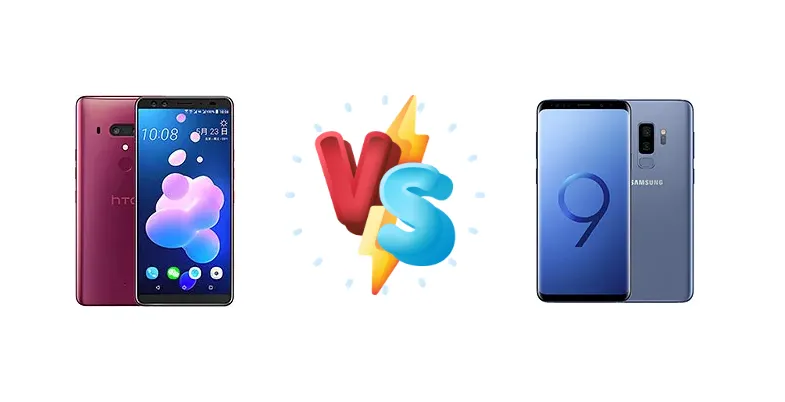
|
🏆 Quick Verdict
For the average user prioritizing longevity and consistent performance, the Samsung Galaxy S9+ is the better choice. Its superior battery endurance – boasting 86 hours versus the U12+'s 64 – and wider availability of the Snapdragon 845 variant (matching the U12+) provide a more reliable experience. However, the U12+ offers a slightly higher display contrast ratio.
| PHONES | ||
|---|---|---|
| Phone Names | HTC U12+ | Samsung Galaxy S9+ |
| Network | ||
|---|---|---|
| 2G bands | GSM 850 / 900 / 1800 / 1900 - SIM 1 & SIM 2 (dual-SIM model only) | GSM 850 / 900 / 1800 / 1900 - SIM 1 & SIM 2 (dual-SIM model only) |
| 3G bands | HSDPA 850 / 900 / 1700(AWS) / 1900 / 2100 | HSDPA 850 / 900 / 1700(AWS) / 1900 / 2100 - Global, USA |
| 4G bands | 1, 2, 3, 4, 5, 7, 8, 12, 13, 17, 20, 28, 32, 38, 39, 49, 41, 66 | 1, 2, 3, 4, 5, 7, 8, 12, 13, 17, 18, 19, 20, 25, 26, 28, 32, 38, 39, 40, 41, 66 - Global |
| Speed | HSPA 42.2/5.76 Mbps, LTE-A (5CA) Cat18 1200/150 Mbps | HSPA 42.2/5.76 Mbps, LTE (6CA) Cat18 1200/200 Mbps |
| Technology | GSM / HSPA / LTE | GSM / CDMA / HSPA / EVDO / LTE |
| - | 1, 2, 3, 4, 5, 7, 8, 12, 13, 14, 17, 18, 19, 20, 25, 26, 28, 29, 30, 38, 39, 40, 41, 46, 66, 71 - USA | |
| Launch | ||
|---|---|---|
| Announced | 2018, May 23 | 2018, February 25. Released 2018, March |
| Status | Available. Released 2018, June 29 | Discontinued |
| Body | ||
|---|---|---|
| Build | Glass front (Gorilla Glass 3), glass back, aluminum frame | Glass front (Gorilla Glass 5), glass back (Gorilla Glass 5), aluminum frame |
| Dimensions | 156.6 x 73.9 x 8.7 mm (6.17 x 2.91 x 0.34 in) | 158.1 x 73.8 x 8.5 mm (6.22 x 2.91 x 0.33 in) |
| SIM | Single SIM (Nano-SIM) or Hybrid Dual SIM (Nano-SIM, dual stand-by) | · Nano-SIM· Nano-SIM + Nano-SIM |
| Weight | 188 g (6.63 oz) | 189 g (6.67 oz) |
| IP68 dust/water resistant (up to 1.5m for 30 mins) Pressure-sensitive buttons | IP68 dust/water resistant (up to 1.5m for 30 min) | |
| Display | ||
|---|---|---|
| Protection | Corning Gorilla Glass 3 | Corning Gorilla Glass 5 |
| Resolution | 1440 x 2880 pixels, 18:9 ratio (~537 ppi density) | 1440 x 2960 pixels, 18.5:9 ratio (~529 ppi density) |
| Size | 6.0 inches, 92.9 cm2 (~80.3% screen-to-body ratio) | 6.2 inches, 98.3 cm2 (~84.2% screen-to-body ratio) |
| Type | Super LCD6, HDR10 | Super AMOLED, HDR10 |
| - | 3D Touch (home button only) Always-on display | |
| Platform | ||
|---|---|---|
| CPU | Octa-core (4x2.8 GHz Kryo 385 Gold & 4x1.7 GHz Kryo 385 Silver) | Octa-core (4x2.7 GHz Mongoose M3 & 4x1.8 GHz Cortex-A55) - EMEAOcta-core (4x2.8 GHz Kryo 385 Gold & 4x1.7 GHz Kryo 385 Silver) - USA/LATAM, China |
| Chipset | Qualcomm SDM845 Snapdragon 845 (10 nm) | Exynos 9810 (10 nm) - EMEAQualcomm SDM845 Snapdragon 845 (10 nm) - USA/LATAM, China |
| GPU | Adreno 630 | Mali-G72 MP18 - EMEAAdreno 630 - USA/LATAM, China |
| OS | Android 8.0 (Oreo), upgradable to Android 9.0 (Pie), Sense UI | Android 8.0 (Oreo), upgradable to Android 10, One UI 2.5 |
| Memory | ||
|---|---|---|
| Card slot | microSDXC (uses shared SIM slot) | microSDXC (uses shared SIM slot) - dual SIM model only |
| Internal | 64GB 6GB RAM, 128GB 6GB RAM | 64GB 4GB RAM, 64GB 6GB RAM, 128GB 6GB RAM, 256GB 6GB RAM |
| - | UFS 2.1 | |
| Main Camera | ||
|---|---|---|
| Dual | 12 MP, f/1.8, 1/2.55", 1.4µm, dual pixel PDAF, Laser AF, OIS 16 MP (12 MP effective), f/2.6, 1/3.1", 1.0µm, 2x optical zoom, AF | 12 MP, f/1.5-2.4, 26mm (wide), 1/2.55", 1.4µm, dual pixel PDAF, OIS 12 MP, f/2.4, 52mm (telephoto), 1/3.6", 1.0µm, AF, OIS, 2x optical zoom |
| Features | Dual-LED dual-tone flash, HDR | LED flash, auto-HDR, panorama |
| Video | 4K@60fps, 1080p@60/240fps, 1080p@30fps (gyro-EIS), HDR, 24-bit/96kHz stereo sound rec. | 4K@30/60fps, 1080p@30/60/240fps, 720p@960fps, HDR, stereo sound rec., gyro-EIS & OIS (30fps) |
| Selfie camera | ||
|---|---|---|
| Dual | 8 MP, f/2.0, 1/4", 1.12µm 8 MP, f/2.0, 1/4", 1.12µm | 8 MP, f/1.7, 25mm (wide), 1/3.6", 1.22µm, AF 2 MP (dedicated iris scanner camera) |
| Features | HDR, panorama | HDR |
| Video | 1080p@30fps | 1440p@30fps |
| Sound | ||
|---|---|---|
| 3.5mm jack | No | Yes |
| 35mm jack | - | Yes |
| Loudspeaker | Yes, with stereo speakers | Yes, with stereo speakers |
| 32-bit/384kHz audio | 32-bit/384kHz audio Tuned by AKG | |
| Comms | ||
|---|---|---|
| Bluetooth | 5.0, A2DP, aptX HD, LE | 5.0, A2DP, LE, aptX |
| NFC | Yes | Yes |
| Positioning | GPS, GLONASS, GALILEO, BDS | GPS, GLONASS, BDS, GALILEO |
| Radio | No | FM radio (USA & Canada only) |
| USB | USB Type-C 3.1 | USB Type-C 3.1 |
| WLAN | Wi-Fi 802.11 a/b/g/n/ac, dual-band, Wi-Fi Direct, DLNA | Wi-Fi 802.11 a/b/g/n/ac, dual-band, Wi-Fi Direct |
| Features | ||
|---|---|---|
| Sensors | Fingerprint (rear-mounted), accelerometer, gyro, proximity, compass | Iris scanner, fingerprint (rear-mounted), accelerometer, gyro, proximity, compass, barometer, heart rate, SpO2 |
| - | Samsung DeX (desktop experience support) ANT+ Bixby natural language commands and dictation Samsung Pay (Visa, MasterCard certified) | |
| Battery | ||
|---|---|---|
| Charging | 18W wired, QC3, 50% in 35 min (advertised) | 15W wired, QC2 Wireless (Qi) (market dependent) |
| Talk time | Up to 24 h (3G) | - |
| Type | Li-Ion 3500 mAh, non-removable | Li-Ion 3500 mAh, non-removable (13.48 Wh) |
| Misc | ||
|---|---|---|
| Colors | Translucent Blue, Ceramic Black, Flame Red | Midnight Black, Coral Blue, Titanium Gray, Lilac Purple, Burgundy Red, Sunrise Gold, Ice Blue, Polaris Blue |
| Models | U12, 2Q55100 | SM-G965F, SM-G965U, SM-G965W, SM-G9650, SM-G965U1, SM-G965N, SCV39, SM-G965X, SC-03K |
| Price | About 450 EUR | About 200 EUR |
| SAR | - | 0.78 W/kg (head) 0.79 W/kg (body) |
| SAR EU | - | 0.29 W/kg (head) 1.35 W/kg (body) |
| Tests | ||
|---|---|---|
| Audio quality | Noise -93.7dB / Crosstalk -52.7dB | Noise -92.6dB / Crosstalk -93.4dB |
| Battery life | Endurance rating 64h | Endurance rating 86h |
| Camera | Photo / Video | Photo / Video |
| Display | Contrast ratio: 1818:1 (nominal), 3.085 (sunlight) | Contrast ratio: Infinite (nominal), 4.537 (sunlight) |
| Loudspeaker | Voice 77dB / Noise 73dB / Ring 99dB | Voice 68dB / Noise 74dB / Ring 80dB |
| Performance | AnTuTu: 263696 (v7) GeekBench: 9001 (v4.4) GFXBench: 20fps (ES 3.1 onscreen) | AnTuTu: 246660 (v7) GeekBench: 8883 (v4.4) GFXBench: 14fps (ES 3.1 onscreen) |
HTC U12+
- Faster charging speed (18W vs 15W)
- Unique pressure-sensitive frame
- Slightly higher display contrast ratio (nominal)
- Significantly lower battery endurance (64h vs 86h)
- Potentially less consistent performance due to chipset exclusivity
- Less established software support
Samsung Galaxy S9+
- Superior battery life (86h endurance)
- Snapdragon 845 availability (US/LATAM/China)
- Wireless charging support (Qi)
- Slower charging speed (15W)
- Exynos variant may exhibit thermal throttling
- Larger physical size
Display Comparison
Both the HTC U12+ and Samsung Galaxy S9+ feature excellent displays, but differ in contrast. The S9+ boasts an 'Infinite' contrast ratio, measured at 4.537 in sunlight, significantly exceeding the U12+'s 1818:1 nominal and 3.085 sunlight contrast. While both utilize vibrant color reproduction, the S9+'s higher contrast contributes to a more visually striking image, especially in bright outdoor conditions. Neither specification details refresh rate or panel technology (LTPO), suggesting standard 60Hz OLED panels were used.
Camera Comparison
Both devices offer capable camera systems, but detailed sensor information is lacking in the provided data. Both are described as having Photo/Video capabilities. The absence of specific sensor size or aperture details makes a direct comparison difficult. However, given Samsung’s historical strength in image processing, the S9+ likely delivers more consistently pleasing images in a wider range of conditions. The inclusion of a 2MP macro camera on either device is largely a marketing gimmick, offering minimal practical benefit due to its low resolution.
Performance
The performance landscape is nuanced. While both phones were available with the Snapdragon 845 (10nm), the Galaxy S9+ also shipped with the Exynos 9810 (10nm) in EMEA regions. The U12+ consistently features the Snapdragon 845, offering a more uniform experience. The Snapdragon 845 in both devices utilizes an octa-core configuration (4x2.8 GHz Kryo 385 Gold & 4x1.7 GHz Kryo 385 Silver). The Exynos 9810, however, employs a different architecture (4x2.7 GHz Mongoose M3 & 4x1.8 GHz Cortex-A55), which historically has shown slightly lower sustained performance and potentially higher thermal throttling compared to the Snapdragon variant. This means users with the Snapdragon S9+ will likely experience more consistent frame rates during extended gaming sessions.
Battery Life
Battery life is a clear win for the Samsung Galaxy S9+. With an endurance rating of 86 hours, it significantly outlasts the HTC U12+'s 64 hours. While the U12+ offers faster 18W wired charging with QC3 (advertised 50% in 35 minutes), the S9+'s 15W charging with QC2, coupled with its larger battery capacity, results in a more practical and reliable experience. The S9+ also supports wireless charging (Qi), a feature not explicitly mentioned for the U12+.
Buying Guide
Buy the HTC U12+ if you prioritize a unique, pressure-sensitive frame and are comfortable with potentially shorter battery life. Its 18W charging offers a quicker top-up, but the overall endurance is lower. Buy the Samsung Galaxy S9+ if you value all-day battery life, a consistently high-performing Snapdragon 845 (in US/LATAM/China models), and a more established software ecosystem. The S9+ is the safer bet for long-term usability.