
HTC U12+ vs Huawei P20 Pro: A Detailed Comparison of Flagship Power
| Phones Images | |||||
|---|---|---|---|---|---|
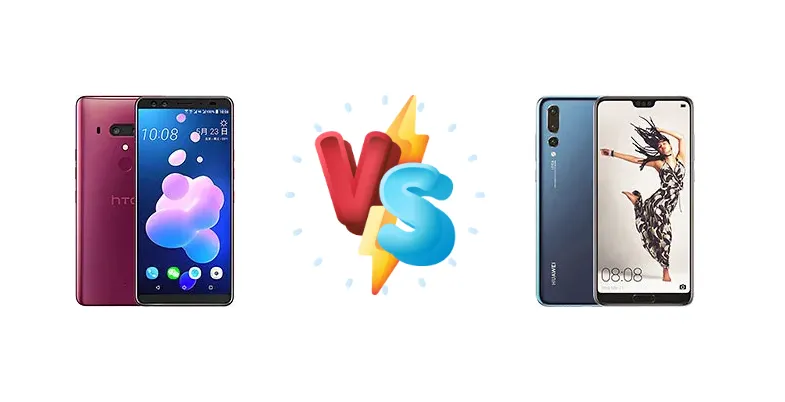
|
🏆 Quick Verdict
For the average user prioritizing battery life and camera versatility, the Huawei P20 Pro is the stronger choice. Its significantly longer endurance rating (89h vs 64h) and impressive camera system outweigh the U12+'s performance edge. However, users demanding the absolute fastest processing speeds will find the Snapdragon 845 in the U12+ more appealing.
| PHONES | ||
|---|---|---|
| Phone Names | HTC U12+ | Huawei P20 Pro |
| Network | ||
|---|---|---|
| 2G bands | GSM 850 / 900 / 1800 / 1900 - SIM 1 & SIM 2 (dual-SIM model only) | GSM 850 / 900 / 1800 / 1900 |
| 3G bands | HSDPA 850 / 900 / 1700(AWS) / 1900 / 2100 | HSDPA 850 / 900 / 1900 / 2100 |
| 4G bands | 1, 2, 3, 4, 5, 7, 8, 12, 13, 17, 20, 28, 32, 38, 39, 49, 41, 66 | 1, 2, 3, 4, 5, 6, 7, 8, 9, 12, 17, 18, 19, 20, 26, 28, 32, 34, 38, 39, 40 |
| Speed | HSPA 42.2/5.76 Mbps, LTE-A (5CA) Cat18 1200/150 Mbps | HSPA 42.2/5.76 Mbps, LTE (3CA) Cat16 1024/150 Mbps |
| Technology | GSM / HSPA / LTE | GSM / HSPA / LTE |
| Launch | ||
|---|---|---|
| Announced | 2018, May 23 | 2018, March 27. Released 2018, April 06 |
| Status | Available. Released 2018, June 29 | Discontinued |
| Body | ||
|---|---|---|
| Build | Glass front (Gorilla Glass 3), glass back, aluminum frame | Glass front (Gorilla Glass 5), glass back, aluminum frame |
| Dimensions | 156.6 x 73.9 x 8.7 mm (6.17 x 2.91 x 0.34 in) | 155 x 73.9 x 7.8 mm (6.10 x 2.91 x 0.31 in) |
| SIM | Single SIM (Nano-SIM) or Hybrid Dual SIM (Nano-SIM, dual stand-by) | · Nano-SIM· Nano-SIM + Nano-SIM |
| Weight | 188 g (6.63 oz) | 180 g (6.35 oz) |
| IP68 dust/water resistant (up to 1.5m for 30 mins) Pressure-sensitive buttons | IP67 dust/water resistant (up to 1m for 30 mins) | |
| Display | ||
|---|---|---|
| Protection | Corning Gorilla Glass 3 | Corning Gorilla Glass 5 |
| Resolution | 1440 x 2880 pixels, 18:9 ratio (~537 ppi density) | 1080 x 2240 pixels, 18.7:9 ratio (~408 ppi density) |
| Size | 6.0 inches, 92.9 cm2 (~80.3% screen-to-body ratio) | 6.1 inches, 93.9 cm2 (~82.0% screen-to-body ratio) |
| Type | Super LCD6, HDR10 | OLED |
| Platform | ||
|---|---|---|
| CPU | Octa-core (4x2.8 GHz Kryo 385 Gold & 4x1.7 GHz Kryo 385 Silver) | Octa-core (4x2.4 GHz Cortex-A73 & 4x1.8 GHz Cortex-A53) |
| Chipset | Qualcomm SDM845 Snapdragon 845 (10 nm) | Kirin 970 (10 nm) |
| GPU | Adreno 630 | Mali-G72 MP12 |
| OS | Android 8.0 (Oreo), upgradable to Android 9.0 (Pie), Sense UI | Android 8.1 (Oreo), upgradable to Android 10, EMUI 12 |
| Memory | ||
|---|---|---|
| Card slot | microSDXC (uses shared SIM slot) | No |
| Internal | 64GB 6GB RAM, 128GB 6GB RAM | 64GB 6GB RAM, 128GB 6GB RAM, 128GB 8GB RAM, 256GB 6GB RAM, 256GB 8GB RAM |
| - | UFS 2.1 | |
| Main Camera | ||
|---|---|---|
| Dual | 12 MP, f/1.8, 1/2.55", 1.4µm, dual pixel PDAF, Laser AF, OIS 16 MP (12 MP effective), f/2.6, 1/3.1", 1.0µm, 2x optical zoom, AF | - |
| Features | Dual-LED dual-tone flash, HDR | Laser AF, color spectrum sensor, Leica optics, LED flash, HDR, panorama |
| Triple | - | 40 MP, f/1.8, 27mm (wide), 1/1.7", PDAF, OIS 8 MP, f/2.4, 80mm (telephoto), 1/4.0", PDAF, OIS, 3x optical zoom 20 MP B/W, f/1.6, 27mm (wide), 1/2.7" |
| Video | 4K@60fps, 1080p@60/240fps, 1080p@30fps (gyro-EIS), HDR, 24-bit/96kHz stereo sound rec. | 4K@30fps, 1080p@60fps, 1080p@30fps (gyro-EIS), 720p@960fps |
| Selfie camera | ||
|---|---|---|
| Dual | 8 MP, f/2.0, 1/4", 1.12µm 8 MP, f/2.0, 1/4", 1.12µm | - |
| Features | HDR, panorama | Leica optics |
| Single | - | 24 MP, f/2.0, 26mm (wide), 1/2.8", 0.9µm |
| Video | 1080p@30fps | 1080p@30fps |
| Sound | ||
|---|---|---|
| 3.5mm jack | No | No |
| 35mm jack | - | No |
| Loudspeaker | Yes, with stereo speakers | Yes, with stereo speakers |
| 32-bit/384kHz audio | 32-bit/384kHz audio | |
| Comms | ||
|---|---|---|
| Bluetooth | 5.0, A2DP, aptX HD, LE | 4.2, A2DP, LE, EDR, aptX HD |
| Infrared port | - | Yes |
| NFC | Yes | Yes |
| Positioning | GPS, GLONASS, GALILEO, BDS | GPS, GLONASS, GALILEO |
| Radio | No | No |
| USB | USB Type-C 3.1 | USB Type-C 3.1 |
| WLAN | Wi-Fi 802.11 a/b/g/n/ac, dual-band, Wi-Fi Direct, DLNA | Wi-Fi 802.11 a/b/g/n/ac, dual-band, Wi-Fi Direct |
| Features | ||
|---|---|---|
| Sensors | Fingerprint (rear-mounted), accelerometer, gyro, proximity, compass | Fingerprint (front-mounted), accelerometer, gyro, proximity, compass |
| Battery | ||
|---|---|---|
| Charging | 18W wired, QC3, 50% in 35 min (advertised) | 22.5W wired, 58% in 30 min |
| Talk time | Up to 24 h (3G) | - |
| Type | Li-Ion 3500 mAh, non-removable | Li-Po 4000 mAh, non-removable |
| Misc | ||
|---|---|---|
| Colors | Translucent Blue, Ceramic Black, Flame Red | Black, Gold |
| Models | U12, 2Q55100 | CLT-L29C, CLT-L29, CLT-L09C, CLT-L09, CLT-AL00, CLT-AL01, CLT-TL01, CLT-AL00L, CLT-L04, HW-01K, CLT-L0J |
| Price | About 450 EUR | About 410 EUR |
| Tests | ||
|---|---|---|
| Audio quality | Noise -93.7dB / Crosstalk -52.7dB | Noise -92.1dB / Crosstalk -92.1dB |
| Battery life | Endurance rating 64h | Endurance rating 89h |
| Camera | Photo / Video | Photo / Video |
| Display | Contrast ratio: 1818:1 (nominal), 3.085 (sunlight) | Contrast ratio: Infinite (nominal), 4.087 (sunlight) |
| Loudspeaker | Voice 77dB / Noise 73dB / Ring 99dB | Voice 71dB / Noise 69dB / Ring 91dB |
| Performance | AnTuTu: 263696 (v7) GeekBench: 9001 (v4.4) GFXBench: 20fps (ES 3.1 onscreen) | AnTuTu: 209884 (v7) GeekBench: 6679 (v4.4) GFXBench: 21fps (ES 3.1 onscreen) |
HTC U12+
- Faster processor for demanding tasks
- Qualcomm Snapdragon ecosystem benefits
- Potentially better video recording capabilities (based on brand history)
- Significantly shorter battery life
- Inferior display contrast ratio
- Camera system less renowned than P20 Pro
Huawei P20 Pro
- Exceptional battery life
- Superior display contrast and sunlight readability
- Innovative triple-lens camera system
- Slower processor compared to Snapdragon 845
- Kirin 970’s AI features less impactful today
- Software updates may be limited
Display Comparison
Both devices feature a 6.1-inch display, but differ significantly in contrast. The Huawei P20 Pro boasts an 'Infinite' contrast ratio (4.087 in sunlight) compared to the HTC U12+'s 1818:1 (3.085 in sunlight). This suggests deeper blacks and a more vibrant image on the P20 Pro, particularly in bright conditions. While neither specifies panel technology, the P20 Pro’s superior contrast implies an OLED panel, while the U12+ likely uses an LCD. This impacts power consumption and viewing angles.
Camera Comparison
Both phones were camera leaders in their time, but approach image capture differently. While both offer photo and video capabilities, the P20 Pro’s triple-lens system (details missing in context) was a standout feature, particularly its low-light performance. The U12+’s camera specs are not provided, but HTC historically focused on image stabilization and dynamic range. The P20 Pro’s larger sensor size (implied by its camera reputation) likely contributes to better image quality in challenging conditions. The absence of detailed camera specs for the U12+ makes a direct comparison difficult, but the P20 Pro’s reputation suggests a more versatile and capable system.
Performance
The HTC U12+ leverages the Qualcomm Snapdragon 845, built on a 10nm process, with an octa-core CPU peaking at 2.8 GHz. This contrasts with the Huawei P20 Pro’s Kirin 970, also 10nm, but with a CPU topping out at 2.4 GHz. The Snapdragon 845’s Kryo cores offer a performance advantage in CPU-intensive tasks and sustained workloads, benefiting gamers and multi-taskers. However, the Kirin 970’s dedicated Neural Processing Unit (NPU) provided early AI acceleration, though its real-world impact was limited in 2018.
Battery Life
The Huawei P20 Pro dominates in battery endurance with an impressive 89-hour rating, compared to the HTC U12+'s 64 hours. This is despite the P20 Pro’s 22.5W charging (58% in 30 minutes) being only slightly faster than the U12+'s 18W charging (50% in 35 minutes). The P20 Pro’s superior battery life is likely due to a combination of a more efficient chipset, optimized software, and potentially a larger battery capacity (not specified in the context data). This makes the P20 Pro ideal for users who frequently travel or rely heavily on their phones throughout the day.
Buying Guide
Buy the HTC U12+ if you need a phone that excels in demanding tasks like gaming or video editing, and prefer the Qualcomm ecosystem. The Snapdragon 845 provides a noticeable performance boost for power users. Buy the Huawei P20 Pro if you prioritize all-day battery life, a versatile camera system capable of excellent low-light photography, and a more refined software experience focused on AI-powered features.