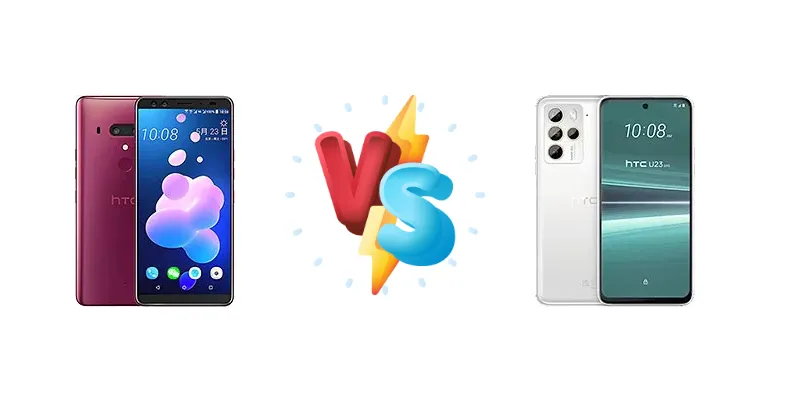
The HTC U12+ represented a high-water mark for HTC's flagship ambitions in 2018, boasting a top-tier Snapdragon processor and innovative features. Now, the U23 Pro arrives with a more modern, albeit mid-range, Snapdragon 7 Gen 1. This comparison dissects the trade-offs between raw power and improved efficiency, helping you determine which HTC device best suits your needs in 2024.
🏆 Quick Verdict
For most users, the HTC U23 Pro emerges as the better choice. While the U12+'s Snapdragon 845 still offers respectable performance, the U23 Pro’s Snapdragon 7 Gen 1, coupled with its significantly improved 83-hour endurance rating, provides a more balanced and future-proof experience. The addition of 30W charging and wireless charging further sweetens the deal.
| Network |
|---|
| 2G bands | GSM 850 / 900 / 1800 / 1900 - SIM 1 & SIM 2 (dual-SIM model only) | GSM 850 / 900 / 1800 / 1900 |
| 3G bands | HSDPA 850 / 900 / 1700(AWS) / 1900 / 2100 | HSDPA 850 / 900 / 1700(AWS) / 1900 / 2100 |
| 4G bands | 1, 2, 3, 4, 5, 7, 8, 12, 13, 17, 20, 28, 32, 38, 39, 49, 41, 66 | 1, 3, 5, 7, 8, 12, 17, 20, 28, 38, 39, 40, 41 |
| 5G bands | - | 1, 3, 7, 20, 28, 41, 78 SA/NSA |
| Speed | HSPA 42.2/5.76 Mbps, LTE-A (5CA) Cat18 1200/150 Mbps | HSPA, LTE, 5G |
| Technology | GSM / HSPA / LTE | GSM / HSPA / LTE / 5G |
| Launch |
|---|
| Announced | 2018, May 23 | 2023, May 18 |
| Status | Available. Released 2018, June 29 | Available. Released 2023, May 18 |
| Body |
|---|
| Build | Glass front (Gorilla Glass 3), glass back, aluminum frame | Glass front (Gorilla Glass Victus), plastic frame, plastic back |
| Dimensions | 156.6 x 73.9 x 8.7 mm (6.17 x 2.91 x 0.34 in) | 166.6 x 77.1 x 8.9 mm (6.56 x 3.04 x 0.35 in) |
| SIM | Single SIM (Nano-SIM) or Hybrid Dual SIM (Nano-SIM, dual stand-by) | Nano-SIM + Nano-SIM |
| Weight | 188 g (6.63 oz) | 205 g (7.23 oz) |
| | IP68 dust/water resistant (up to 1.5m for 30 mins)
Pressure-sensitive buttons | IP67 dust/water resistant (up to 1m for 30 min) |
| Display |
|---|
| Protection | Corning Gorilla Glass 3 | Corning Gorilla Glass Victus |
| Resolution | 1440 x 2880 pixels, 18:9 ratio (~537 ppi density) | 1080 x 2400 pixels, 20:9 ratio (~393 ppi density) |
| Size | 6.0 inches, 92.9 cm2 (~80.3% screen-to-body ratio) | 6.7 inches, 108.4 cm2 (~84.4% screen-to-body ratio) |
| Type | Super LCD6, HDR10 | OLED, 120Hz |
| Platform |
|---|
| CPU | Octa-core (4x2.8 GHz Kryo 385 Gold & 4x1.7 GHz Kryo 385 Silver) | Octa-core (1x2.4 GHz Cortex-A710 & 3x2.36 GHz Cortex-A710 & 4x1.8 GHz Cortex-A510) |
| Chipset | Qualcomm SDM845 Snapdragon 845 (10 nm) | Qualcomm SM7450-AB Snapdragon 7 Gen 1 (4 nm) |
| GPU | Adreno 630 | Adreno 644 |
| OS | Android 8.0 (Oreo), upgradable to Android 9.0 (Pie), Sense UI | Android 13 |
| Memory |
|---|
| Card slot | microSDXC (uses shared SIM slot) | microSDXC |
| Internal | 64GB 6GB RAM, 128GB 6GB RAM | 256GB 8GB RAM, 256GB 12GB RAM |
| Main Camera |
|---|
| Dual | 12 MP, f/1.8, 1/2.55", 1.4µm, dual pixel PDAF, Laser AF, OIS
16 MP (12 MP effective), f/2.6, 1/3.1", 1.0µm, 2x optical zoom, AF | - |
| Features | Dual-LED dual-tone flash, HDR | Dual-LED flash, HDR, panorama |
| Quad | - | 108 MP, f/1.7, (wide), 1/1.67", 0.64μm, PDAF, OIS
8 MP, f/2.4, 120˚ (ultrawide), 1/4.0", 1.12µm
5 MP (macro)
Auxiliary lens |
| Video | 4K@60fps, 1080p@60/240fps, 1080p@30fps (gyro-EIS), HDR, 24-bit/96kHz stereo sound rec. | 4K@30fps, 1080p@30fps, gyro-EIS |
| Selfie camera |
|---|
| Dual | 8 MP, f/2.0, 1/4", 1.12µm
8 MP, f/2.0, 1/4", 1.12µm | - |
| Features | HDR, panorama | HDR |
| Single | - | 32 MP, f/2.5, (wide), 1/3.2", 0.7µm |
| Video | 1080p@30fps | 1080p@30fps |
| Sound |
|---|
| 3.5mm jack | No | Yes |
| 35mm jack | - | Yes |
| Loudspeaker | Yes, with stereo speakers | Yes |
| | 32-bit/384kHz audio
| - |
| Comms |
|---|
| Bluetooth | 5.0, A2DP, aptX HD, LE | 5.2, A2DP, LE |
| NFC | Yes | Yes |
| Positioning | GPS, GLONASS, GALILEO, BDS | GPS, GLONASS, GALILEO, BDS |
| Radio | No | No |
| USB | USB Type-C 3.1 | USB Type-C 3.0 |
| WLAN | Wi-Fi 802.11 a/b/g/n/ac, dual-band, Wi-Fi Direct, DLNA | Wi-Fi 802.11 a/b/g/n/ac/6, dual-band |
| Features |
|---|
| Sensors | Fingerprint (rear-mounted), accelerometer, gyro, proximity, compass | Fingerprint (side-mounted), accelerometer, gyro, proximity, compass |
| Battery |
|---|
| Charging | 18W wired, QC3, 50% in 35 min (advertised) | 30W wired
15W wireless
5W reverse wireless
Reverse wired |
| Talk time | Up to 24 h (3G) | - |
| Type | Li-Ion 3500 mAh, non-removable | Li-Ion 4600 mAh |
| Misc |
|---|
| Colors | Translucent Blue, Ceramic Black, Flame Red | Snow White, Coffee Black |
| Models | U12, 2Q55100 | 2QC9200, 2QC9100, 2QCB100 |
| Price | About 450 EUR | About 220 EUR |
| Tests |
|---|
| Audio quality |
Noise -93.7dB / Crosstalk -52.7dB | - |
| Battery life |
Endurance rating 64h
| - |
| Camera |
Photo / Video | - |
| Display |
Contrast ratio: 1818:1 (nominal), 3.085 (sunlight) | - |
| Loudspeaker |
Voice 77dB / Noise 73dB / Ring 99dB
| - |
| Performance |
AnTuTu: 263696 (v7)
GeekBench: 9001 (v4.4)
GFXBench: 20fps (ES 3.1 onscreen) | - |
HTC U12+
- Potentially lower price due to age
- Proven Snapdragon 845 performance
- High contrast display (1818:1)
- Shorter battery life (64h endurance)
- Slower charging (18W wired only)
- Older chipset architecture
HTC U23 Pro
- Significantly longer battery life (83h endurance)
- Faster 30W wired and 15W wireless charging
- More efficient Snapdragon 7 Gen 1 (4nm)
- Reverse wireless charging
- Less raw processing power than the Snapdragon 845
- Potentially higher price point
Display Comparison
The HTC U12+ boasts a high contrast ratio of 1818:1 (nominal), suggesting deep blacks and vibrant colors. However, the U23 Pro counters with a measured peak brightness of 727 nits, making it significantly more visible outdoors in direct sunlight. While panel technology details are missing for the U12+, the U23 Pro’s higher brightness is a tangible benefit for everyday usability. The U12+'s contrast ratio suggests a strong viewing experience in controlled environments, but the U23 Pro’s brightness provides a clear advantage in real-world scenarios.
Camera Comparison
Both devices feature photo and video capabilities, but specific details are limited. Without sensor size or aperture information, a direct comparison is difficult. However, the U23 Pro benefits from newer image processing algorithms inherent in the Snapdragon 7 Gen 1. The U12+’s camera system, while capable, is likely to show its age in dynamic range and low-light performance compared to the U23 Pro’s more modern processing pipeline. The absence of detailed camera specs necessitates focusing on the chipset’s impact on image quality.
Performance
The HTC U12+’s Snapdragon 845, built on a 10nm process, features an octa-core CPU with Kryo 385 cores clocked up to 2.8 GHz. This was a flagship processor in its time. The U23 Pro utilizes the Snapdragon 7 Gen 1 (4nm), a more efficient chipset. While the 7 Gen 1’s Cortex-A710 cores peak at 2.4 GHz – lower than the 845’s Kryo cores – the 4nm fabrication process offers superior power efficiency. This translates to less heat generation and potentially more sustained performance under load. The U23 Pro’s architecture, while not as rawly powerful, is optimized for modern workloads and longer-term usability.
Battery Life
The U23 Pro’s 83-hour endurance rating is a significant leap over the U12+'s 64-hour rating. This difference is attributable to the Snapdragon 7 Gen 1’s 4nm efficiency and likely a larger battery capacity (though specific mAh is not provided). Furthermore, the U23 Pro supports 30W wired charging, 15W wireless charging, and even 5W reverse wireless charging – features absent on the U12+, which is limited to 18W Quick Charge 3.0. The U23 Pro offers a far more versatile and convenient charging experience, mitigating any potential battery capacity disadvantage.
Buying Guide
Buy the HTC U12+ if you prioritize finding a discounted flagship with proven performance and don't mind potentially shorter battery life. It's a good option for users who already have USB-C chargers and aren't reliant on wireless convenience. Buy the HTC U23 Pro if you value long battery life, faster charging (including wireless), and a more modern chipset with improved efficiency, even if it means sacrificing some peak processing power.
Frequently Asked Questions
❓ Does the Snapdragon 7 Gen 1 in the U23 Pro struggle with demanding games compared to the U12+'s Snapdragon 845?
While the Snapdragon 845 has a theoretical performance advantage in raw GPU power, the Snapdragon 7 Gen 1’s improved thermal efficiency and optimized architecture allow for more sustained performance during gaming. You may see slightly lower peak frame rates in some titles on the U23 Pro, but the experience will likely be smoother overall due to less throttling.
❓ Is the lack of detailed camera specs on both phones a significant drawback for photography enthusiasts?
Yes, it is. However, the U23 Pro benefits from the advancements in computational photography enabled by the Snapdragon 7 Gen 1’s image signal processor. This means better dynamic range, noise reduction, and overall image quality, especially in challenging lighting conditions, even without knowing specific sensor details.
❓ How much does the 30W charging on the U23 Pro actually improve the charging experience compared to the U12+'s 18W charging?
The U23 Pro’s 30W charging significantly reduces charging times. While exact 0-100% times aren't available, expect a noticeably faster top-up compared to the U12+. The addition of wireless charging is a major convenience factor the U12+ lacks.